Hello.
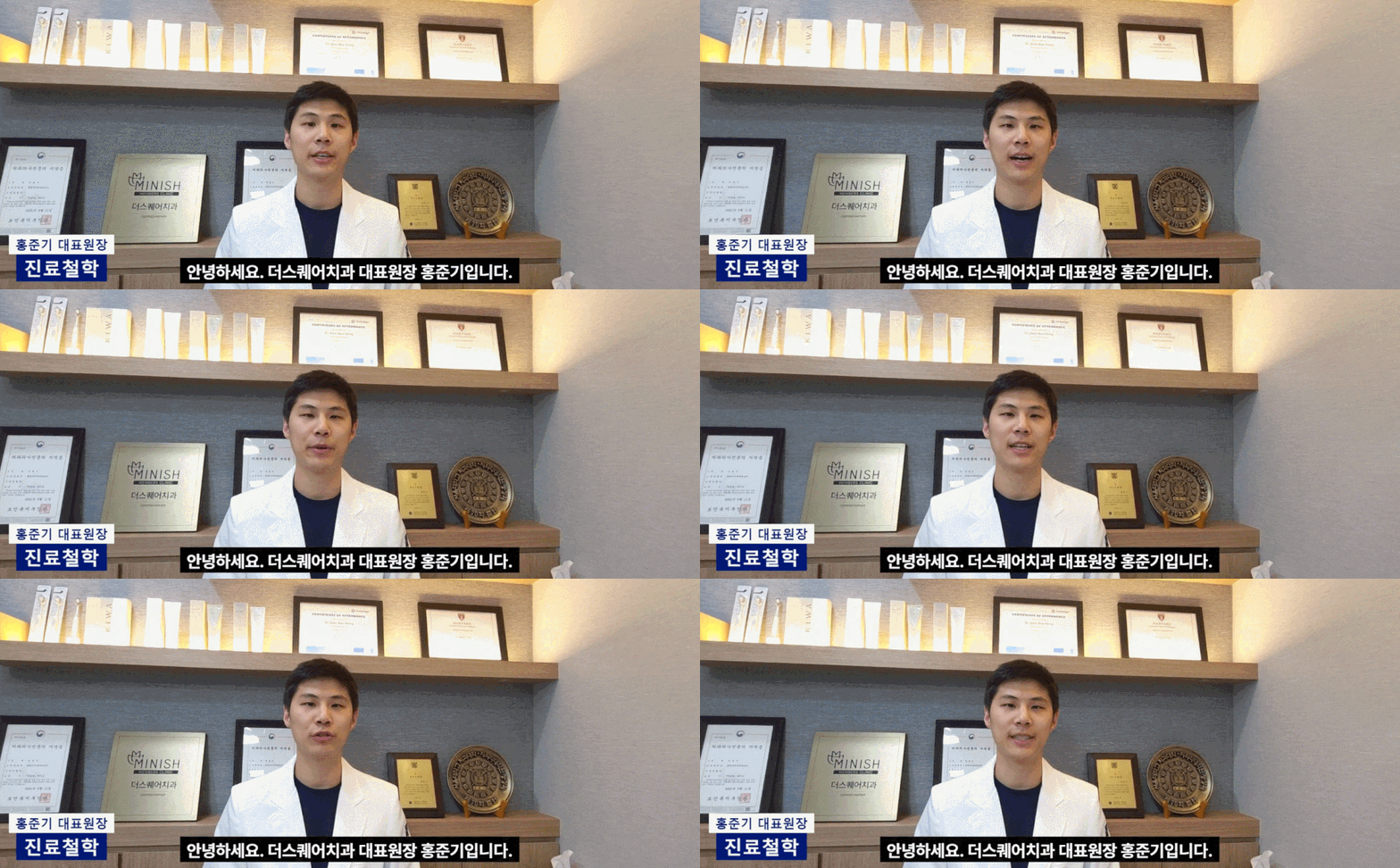
We are The Square Dental Clinic, here to help you catch the signals your teeth are sending.
"My molar is slightly chipped, but it doesn’t hurt.
What happens if I just leave it alone?"
Many people hear the word "slight" and think
it must not be a serious problem.
Because it doesn’t hurt right away.
But in reality, that "slight" point
is often where your options start to narrow.
A slightly chipped molar is one of those signs
that is easy to overlook because it is hard to notice
and usually not very uncomfortable.
That is why we often hear things like this:
"I was fine until yesterday,
but today it suddenly feels uncomfortable."
"It looked like it was only a little chipped, so I left it alone,
but now I keep noticing it every time I eat."
A change that first felt like no big deal can,
over time, show up in a different way.
Today, I’ll explain clearly what can happen
if a slightly chipped molar is left untreated,
and when you should have it checked.
If you read this to the end,
it may help you estimate where your current condition stands.
A slightly chipped molar?
This is where most people miss the judgment call.
Many people say this when a molar chips:
"I think it only chipped a little."
So at first, it often doesn’t feel like a big problem.
But when we look at a molar crack at the dental clinic,
what matters more than the size visible on the surface
is how far it extends inward.
Even if the outside looks small,
there are many cases where the crack has already gone through
the enamel and into the dentin.
To put it simply,
it is similar to a crack in a glass cup.
At first, it looks so thin that you keep using it,
then one day, with a sharp "snap," it suddenly breaks.

A molar is the same.
With repeated force every time you eat,
the crack quietly, but clearly, widens.
The problem is that this process is almost invisible to the eye.
So you end up feeling, "It’s still okay."
But in reality, changes are already progressing inside.
Not hurting does not mean it will last a long time.
A slightly chipped molar
There is a phrase we hear often.
"Doctor, it was really fine until yesterday..."
Every time I hear that, I do feel a little sorry.
Because in many cases,
the pain did not appear suddenly.
First of all, the outermost layer of the tooth, the enamel,
does not have nerves.
So when the crack stays within this layer,
there are many cases where you hardly feel any pain.
But as time passes and the crack extends
into the dentin,
the situation changes a bit.
From that point on, drinking cold water may cause a twinge,
or you may start to feel a slight discomfort only when eating.
That is why many people at this stage say,
"It only feels a little uncomfortable when I drink cold water."
The problem is right here.
Even at this stage, many people simply endure it,
thinking it is only a minor discomfort.
Then, when the crack reaches the pulp,
that is, closer to the nerve,
the pattern of pain changes completely.
One day, even when you are doing nothing,
it starts to feel throbbing or unbearably painful.
That is when people end up saying,
"It was fine until yesterday,
but today it suddenly hurts."
In other words, the pain may feel like it appeared overnight,
but in fact, it is closer to changes that were slowly progressing and then became noticeable at some point.
These changes are often first noticed in small moments of daily life.
| Does it only sting or feel uncomfortable when eating?Is it especially noticeable in a certain direction?Do you keep being aware of the cracked area? |
If even one of these applies,
now is the time to have it checked once.
The changes that come from leaving it alone
are bigger than you might think.
A slightly chipped molar requires a different approach
depending on how far it has progressed.
So it helps to look at it by stage.
First, in the early stage,
the crack is relatively shallow
and still far from the nerve.
In that case, it may be worth considering a direction
that focuses on preserving the existing structure.
There are many cases where it can be stabilized
without a heavy burden.
On the other hand, if time passes and the crack extends
into the dentin,
the story changes.
At that point, the range that needs reinforcement
to withstand chewing force may become broader.
It is also the point where your options
start to narrow a bit compared to the beginning.
And if it is left even longer,
the crack continues to be repeatedly stressed,
and a reaction close to the nerve may appear.
Once it reaches this stage,
the approach itself has no choice but to change.
There is one thing I want to point out clearly here.
The difference between checking now
and deciding later
is not the size of the pain,
but the amount of structure that can still be preserved.
If the condition is examined early,
there are many cases where a relatively generous amount
of structure can be left intact.
But the later the timing,
the more naturally the options decrease.
That is why we always think this way:
Preserve what can be preserved,
and perform only the intervention that is truly necessary.
We believe this standard leads to a direction
that helps you use your molars for a long time.

A slightly chipped molar is not a small issue,
but a signal that tells you how far things have progressed.
Even if it does not look like a big deal on the surface,
things may already be moving in a different direction inside.
At The Square Dental Clinic,
we look at it with the standard of preserving
as much of the tooth’s natural structure as possible
so it can be used comfortably for as long as possible.
If it feels hard to judge on your own,
it is perfectly fine to have it checked lightly.
Only as much as necessary, and accurately.
That is the standard The Square Dental Clinic follows in treatment.
Thank you for reading to the end today.
This has been The Square Dental Clinic.
[Stories from people who had the same concern]
[It’s okay if you’re not ready to book right away]
[Directions to the clinic, organized so you won’t get lost]
| This article was written in compliance with the Medical Service Act (Article 56, Paragraph 1) so that you can obtain accurate information.Rather than simple promotion, we wanted to transparently share what actually happens in the treatment room.Please do not contact us right away after reading this article; simply taking away accurate information is enough. |