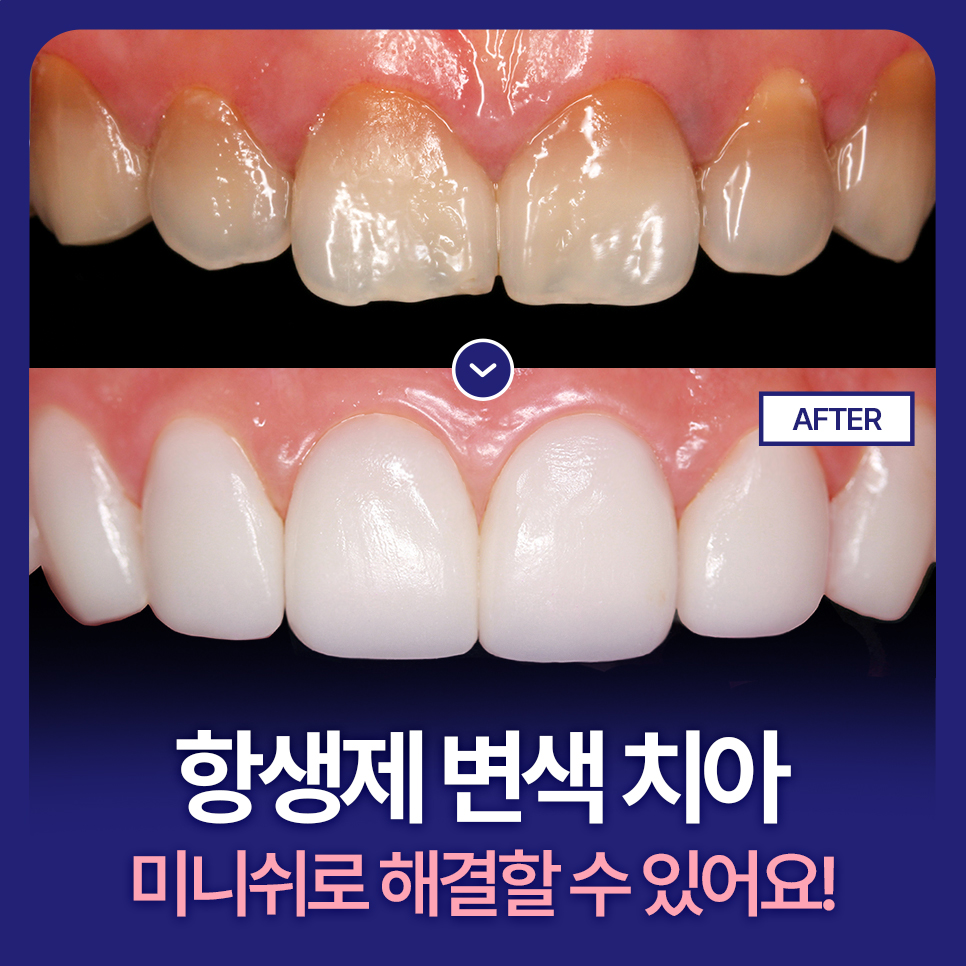
Tetracycline antibiotics, which were used in childhood to treat various conditions such as colds and acne, can cause discoloration inside the teeth if taken during the period when teeth are developing. This discoloration settles deep within the teeth and remains permanently, making it difficult to improve with ordinary whitening treatment. Discolored teeth are also unpleasant to look at, can cause aesthetic stress, and may lower confidence.
Why Does Antibiotic Tooth Discoloration Occur?
Tetracycline antibiotics deposit drug components in the enamel and dentin as teeth are developing, forming pigmentation. In particular, if taken between 4 months after birth and age 7, the drug is more likely to deposit in the teeth, causing them to lose their natural, bright color and turn dark shades such as yellow, brown, or gray. The earlier the medication is taken and the greater the dose, the more severe the discoloration can become.
What Are the Symptoms of Antibiotic-Discolored Teeth?
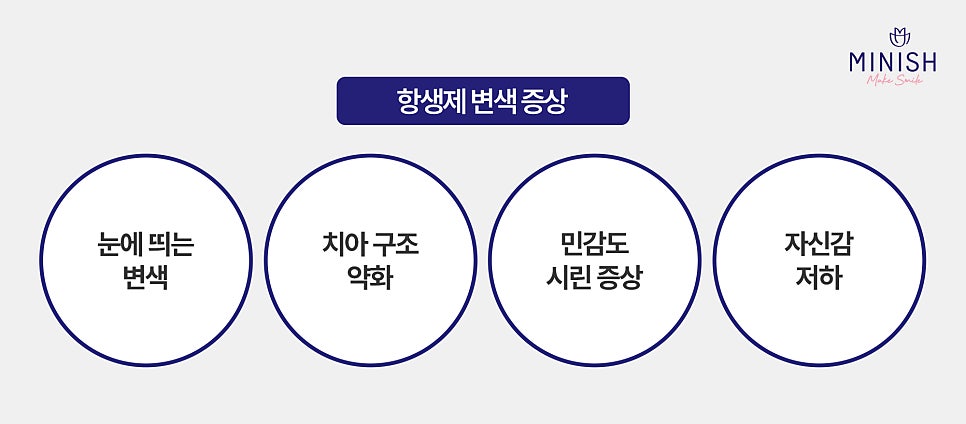
Antibiotic discoloration is accompanied by the following symptoms and can cause not only aesthetic concerns but also functional problems.
-
Noticeable discoloration
-
The tooth surface turns yellow, brown, gray, or other shades.
-
The discoloration forms deep inside the tooth and is difficult to improve with ordinary whitening treatment.
-
The discoloration may appear evenly across the entire tooth, or it may be separated into horizontal bands.
- Weakened tooth structure
-
Discolored teeth are often structurally weaker and more likely to develop cavities.
-
Tooth wear can occur more easily, leading to additional damage.
- Sensitivity and sharp pain
-
Discolored teeth may react sensitively to external stimuli.
-
A sharp, sensitive feeling may occur more often when eating cold foods or drinking hot beverages.
- Reduced confidence due to aesthetic concerns
-
As the bright, clean appearance of the teeth is lost, people may feel psychologically withdrawn when smiling or speaking.
-
Because discolored teeth stand out visually, many people feel burdened in social interactions.
Why Should Antibiotic-Discolored Teeth Not Be Left Untreated?
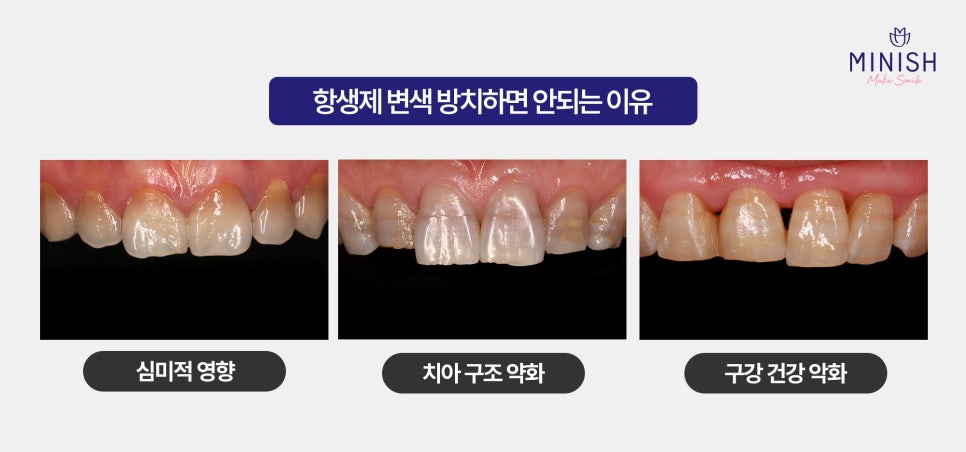
Tooth discoloration caused by antibiotics is not just an appearance issue; it can negatively affect overall dental health. If discolored teeth are left untreated, aesthetic, structural, and functional problems may occur, and oral health may worsen significantly over time.
- Aesthetic impact
Discolored teeth can reduce confidence in social situations. Bright, clean teeth have a major effect on smiles and first impressions, and discolored teeth interfere with that, creating psychological stress. Repeatedly covering the teeth when smiling or speaking can lead to lower confidence and social withdrawal. If discoloration begins in childhood, the burden can continue into adulthood.
- Weakened tooth structure
Antibiotic discoloration is not simply a pigmentation issue. It may also affect the internal structure of the tooth. Discolored teeth can have weaker surfaces, making them more sensitive to external stimuli and increasing the likelihood of cavities. In addition, tooth wear may accelerate, causing problems with chewing function and increasing the risk that the overall durability of the teeth will weaken. Weakened teeth are more prone to cracks or fractures, and more complex treatment may be needed over time.
- Worsening oral health
Leaving tooth discoloration untreated can negatively affect not only tooth function but also overall oral health. Discolored teeth are more likely to lead to gum disease, cavities, and inflammation around the tooth root. As discoloration and damage worsen, more time is needed to restore the teeth, and the longer treatment is delayed, the more difficult restoration becomes and the higher the cost. In the worst case, tooth extraction may become necessary.
Tooth discoloration caused by antibiotics is not just an unattractive issue; it is an important problem that can seriously affect dental health and function. Rather than leaving discolored teeth untreated, it is important to restore both aesthetics and health through appropriate treatment as early as possible.
Why MINISH, a tooth restoration solution, is effective for antibiotic-discolored teeth
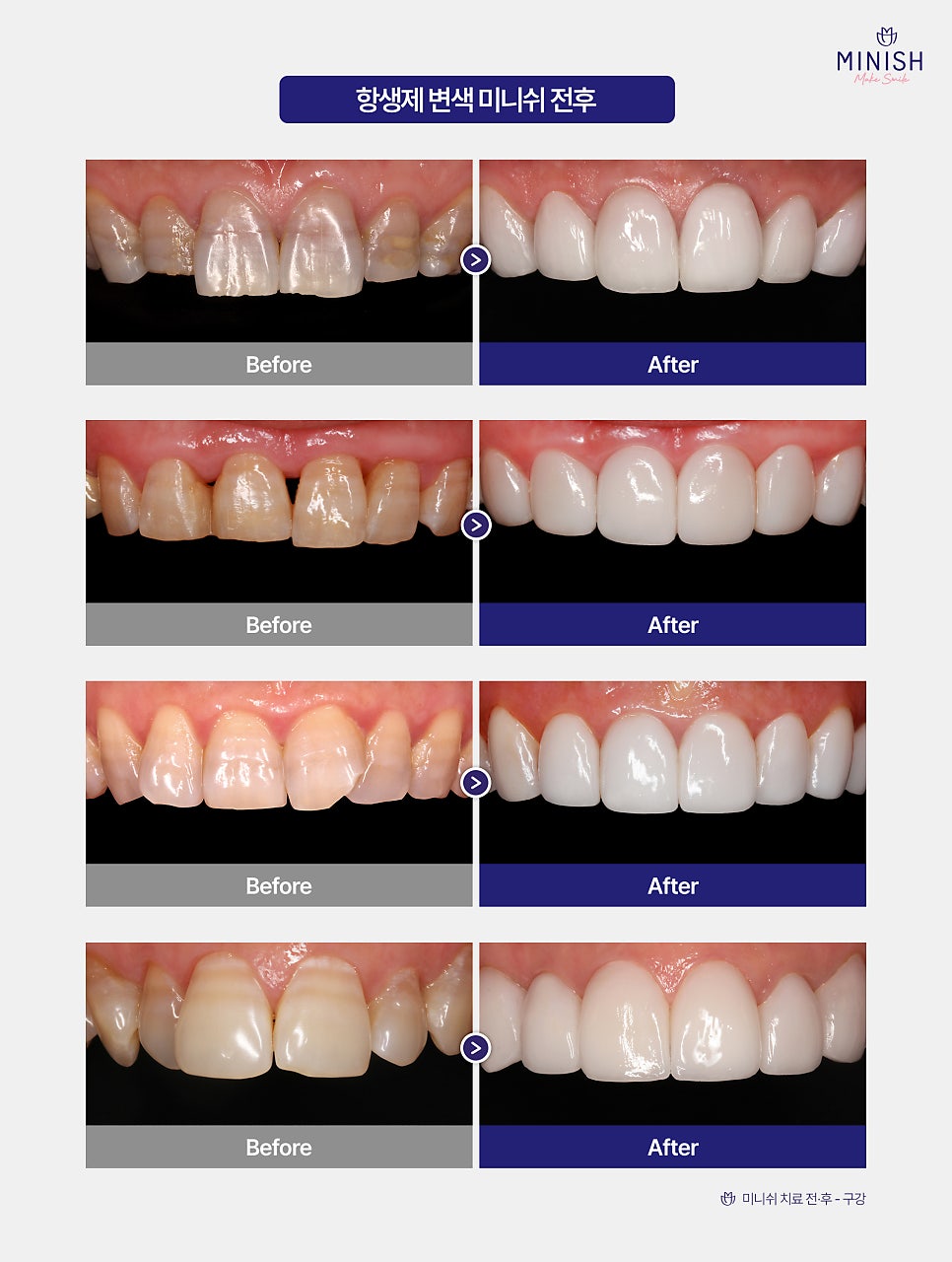
MINISH is a tooth restoration solution suitable for treating antibiotic-discolored teeth. It restores damaged teeth to look like natural teeth, addressing both functional and aesthetic concerns at the same time.
- Application of biomimetic technology
The MINISH tooth restoration solution uses MINISH blocks with material properties similar to natural teeth. This material is hard yet flexible, providing strength and durability very close to those of natural teeth. Thanks to biomimetic technology that reproduces the original properties of teeth, patients can experience a natural feel even after treatment.
- Customized restoration design
Antibiotic-discolored teeth vary from person to person in color, degree of discoloration, size, and shape. The MINISH tooth restoration solution is custom-designed according to each individual's dental condition to reproduce natural color and translucency. As a result, the teeth can regain their original healthy and balanced appearance.
- Strong bonding technology
The MINISH tooth restoration solution bonds the tooth and restoration together as one unit. Strong bonding technology ensures a perfect fit between the tooth and the restoration, and after bonding, the likelihood of detachment is low, allowing it to remain stable for a long time. This technology is also effective in preventing further damage to discolored teeth.
- Aesthetic restoration
The MINISH tooth restoration solution does more than simply cover discoloration; it restores a natural and balanced tooth shape. After treatment, the teeth have a vitality similar to their original color and deliver aesthetically excellent results. This helps increase patient satisfaction and restore confidence.
The MINISH tooth restoration solution is the optimal choice for regaining healthy teeth, offering aesthetics and function closest to natural teeth while restoring antibiotic-discolored teeth.
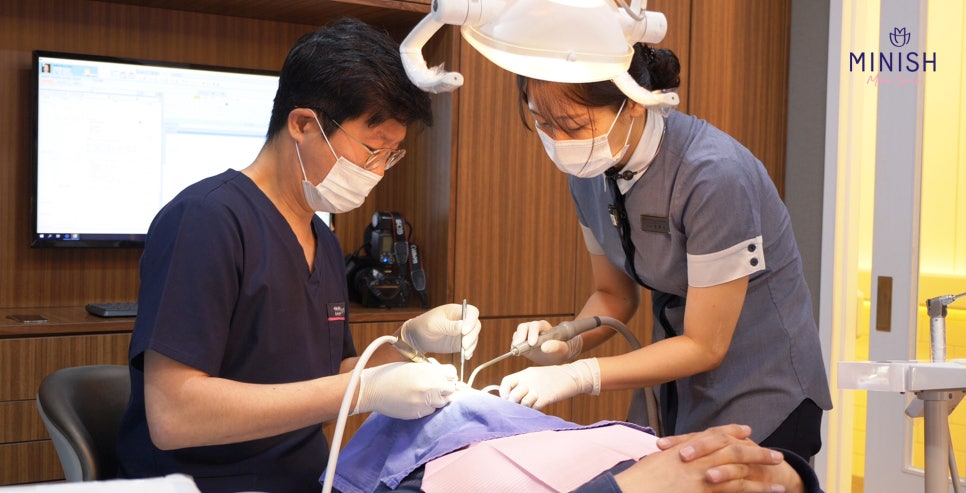
Tooth discoloration caused by antibiotics cannot be solved by simple whitening and requires more precise, specialized treatment. The MINISH tooth restoration solution restores damaged teeth while providing natural aesthetics and function at the same time. If you are concerned about tooth discoloration, regain healthy teeth and a bright smile through the MINISH tooth restoration solution.
Instagram of Minish Dental Hospital | MINISH: "A patient who had been struggling with discolored teeth after cancer treatment regained a bright smile through MINISH! ‘I can smile confidently even when meeting new people!’ As the patient’s heartfelt review shows, #MINISH is not just a treatment, but a gift of life change. We will continue to do our best as #MinishDentalHospital so that everyone struggling with teeth that have lost their health can regain a bright smile! [EN] Our patient who had struggled with discolored teeth after cancer treatment has regained a bright smile thanks to MINISH! "Now I can smile confidently, even when meeting new people!" #MINISH is more than a simple treatment—it’s a gift of life transformation. Just like in our patient’s case. At #MinishDentalHospital, we are committed to helping everyone who faces challenges with teeth losing their health to rediscover a bright smile. #CancerTreatment #CancerTreatmentSideEffects #ToothDiscoloration #CancerTherapy #FightingCancer #MinishDentalHospital #MinishDental #MinishBeforeAfter #KoreanDentist #SeoulDentist #GangnamDentist #항암치료 #항암치료부작용 #치아변색 #암치료부작용 #암치료 #암투병 #미니쉬치과병원 #미니쉬치과 #미니쉬전후 #한국치과 #서울치과 #강남치과"
minish_official - October 31, 2024: "A patient who had been struggling with discolored teeth after cancer treatment regained a bright smile through MINISH! ‘I can smile confidently even when meeting new people!’ As the patient’s heartfelt review shows, #MINISH is not just a treatment, but a gift of life change. We will continue to do our best as #MinishDentalHospital so that everyone struggling with teeth that have lost their health can regain a bright smile! [EN] Our patient who had struggled with discolored tee...
www.instagram.com