Hello! We are Minish Dental Hospital, dedicated to both oral health and beauty.
Today, we’ll explain in an easy and detailed way the differences between Minish and veneers, two tooth-restoration solutions that many people are curious about!
How much do you know about veneers?
Veneers are a cosmetic procedure intended to improve the appearance of teeth. They were originally developed for Hollywood actors and are now widely performed.
Veneers are done by removing part of the tooth surface and bonding a thin ceramic shell to that area. According to Seoul National University Medical Information, veneers are a method of attaching porcelain restorations with a hybrid composite resin adhesive after minimally removing the enamel of the front teeth for aesthetic purposes.

After a celebrity’s story was revealed about having teeth shaved down and crowns placed to make the front teeth look better, many viewers felt sorry.
Veneers, when performed properly, are a more conservative method than crowns, which require the entire tooth to be shaved down. However, in Korea there is still a strong negative perception of them. In particular, cases of celebrities experiencing side effects after treatment are enough to bring tears.
A representative problem with veneers is sensitivity and pain caused by excessive removal of tooth enamel.
No-prep veneers? No-prep + veneers?
Recently, the internet has been flooded with contradictory advertising keywords like “no-prep veneers.” Veneers are a treatment in which part of the tooth surface is removed and a thin ceramic shell is bonded on top. So what exactly does the modifier “no-prep” mean here?
“No-prep veneers” is nothing more than a marketing term that exploits patients’ fear of tooth reduction. Although it gives the impression that veneers can be done without shaving the teeth, this distorts the basic principle of veneers.
This term does not appear in dental textbooks, and the Korean Dental Association does not issue official advertising approval for it, making it an unofficial expression.
Applicable in only very limited cases
Even so, cases in which “no-prep veneers” are possible are very limited. They can only be applied in cases such as small teeth, spaced teeth, or teeth that are tilted inward. Since veneers work by adding restorations, they are suitable for teeth that are small or have space.
The problem is that it is advertised as if it can be done for all teeth.
What happens if restorations are bonded without reduction to teeth of normal size, long or wide teeth, protruding teeth, or crooked teeth?
In the end, the teeth become thick and unnaturally large, and the goal of making the teeth look beautiful—the original purpose of veneers—becomes limited.
No-prep veneers vs. Minish: What’s the difference?
Then what is Minish? In any case, let’s compare it with the no-prep veneers that are drawing attention. Looking at the purpose, materials, theoretical background, and history, the differences between the two concepts become clear.
Purpose
Cosmetic vs. Tooth Restoration
No-prep veneers are for cosmetic purposes. They are performed to create prettier teeth.
Minish, on the other hand, was developed in response to concerns about tooth reduction in veneers. Rather than simple aesthetics, it is a tooth-restoration solution whose core purpose is to restore decayed, broken, and worn teeth to their original composition and shape. It does not aim to make teeth merely pretty at the expense of healthy teeth.
The beautiful smile and balanced facial appearance created by Minish are effects that naturally follow from restoring healthy teeth.
Target
Front Teeth vs. All Teeth
No-prep veneers can only be applied to front teeth, and they are not possible in the following cases.
-
When you want to reduce the size of normally sized teeth
-
When you want to reduce the size of long or wide teeth
-
When you want to move protruding teeth inward
-
When you want to align crooked teeth
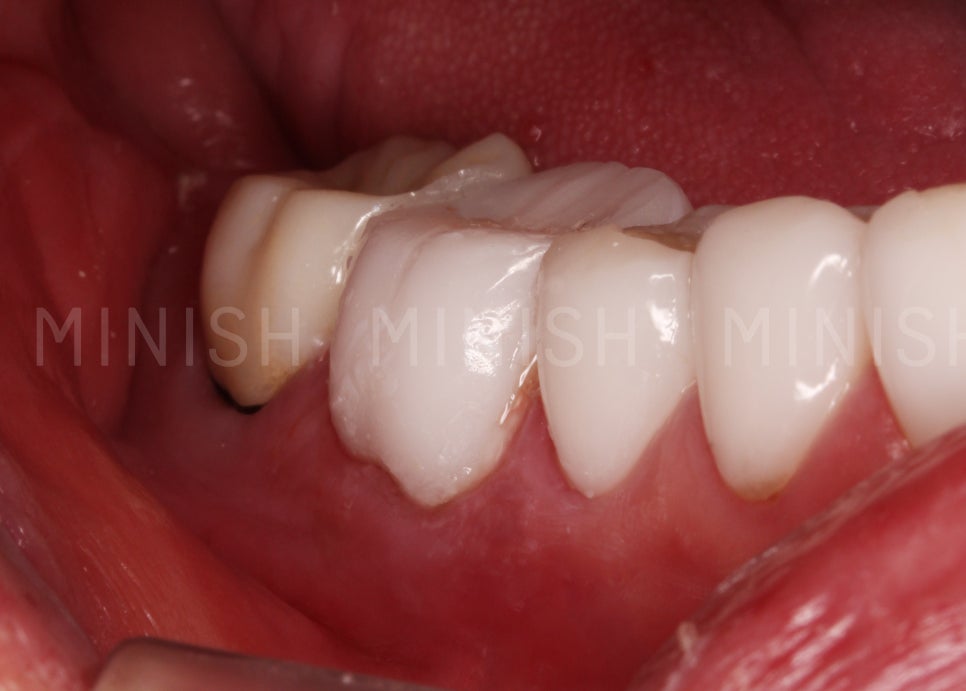
Minish can also be applied to molars. In general, crowns are often used for molars, but the drawback is that this requires a large amount of tooth reduction. In contrast, molar Minish involves minimally removing only the damaged area and then bonding the Minish material. This allows restoration that considers both function and aesthetics while reducing unnecessary tooth reduction.
By contrast, Minish can be applied not only to front teeth but to all teeth, including molars. Of course, cases requiring jaw surgery are exceptions, but with expertise accumulated through more than 160,000 clinical cases, a wide range of dental problems can be addressed.
Limitations
Detachment vs. None
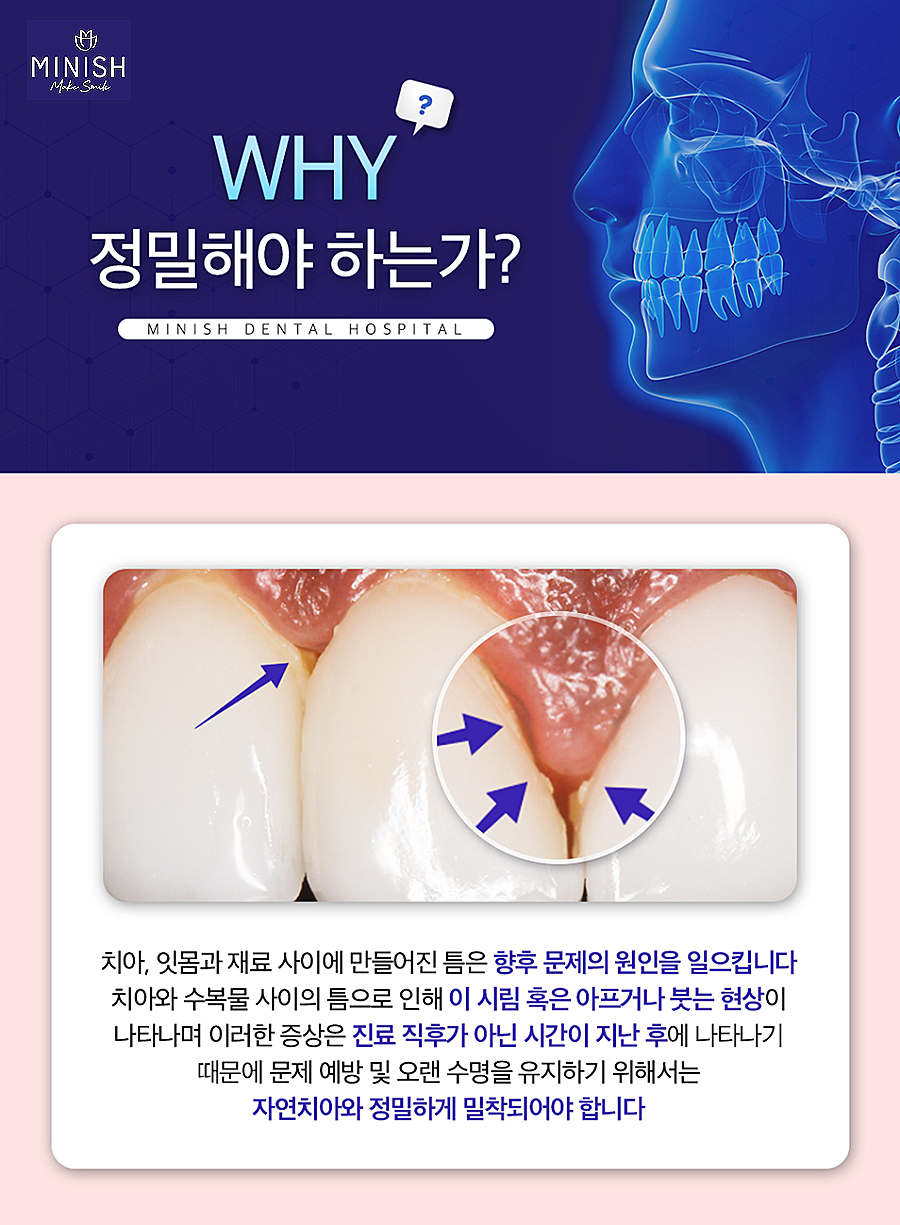
Because no-prep veneers are bonded directly without smoothing the stained or uneven tooth surface, the risk of poor adhesion and detachment is high. Also, when restorations are attached to unprepared teeth, they are more likely to chip even from minor impacts.
Minish, on the other hand, does not have these limitations. However, in retreatment cases for front tooth crowns done elsewhere, tooth discoloration may not be completely hidden. But this is only an exceptional case limited to retreatment.
History
Recent vs. Since 2009
No-prep veneers are not a new treatment, but recently they have been distorted into an advertising keyword aimed at people sensitive to the amount of tooth reduction in veneers. They began appearing in advertising at some point and now dominate the advertising market.
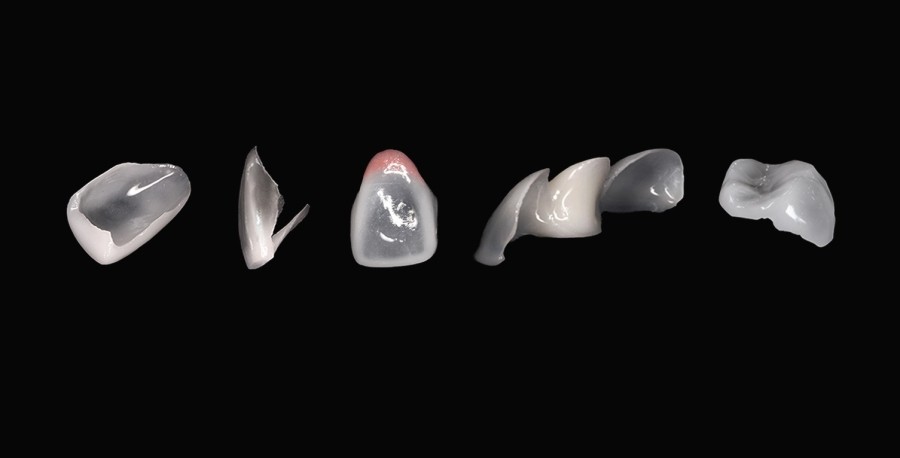
Minish, on the other hand, began research in 2009 to solve the problem of excessive tooth reduction in veneers.
-
Dual Minish: a method that wraps around the front and back of the tooth
-
Pink Finish: a method that provides a gum-regeneration effect when the gums have receded and the tooth roots are exposed
-
Minish Bridge: an alternative to crown bridges that require shaving down the teeth on both sides of an extracted tooth
And in 2017, Minish continued to evolve by developing the Minish One-Day treatment system and molar Minish.
Medical Staff
Anyone vs. Experienced
No-prep veneers do not require special technical skill. Because they simply involve bonding restorations to the teeth, they are a relatively simple procedure.
Minish, by contrast, requires delicate techniques unlike conventional procedures. For this, one must complete specialized training at Minish Academy and go through a systematic hands-on practice course. At the academy, hands-on training and education are provided so that participants can master the overall treatment process, including tooth alignment, Minish bonding, and Minish fitting.
Currently, the number of dentists who have learned and been certified in Minish has exceeded 210 nationwide.
In particular, in December 2024, the first “Global Minish Academy” for dentists from Japan and the United States was successfully completed, and in February 2025, the first Minish seminar in Japan was held. Through this, interest in Minish is growing even more overseas.
Materials
E.max, Zirconia vs. Minish Block
The materials used for no-prep veneers are zirconia, which is 3 to 4 times stronger than natural teeth, or opaque e.max.
-
Zirconia: It is strong on its own, but it can place stress on the treated tooth’s ligament or root and may cause damage by continuously impacting the opposing tooth.
-
e.max: Because of its unnatural opaque color, it is difficult to harmonize with the face.
As a result, due to the nature of the materials, no-prep veneers have difficulty achieving balance with natural teeth and may place a burden on dental health in the long term.
Source: VITA website
Minish uses Minish Block, a material that is most similar to natural teeth in physical properties.
-
Biocompatibility
-
Fracture strength, compressive strength, tensile strength
-
Abrasion resistance, elasticity, transparency
-
Coefficient of thermal expansion
It was also developed in partnership with VITA, a global dental materials company that exports dental materials to 150 countries around the world, and is produced and supplied exclusively for Minish.
Warranty period
Various vs. Up to 10 years
The warranty period for no-prep veneers is around 1 to 2 years, and many places do not offer any warranty at all.
However, it is questionable that some places advertise a 10-year warranty even though only a few years have passed since the procedure. It would be reasonable to set a warranty period only after sufficiently verifying 10 years of stability after treatment, so it is disappointing to see the indiscriminate offering of long-term warranties, almost like a warranty card for a mass-produced product.
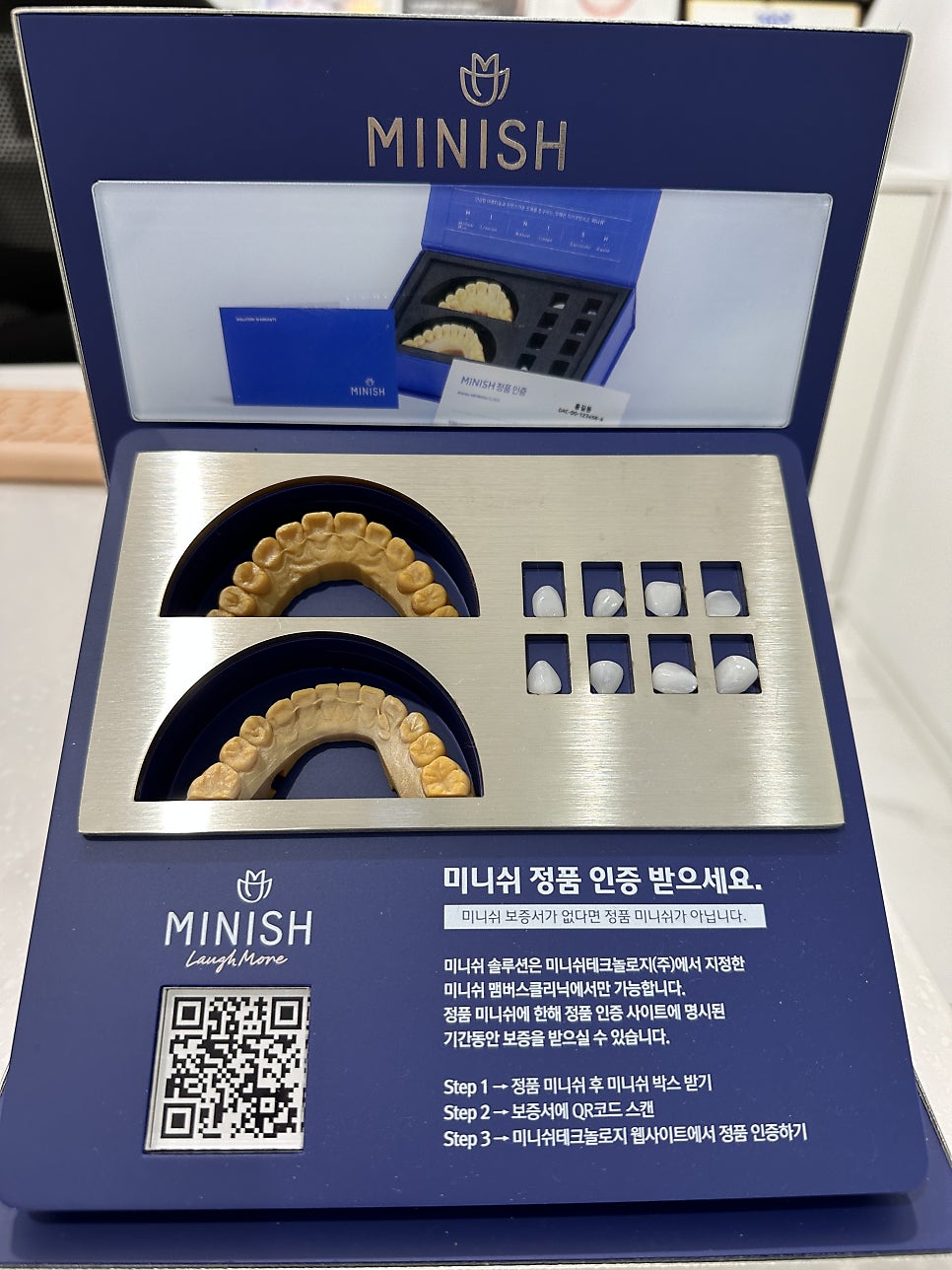
Minish warranty certificate and box
The tooth-restoration solution Minish issues a warranty certificate of up to 10 years based on long-term follow-up data. This is not simple marketing, but a warranty period established on the basis of actual clinical results. If it is determined that no problems occur even after 15 years, the warranty period will naturally be extended. In addition, Minish provides an oral model that reproduces the condition of the teeth before and after treatment in a “Minish Box.” This allows patients to see their own amount of tooth reduction and changes directly.
Comparison of media coverage
Most reports related to no-prep veneers are nothing more than promotional columns from specific dental clinics. There are very few objective evaluations of the superiority or growth potential of no-prep veneers.
Minish, on the other hand, is drawing attention because the skill and results of its medical staff have been recognized. Kang Jeong-ho, the head doctor who developed Minish, was introduced as an outstanding physician in a ChosunBiz article, and he is being evaluated based on objective medical expertise.
[Finding an Outstanding Doctor] “Even smartphones have protective films, so why shave down teeth?”
Kang Jeong-ho, head of Minish Dental Hospital, developed a way to preserve teeth using thin ceramics. Graduated from Chosun University School of Dentistry, opened a practice in Gangnam after working in Seongnam. “Sensitivity in teeth is due to the enamel being shaved away.” “Even though screen protectors are thin, they don’t break when attached.” “As science advances and the times change”
n.news.naver.com
<Reference to the ChosunBiz article on finding an outstanding doctor>
Minish, clinically verified through more than 160,000 cases
As mentioned at the beginning, no-prep veneers and Minish are that different.
The problem with dental treatment does not appear right after treatment, but gradually over time, in hidden places, after one or two years.
Minish has accumulated more than 160,000 clinical data cases since 2009, and has been chosen by more than 500 celebrities, businesspeople, and public figures. In particular, it is trusted to the point that most idol trainees and idols these days are receiving Minish.
Clinically and in the media, Minish has been verified. Going forward, we will continue to do our best so that everyone can “use their own teeth for life.”
Thank you.