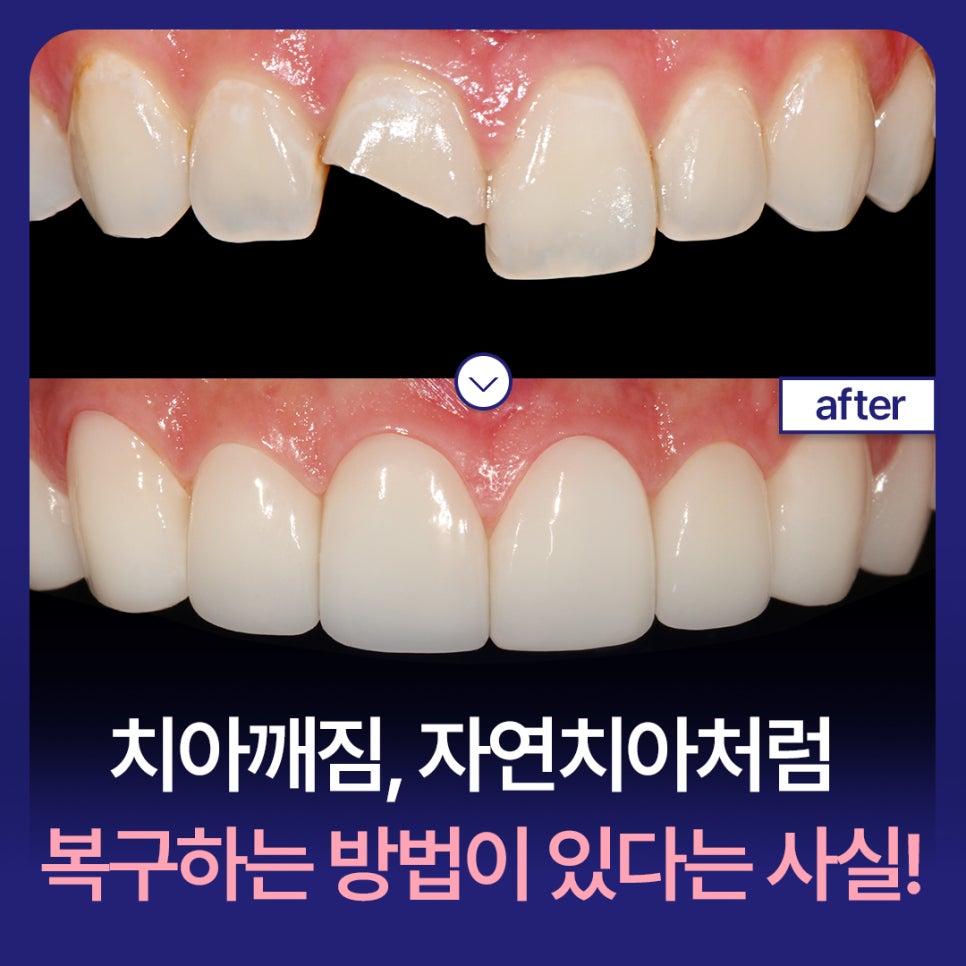
Have you ever suddenly felt the edge of a front tooth chip a little, or noticed something odd in a molar while chewing food?
Teeth may look very hard on the outside, but cracks or chips often happen at unexpected moments. Teeth can be damaged while chewing hard foods, clenching your teeth as a habit, or even from a simple external impact.
When a tooth is chipped, the required treatment differs depending on the extent of the damage, so an accurate diagnosis by a specialist is essential. Even if you do not feel pain right away, leaving it untreated can lead to periodontal disease, a larger fracture, chronic pain, and in severe cases even extraction, so early diagnosis is very important. In this post, we will explain step by step the problems that can occur if a chipped tooth is left untreated, treatment methods according to the extent of damage, and even a way to restore it like a natural tooth.
Why should a chipped tooth not be left untreated?
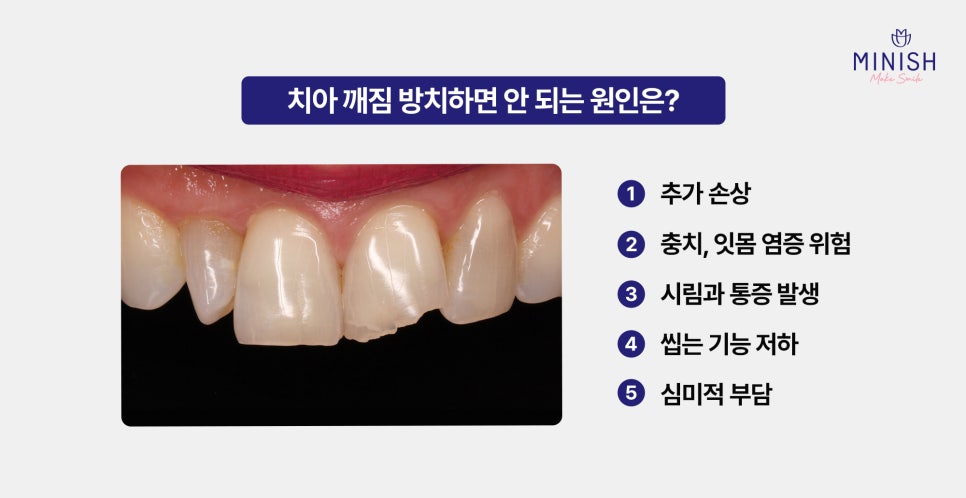
If a chipped tooth is left untreated, it can lead to several problems surprisingly quickly. Typical examples are as follows.
A small crack can gradually grow and lead to a larger chip. In severe cases, the tooth nerve may also be damaged, making root canal treatment necessary.
- Risk of cavities and gum inflammation
Food particles and bacteria can enter through the chipped gap, increasing the likelihood of cavities or gum inflammation.
If the dentin or pulp (nerve) is exposed, you may feel sensitivity to cold water or hot food, or experience pain.
If you avoid chewing with the damaged tooth, the opposite side teeth or the jaw joint may be strained.
Especially when a front tooth is chipped, it is noticeable and can lead to psychological withdrawal when smiling or speaking.
Chipped tooth: What are the treatment methods according to the extent of damage?
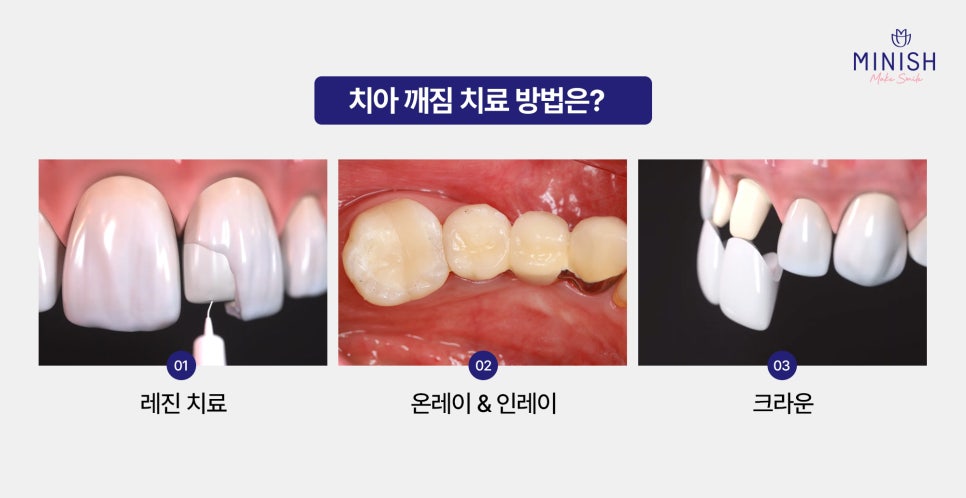
When a tooth is chipped, the condition can vary from a slight crack to a severe case where the nerve is damaged, so the treatment method also differs accordingly.
- Resin (when the edge of a front tooth is slightly chipped)
Applicable area: mainly the edges of front teeth, shallow chips
Advantages
Disadvantages:
-
Low durability; over time, the adhesion at the bonded area may weaken, leading to discoloration, detachment, or wear, so retreatment is often needed
-
Shrinkage of the material can create gaps at the boundary between the tooth and the resin
-
Not suitable for molars with strong chewing force or for severely chipped cases
- Inlay / Onlay (moderate chip, mainly for molars)
Applicable area: mainly molars, chips over a certain range
Advantages:
-
Suitable for restoring function
-
Various material options such as ceramic or gold
-
Less tooth removal than a crown
Disadvantages:
-
If the damaged area is irregular in shape or too wide, it may be difficult to apply, and the material may not be properly fixed
-
If tiny gaps form at the margin (between the inlay and the tooth), there is a risk of secondary cavities or detachment over time
-
Mainly used for molars and not suitable for front teeth or areas where aesthetics are important
-
More expensive than resin and requires manufacturing time
- Crown (when a large portion of the tooth is chipped)
Applicable area: teeth that have had root canal treatment, molars with a large fracture extending to the wall, etc.
Advantages:
Disadvantages:
-
A large amount of natural tooth structure must be removed
-
Problems such as gum irritation or poor fit may occur at the margin
-
If the bonding is not perfect or the adhesive weakens over time, there is a risk of lifting, detachment, or secondary cavities
-
Retreatment requires more tooth removal, and repeated procedures shorten the tooth’s lifespan
A way to restore it like a natural tooth, Minish Ever
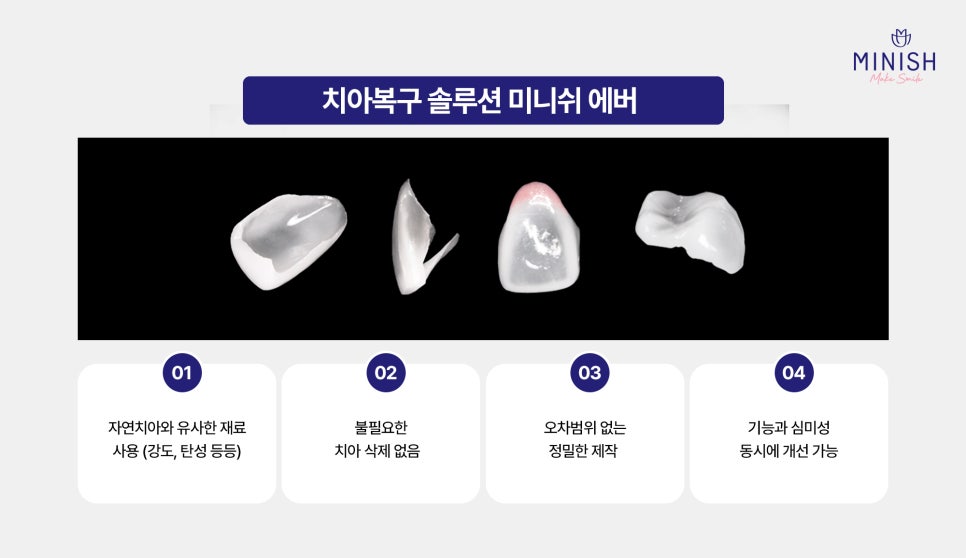
When a tooth is chipped, there are various treatment methods such as resin, inlay, and crown, but simply filling the damaged area makes it difficult to maintain function and durability for a long time.
Minish Ever is a tooth restoration solution that began with the philosophy of “using my own teeth healthily for life,”
and it presents a differentiated approach to restoring both structure and function like a natural tooth. Its major advantage is that it can restore function while also bringing back a natural shape and color by precisely rebuilding only the damaged area without unnecessary removal.
✅ Why Minish Ever is special
- Strength and elasticity similar to natural teeth
Minish uses materials almost identical to real teeth to restore the structure in the same way. As a result, chewing force and stimulation are evenly distributed, so it does not burden surrounding teeth and can maintain stable function for a long time. When teeth use materials that are too hard (such as crowns), they may wear down or break the opposing teeth, so properties similar to natural teeth are especially important.
- Restoration without unnecessary tooth removal
Only the damaged area is precisely restored, preserving as much of the existing healthy tooth as possible.
- Precision manufacturing with no margin of error
Digital scanning and milling enable precise restoration with no error, and by applying margin sealing technology and precise bonding techniques, it adheres closely so that no gap forms between the natural tooth and Minish. This minimizes bacterial infiltration and can effectively reduce the possibility of secondary cavities.
- Aesthetic improvement based on functional restoration
As the tooth is restored healthily, natural-looking appearance improvements are achieved together with functional recovery.
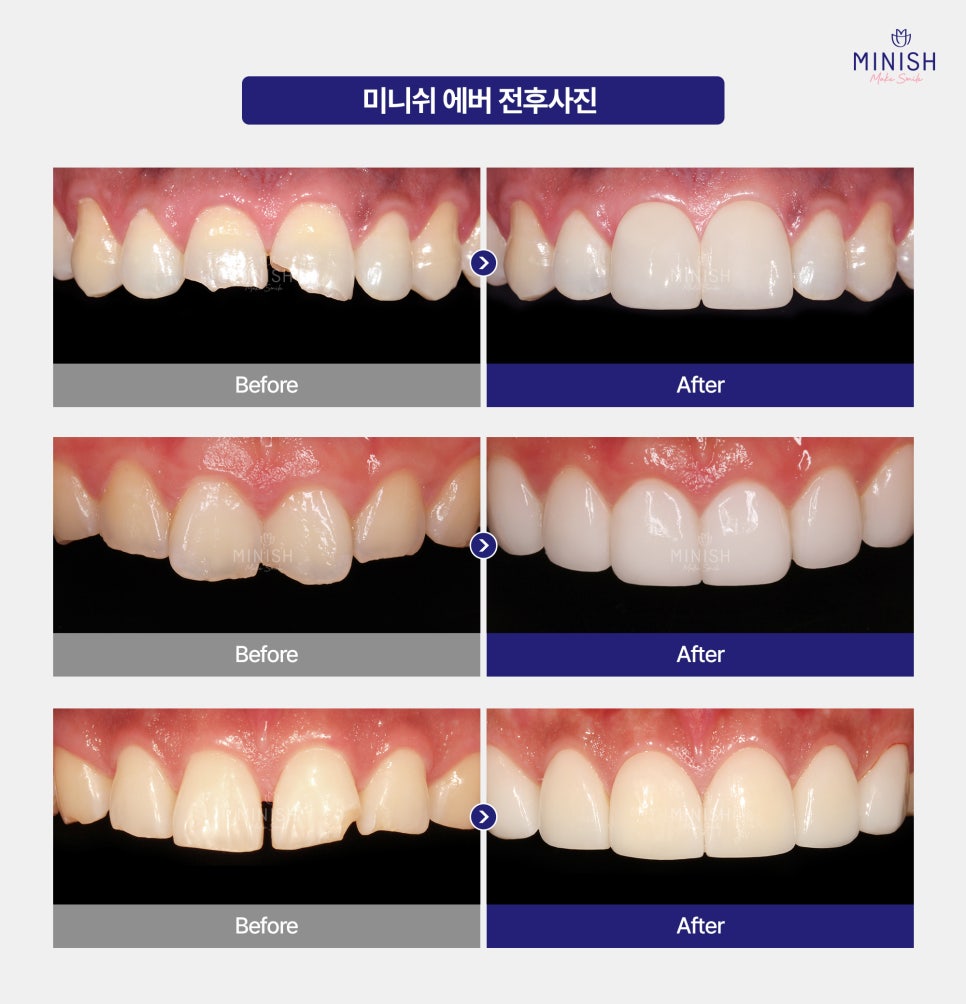
Minish Ever, restored like a natural tooth — see the results with your own eyes
As mentioned above, a chipped tooth is not just a cosmetic issue; if it is not treated in time, it can lead to greater damage. If you want to restore your teeth healthily without removing tooth structure, please contact Minish Dental Hospital now!