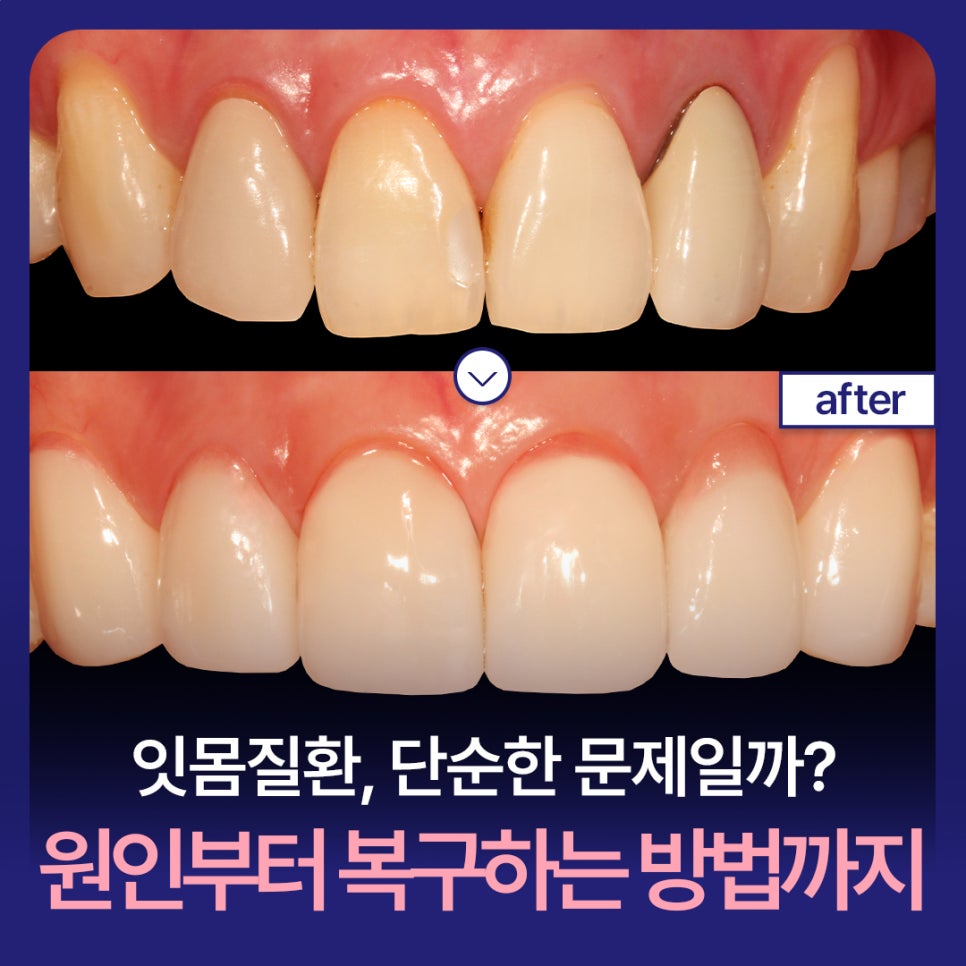
When you look in the mirror, have you ever felt that your teeth look longer than before, or that your gum line seems uneven? You may also have noticed bleeding when brushing or sensitivity in your teeth when drinking cold water.
These changes may not simply be due to aging, but could be a sign that gum disease is sending a warning. In the early stages, it may seem mild, but over time it can lead not only to functional problems but also to a loss of harmony between the teeth and gums.
Why does gum disease occur?
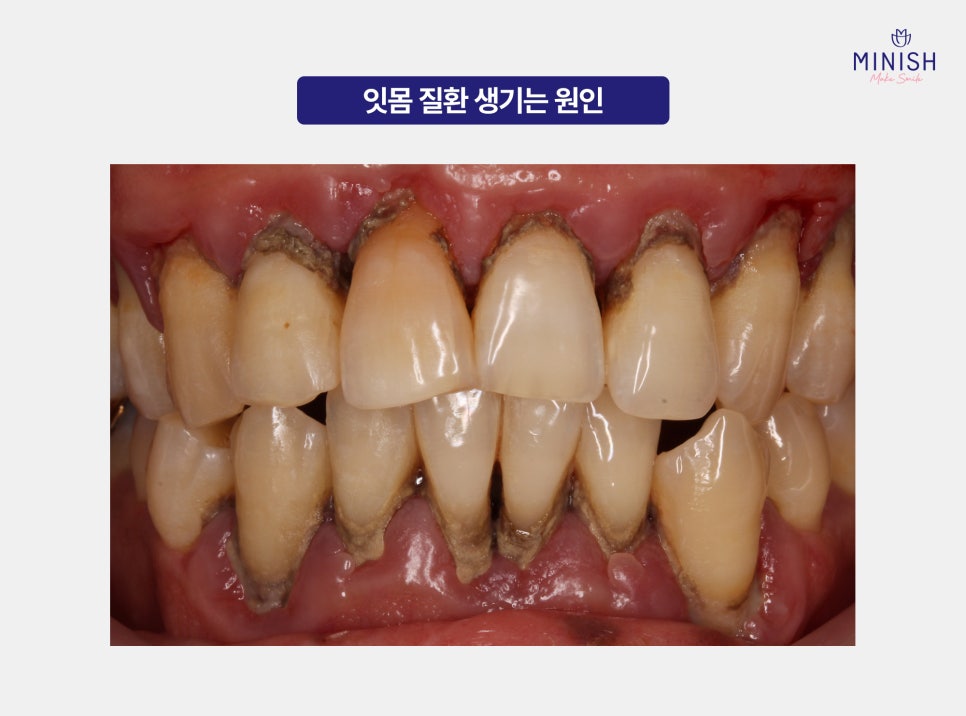
Gum disease, often also called periodontal disease, begins when bacteria in the mouth cause inflammation in the gum tissue. If food debris left after eating is not properly removed, bacteria form plaque, and when this plaque hardens into tartar, it irritates the gums and causes inflammation. The problem does not end there. If the inflammation spreads deeper into the gums, even the bone that supports the teeth (the alveolar bone) can be damaged, causing the gums to gradually recede and exposing the tooth roots, known as dentin.
Changes that occur when the gums recede
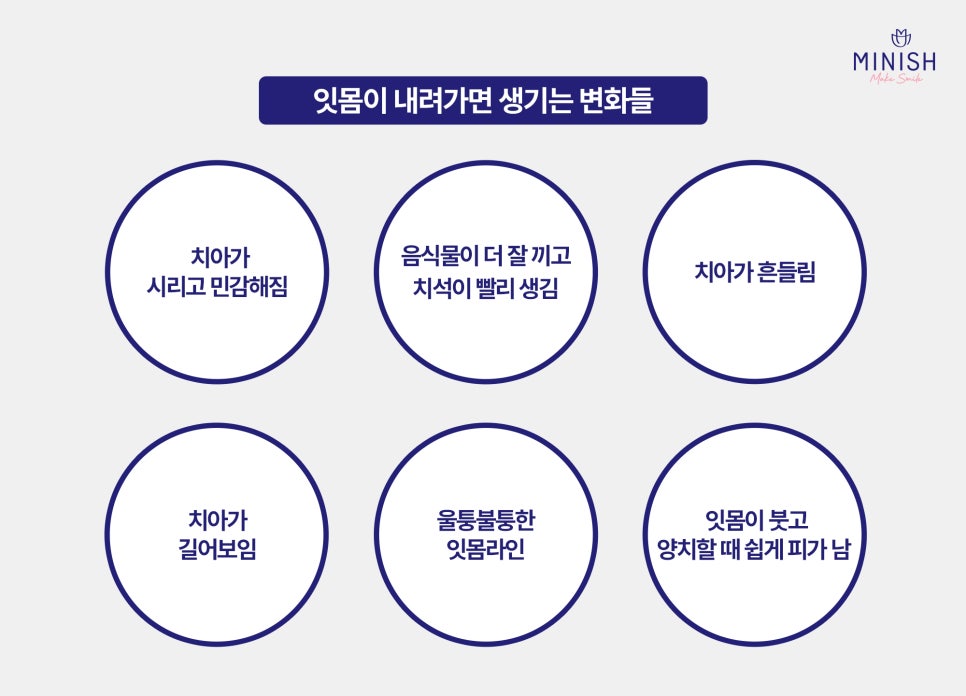
Gum recession is not just a cosmetic issue. It is a sign that the functional structure created by the teeth and gums is beginning to break down.
- Your teeth become sensitive and easily irritated
→ As the gums recede, the dentin in the root area of the teeth becomes exposed. This area is close to the nerves, so it reacts sensitively to outside stimuli such as cold water, wind, and sweet foods. This is why teeth become sensitive and brushing becomes difficult.
- Food gets stuck more easily, and tartar forms faster
→ Food often gets trapped in the gaps created by receding gums (periodontal pockets), and the gum line becomes irregular, making brushing difficult and allowing bacteria to multiply easily. As a result, inflammation repeats, increasing the risk that periodontal disease will worsen.
- Your teeth begin to loosen
→ When the alveolar bone that supports the gums is also damaged along with the gums, the structure that holds the teeth in place weakens, and the teeth may loosen or your chewing force may decrease.
- Your teeth look longer
→ As the gums recede, the tooth roots become exposed below the gum line, making the teeth appear longer overall and giving a more aged impression.
- The gum line becomes uneven
→ The gums visible when smiling may become asymmetrical or develop sunken areas here and there, making the overall smile line feel unbalanced.
- The gums swell and bleed when brushing.
→ Even slight contact while brushing can cause the gums to bleed easily, and a throbbing pain may be felt. This is a sign that the gums have become weakened, and it may be an early sign of periodontal disease caused by gum recession, so caution is needed.
These changes are not just a matter of appearance; they can affect tooth function and overall oral health, so appropriate treatment is needed according to the stage of progression.
Gum disease progresses in stages.
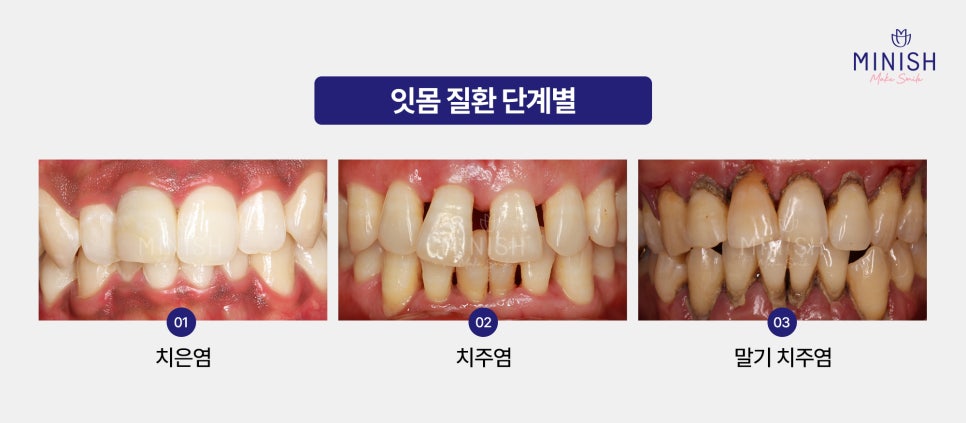
Gum disease (periodontal disease) does not become severe suddenly; it progresses slowly, often almost imperceptibly, and can lead to functional and aesthetic problems. In particular, the symptom commonly called "pyungchi" is a representative result of gum recession, and its course can vary greatly depending on whether early action is taken.
Stage 1 – Gum inflammation (gingivitis)
-
The gums swell, turn red, and begin to bleed when brushing.
-
There is almost no pain, but this is already an early sign that inflammation has started in the gums.
-
At this stage, there is no damage to the alveolar bone, so recovery is possible with regular scaling and proper brushing habits alone.
-
If you manage early gingivitis well, you can prevent the gums from receding.
Stage 2 – Gum recession begins (early periodontitis)
-
The inflammation gradually penetrates deeper into the gums, and the gums actually begin to recede.
-
The gap between the teeth and gums (periodontal pocket) deepens, food can get trapped easily, and bad breath may develop.
-
At this stage, simple scaling is not enough, and root planing to clean the root surface must be performed together.
-
Since this is just before alveolar bone damage progresses, appropriate professional treatment is very important.
Stage 3 – Damage to the gum bone (advanced or late-stage periodontitis)
-
As the inflammation reaches the alveolar bone, the gums recede noticeably, the tooth roots are exposed, and sensitivity and looseness accompany it.
-
At this stage, specialized treatment such as flap surgery with debridement, which involves making an incision in the gums and removing the inflammation, is absolutely necessary.
-
If damage to the alveolar bone worsens, the likelihood of losing teeth increases, so accurate diagnosis and prompt action are important before it is too late.
-
From this stage onward, cosmetic changes become more obvious, and both functional and psychological discomfort begin to increase at the same time.
Depending on the stage of progression, various treatment methods such as scaling, root planing, and flap surgery with debridement are applied.
However, the problem is that once the gums recede, they do not naturally grow back. If the alveolar bone has been damaged or the tooth roots are exposed, functional and aesthetic recovery may remain difficult even after treatment. Rather than stopping at treatment alone, a design that also restores and protects the receded areas of the gums must be carried out together to expect more stable oral health.
Restore healthy gums too with Pink Minishe
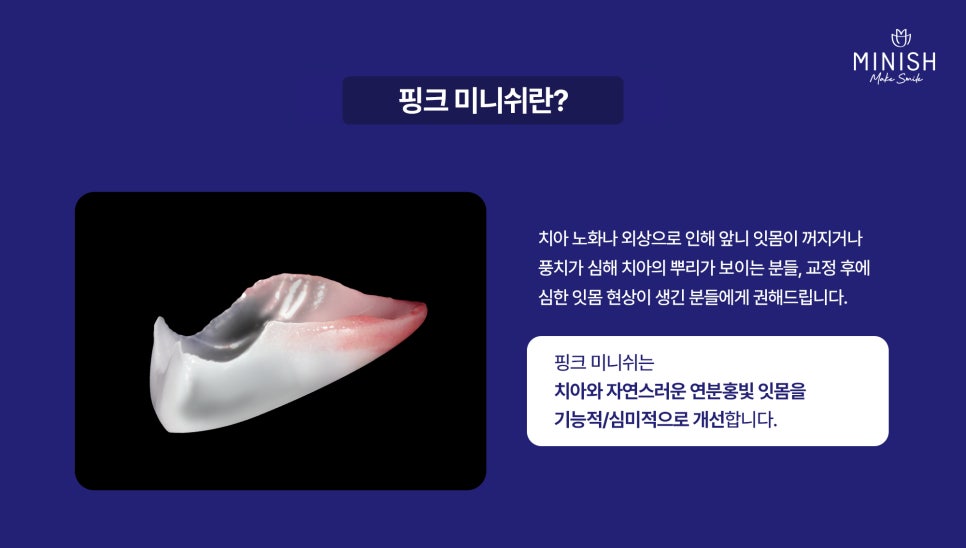
Even after treatment, the biggest remaining concerns are the exposed tooth roots and the collapsed gum line. This part cannot be solved with treatment alone, and over time it can lead to sensitivity, reduced function, and changes in appearance. The way to address these problems is Pink Minishe.
✔ Relieves sensitivity caused by exposed tooth roots
The dentin area exposed as the gums recede reacts sensitively even to cold water, sweetness, and brushing. Pink Minishe is designed to delicately cover the exposed root area, providing both sensitivity relief and protection against irritation.
✔ A structure that also considers chewing force and tooth protection
It precisely analyzes the tooth structure and restores the damaged area using the most similar material possible. Through this, it goes beyond simple covering to help restore chewing function and bite stability, and especially covers the receded gum area to reduce strain on the gums as well. In this way, Pink Minishe is designed with the goal of practical functional restoration that prioritizes not only appearance but also stable force distribution during chewing and tooth protection.
✔ Improves aesthetic imbalance by restoring the gum line
When the gums recede, teeth can look longer, and the gum line visible when smiling can become uneven, easily creating an asymmetrical impression. Pink Minishe restores the teeth and gums together with a design that harmonizes with natural teeth, helping recover a brighter and healthier appearance.
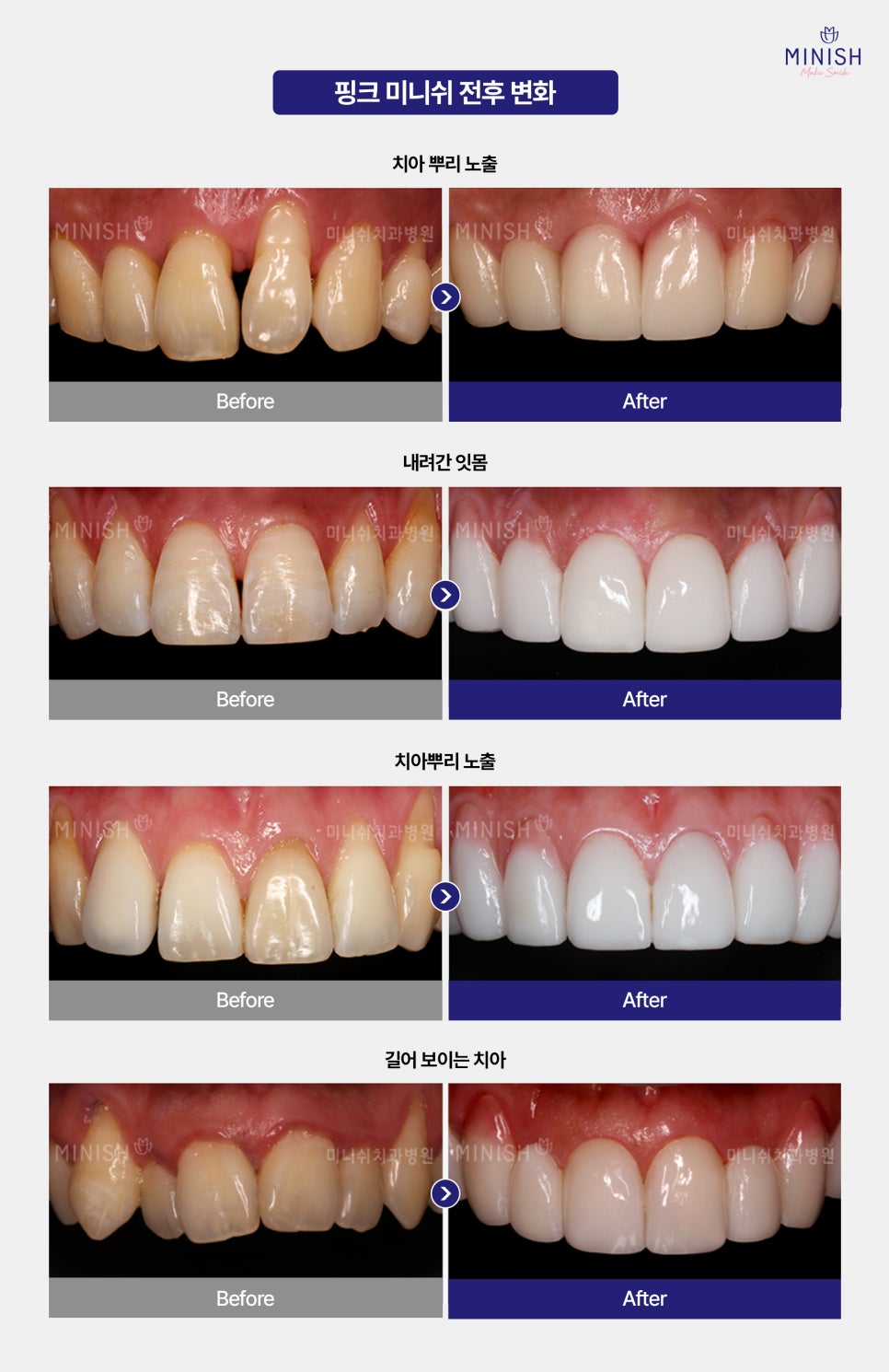
Gum disease is a condition that progresses quietly, yet certainly. In the early stages, it is easy to overlook because there are almost no noticeable symptoms, but if the alveolar bone has already been damaged or the tooth roots are exposed, simple care alone will not restore it.
Check which stage your gums are currently in, and when necessary, consider functional and aesthetic recovery together through Minishe, a tooth restoration solution that takes both teeth and gums into account.