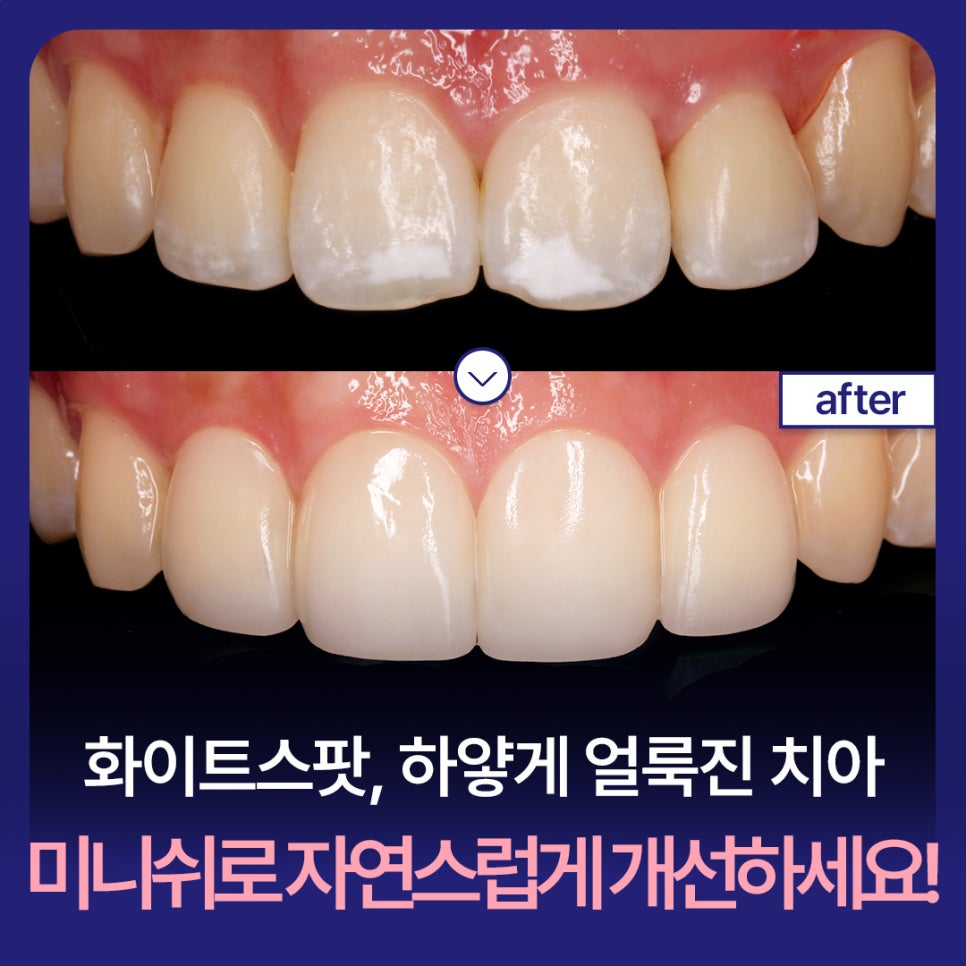
Have you ever noticed white-stained areas on your teeth when looking in the mirror or taking photos? That area that makes you wonder, “I brush well, so why did this stain appear?” is most likely a white spot (enamel hypocalcification). Even though your teeth do not look evenly white overall, many people worry because it does not go away with simple whitening. Today, let’s take a look at why white spots appear and how they can be restored naturally without damaging the teeth.
What Are White Spots (Enamel Hypocalcification)?
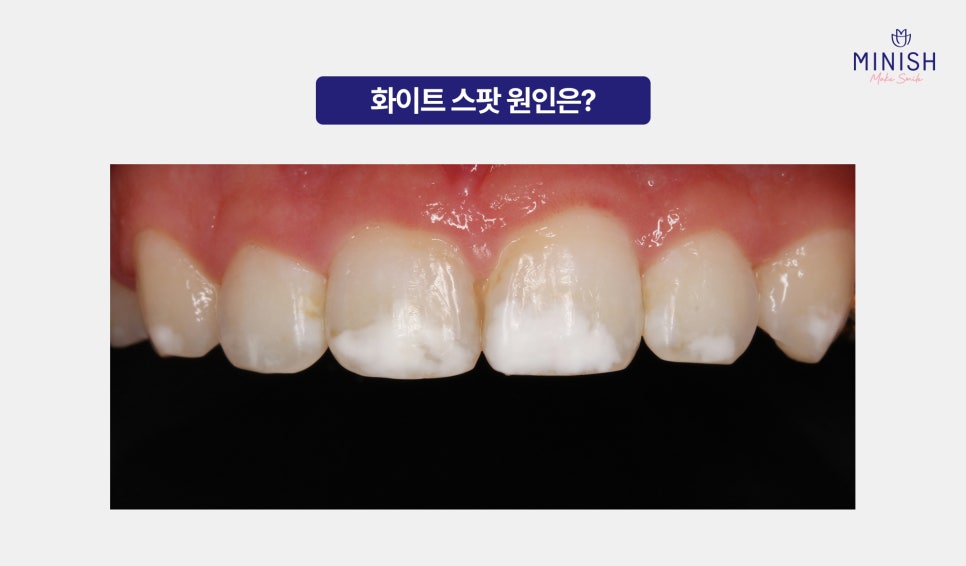
A white spot, as the name suggests, refers to a white spot or stain that appears on the tooth surface. Medically, it is a phenomenon in which a specific area of the tooth is demineralized or loses minerals due to enamel developmental defects, and it may appear as a white, yellow, or brown stain. Because it usually does not cause pain, it is easy to dismiss, but it can be a sign that the tooth surface has been damaged, so both aesthetic and functional care are important.
Why Do White Spots Appear?
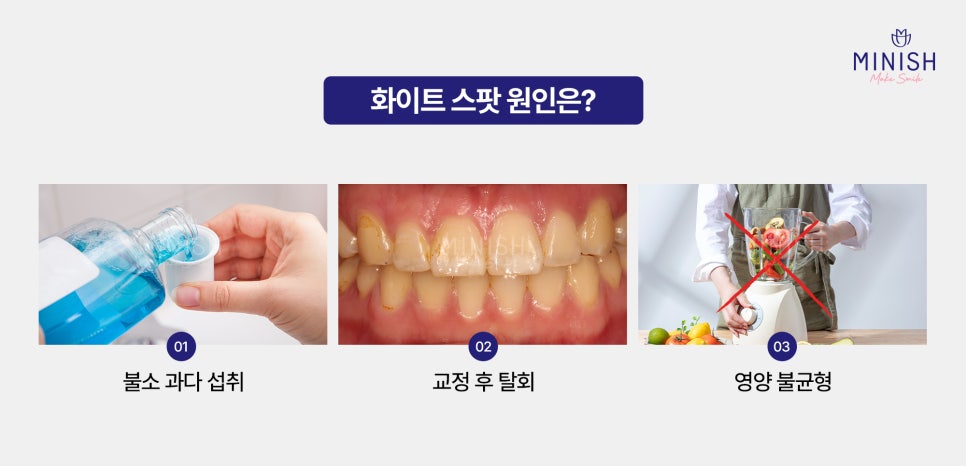
White spots can occur for various reasons.
- Excessive fluoride intake
If too much fluoride is consumed during the tooth-forming stage, the mineral balance in the enamel can be disrupted, causing white spots.
- Demineralization after orthodontic treatment
If the area around the brackets is not cleaned well after orthodontic treatment, or if the area where plaque has accumulated becomes acidic, the minerals on the tooth surface dissolve, causing demineralization and leaving white marks. This process follows the same principle as early caries (initial demineralization) and is a stage before it progresses into cavities.
- Nutritional imbalance
If sufficient calcium, phosphorus, vitamins, and other nutrients are not supplied during the growth period, the enamel may not form properly, causing part of the tooth to appear opaque.
In this way, white spots are not simply a cosmetic issue; they can be a warning sign of tooth health, indicating that the teeth are weakening and microscopic damage is progressing.
How Can White Spots Be Improved?
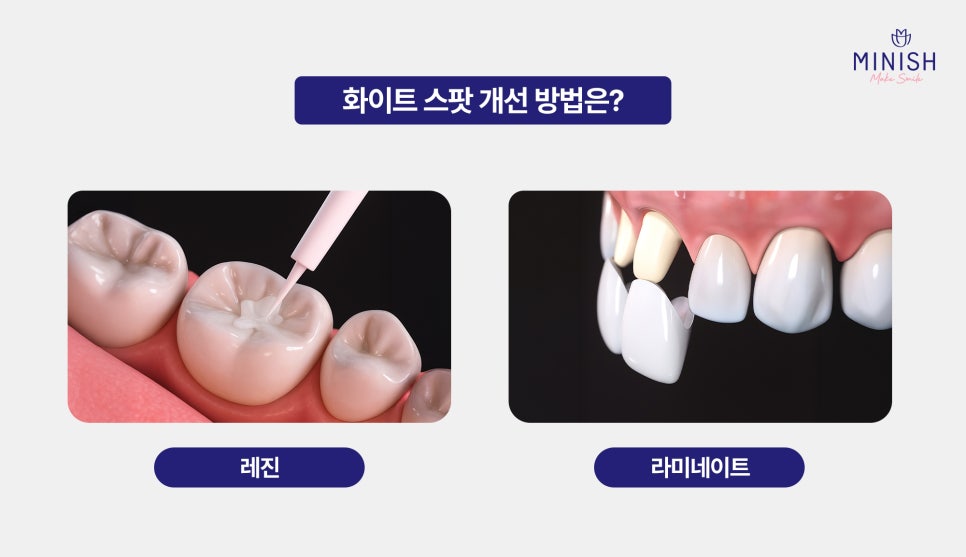
To remove white spots, many people usually consider resin or laminate treatment. Both methods can improve aesthetics, but the choice should vary depending on the degree of tooth damage and the purpose of treatment.
- Resin treatment
This method involves removing or lightly shaping the white spot area and then filling it with a tooth-colored resin (composite resin) material. It may look simple on the surface, but because the material’s properties and adhesion differ from natural teeth, long-term care is important.
✔ Advantages
Because there is little tooth removal and the procedure can be done in a single visit, improvement is quick.
It costs less than other aesthetic treatments, so it is relatively accessible.
- Immediate results can be confirmed on the same day
Because the color and shape can be adjusted right away, you can see the improvement immediately after the procedure.
✔ Disadvantages
- Possible discoloration and detachment
Since resin is a material that absorbs moisture, it can turn yellow over time when exposed to food coloring or saliva.
- Lifting caused by reduced adhesion
The bonding area can weaken due to chewing forces or temperature changes, which may create gaps or cause lifting.
- Unnatural surface texture
Over time, the gloss may disappear and the surface may become rough, making the texture difference from natural teeth noticeable.
- Limits in functional restoration
Because it does not take into account the structural balance or occlusion of the teeth, there are limits to functional recovery.
- Laminate
This method involves removing a certain thickness from the outer surface of the tooth and bonding a thin ceramic (porcelain) veneer on top. It is often chosen when white spots are wide or the color difference is distinct.
✔ Advantages
Because it can change the color and shape of the teeth at once, immediate aesthetic improvement is possible.
- Durability and gloss retention
Ceramic material has a hard surface and retains its gloss for a long time, so discoloration is less likely.
It can cover a wide range of color imbalances (white spots, discolored teeth, etc.) at once.
✔ Disadvantages
- Requires significant removal of natural tooth structure
To attach a laminate, a certain thickness of the tooth must be shaved down, and this is irreversible damage.
- Differences in material properties from natural teeth
Ceramic is much harder than natural teeth, so it can wear down the opposing teeth that bite against it.
- Lifespan varies depending on precision
If the bonding margin is not precise, discoloration, lifting, or detachment may occur, and there is also a risk of secondary decay forming through the gap.
- Additional removal is needed for retreatment
When removing or replacing an existing laminate, more tooth structure must be removed than before.
As such, resin and laminate are focused on improving appearance, so they have limitations when it comes to fundamental improvement that also considers preservation of natural teeth and functional restoration.
A Healthy Tooth Restoration Solution, Minish Bella

White spots are not just a matter of covering them up; they require a process of restoring the structure of the damaged tooth surface and recovering its natural color and texture. Minish Bella is a tooth restoration solution that takes these factors into account and restores both the natural health of the tooth and its harmony.
✔ Function-centered structural design
Minish Bella precisely analyzes the shape, occlusion, and wear condition of the teeth and restores not only the color but also the tooth’s original function and structure.
✔ Material and texture similar to natural teeth
Minish Block, which can reproduce the translucency, reflected light, and surface texture of natural teeth, is a material produced by the German dental materials company VITA, which has 100 years of tradition. It is manufactured with ultra-precision processing technology to create a uniform, lively color without stains.
✔ Preservation of the original tooth
Because only the damaged area is precisely restored without unnecessary removal, the healthy parts of the natural tooth are preserved. In addition, margin sealing is applied so that there is no gap between the tooth and Minish, reducing the risk of secondary cavities and gum disease.
✔ Harmonious appearance improvement
Not only the color but also the size, length, and proportions of the teeth are finely adjusted to complete a clear, uniform smile line without stains.
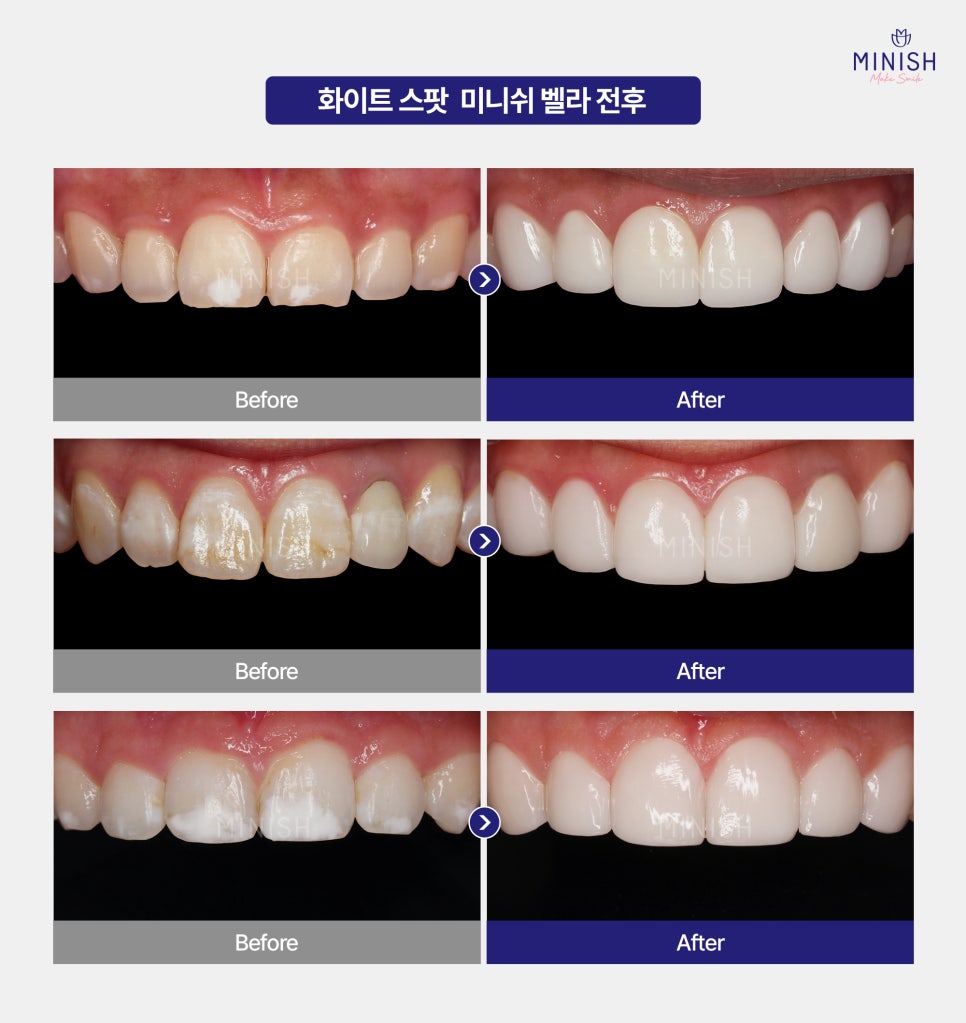
Teeth stained by white spots, naturally restored with Minish Bella.
Even though white spots may seem like a simple cosmetic issue, they can be a sign that the balance of tooth health has been disrupted. Nish Dental Hospital’s tooth restoration solution, Minish Bella, restores the original structure of the teeth without unnecessary removal and improves them in a healthy way. If you have been bothered every time you smile because of tooth-colored stains, we hope you will regain a uniform, healthy smile with Minish.