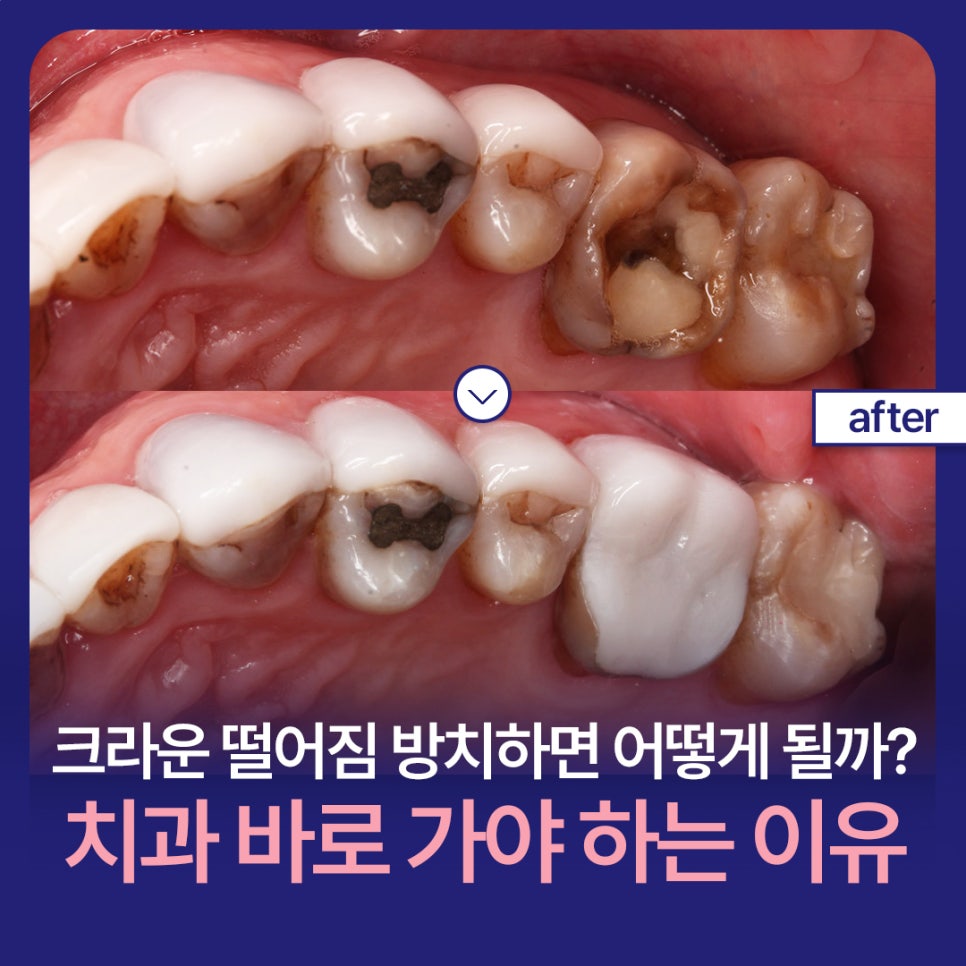
When you are eating, you may suddenly feel something come loose from your tooth, or you may be surprised when a restoration falls out while brushing your teeth. Some people think, “It’s probably fine,” if there is no pain and leave it alone, but this kind of situation may not be something to take lightly. In particular, when a crown falls out, it means the structure that was protecting the tooth is gone, leaving the tooth exposed directly to external irritation. That is why, if this happens, it is important to check the cause and get an accurate diagnosis of the tooth’s condition.
What causes a crown to fall out?
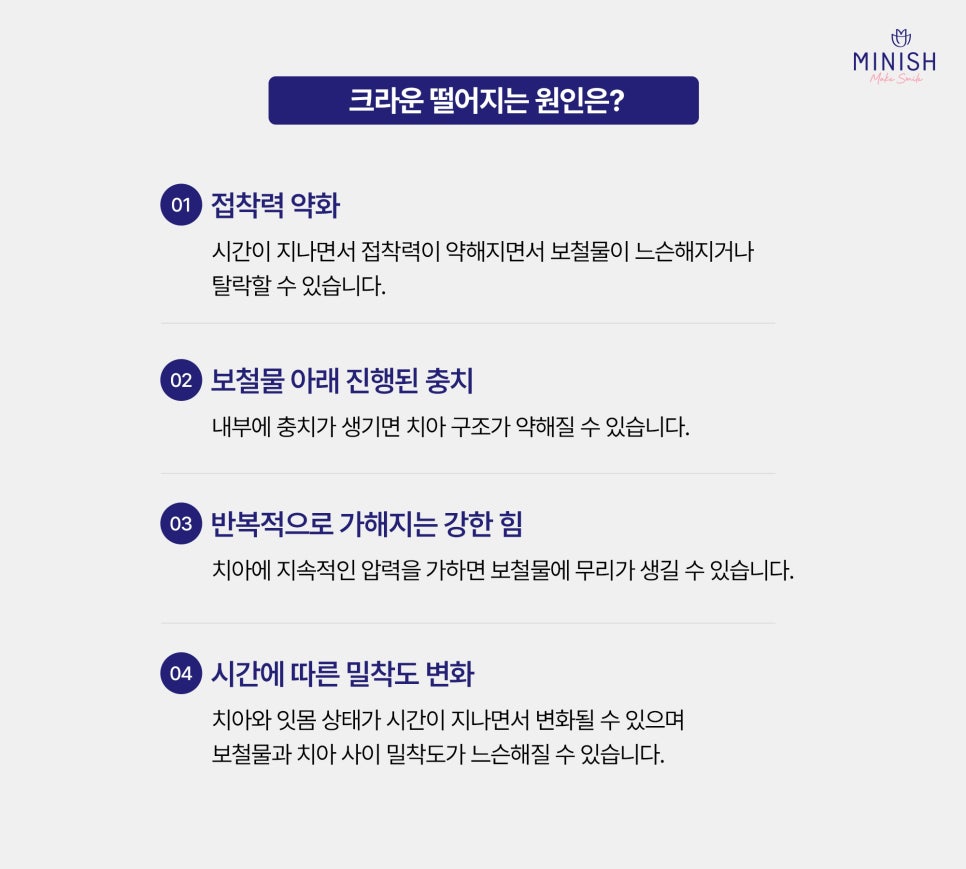
A crown is a restoration made to cover and protect a damaged tooth. If treatment has been done properly, it should not come off easily, but there are cases where it falls out for various reasons. Common causes include the following.
- Weakened bonding strength
A crown is fixed to the tooth with adhesive. Over time, if the bonding strength weakens, the restoration may become loose or fall out.
- Cavities that developed under the restoration
Even if the crown looks intact on the outside, if decay develops underneath, the tooth structure can weaken. In that case, the crown may no longer stay in place and can fall out.
- Repeated strong force
Continuous pressure on the tooth from teeth grinding, clenching, or eating hard foods can put stress on the restoration. If this force is repeated, there is a possibility that it may come loose.
- Changes in fit over time
The condition of the teeth and gums can change little by little over time. If these changes loosen the fit between the restoration and the tooth, the crown may fall out.
If a crown falls out, what happens if you leave it alone?
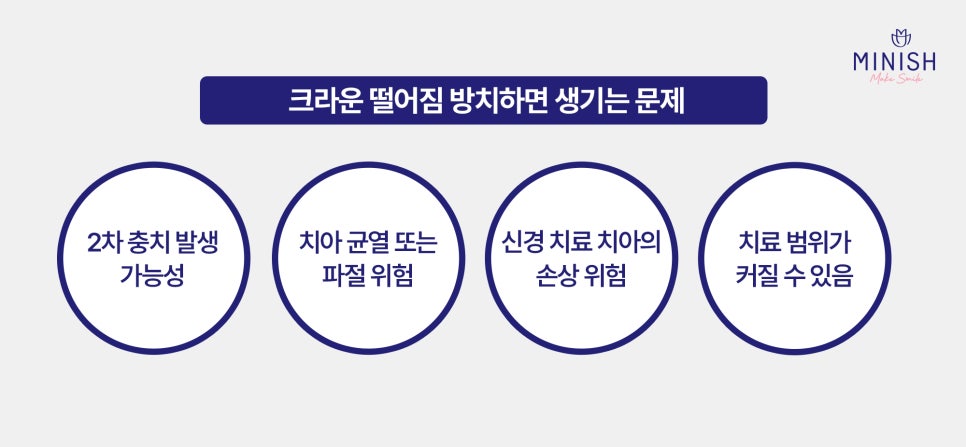
Losing a restoration does not necessarily mean pain will start right away. However, if the tooth is left unprotected for a long time, the following problems can occur.
- Possibility of secondary decay
A tooth whose restoration has fallen out is easily exposed to food particles and bacteria. If this continues, the likelihood of decay recurring inside the tooth increases.
- Risk of tooth cracks or fracture
Without the restoration, chewing force is transmitted directly to the tooth. In this process, cracks may develop, or in severe cases, the tooth may break.
- Risk of damage to a tooth that has had root canal treatment
Teeth that have undergone root canal treatment are often structurally weakened. If such a tooth is left unprotected for a long time, it may be less able to withstand external force and more likely to fracture.
- The scope of treatment may become larger
As time passes and tooth damage progresses, treatment can become more complicated. A problem that could have been solved with simple treatment at first may require a larger scope of treatment later.
If a crown falls out, can’t it just be glued back on?
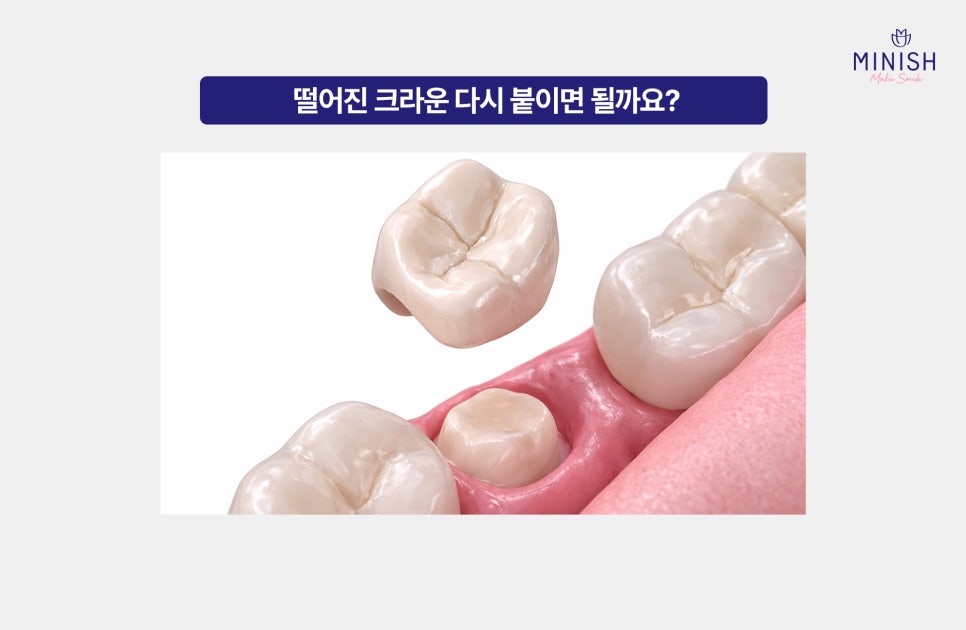
When a crown falls out, many people think, “Can’t it just be glued back on?” But in reality, simple reattachment is not often enough to solve the problem. If decay has developed under the restoration, the tooth structure has weakened, or the gum condition has changed, the underlying cause must be treated first. In addition, if retreatment for the crown is needed, there are cases where the existing restoration must be removed and a new one made. During this process, additional tooth reduction may be necessary depending on the condition of the tooth. However, natural teeth do not regenerate once they have been removed. So the more retreatment is repeated, the weaker the tooth structure can become. For these reasons, if a crown falls out, the first step is not simply to glue the restoration back on, but to accurately check the current condition of the tooth. With an accurate diagnosis, necessary treatment can be provided and the chances of the same problem happening again can be reduced.
A tooth restoration solution, Minish Revive
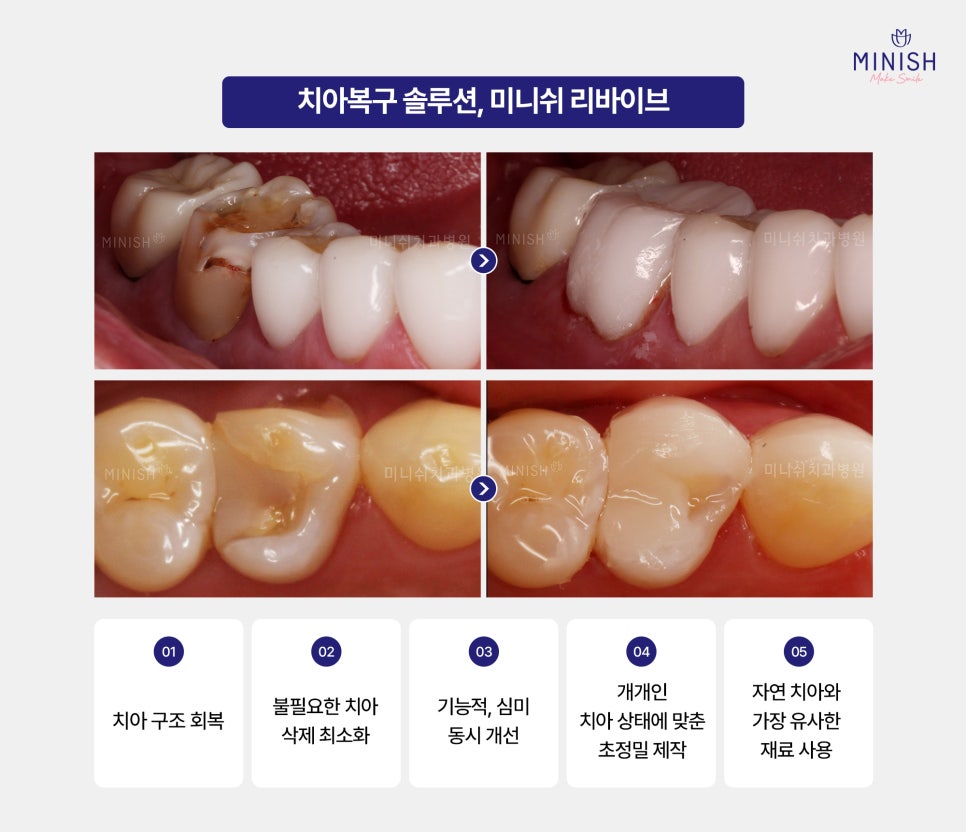
Minish Revive is a retreatment method that restores the damaged tooth condition and stabilizes function again when problems occur after existing crown treatment. It first checks and treats cavities, inflammation, and minor damage that developed under the restoration, aiming not just to improve the appearance but to restore the affected tooth to a healthy condition while considering both function and aesthetics.
- Restoring tooth structure after removing problems from the existing restoration
After checking and treating cavities or inflammation that developed under the restoration, the tooth structure is restored as close to its original form as possible.
- Minimizing unnecessary tooth reduction
Treatment is carried out with a focus on preserving as much of the tooth structure as possible.
- Improving functional and aesthetic issues at the same time
Both functional issues that can occur with restorations, such as gum discoloration and gaps at the margin, and aesthetic aspects are considered together.
- Ultra-precise fabrication tailored to each person’s tooth condition
It is fabricated precisely according to the condition and shape of the tooth to improve fit and stability.
- Use of materials most similar to natural teeth
It is made using Minish block, a material with physical properties closest to those of natural teeth, and a natural result can be expected with consideration of the tooth’s original color and shape.
In addition, the ultra-precise fabrication process can help increase the fit between the tooth and the Minish block, which may help reduce the possibility of external irritation or bacterial infiltration.
Just because there is no pain when a restoration falls out does not mean everything is fine. In particular, if a crown falls out, the tooth is exposed without protection, so prompt evaluation is necessary. Dental problems can require more extensive treatment as time goes on, so it is important to receive an accurate diagnosis while the problem is still small. If your crown has fallen out, do not delay and visit Minish Dental Hospital to check the condition of your tooth.