Hello. This is Yonsei Bombit Dermatology.
Recently, the number of women visiting us with concerns about hair loss has been steadily increasing.
In particular, when a large amount of hair suddenly falls out,
many people ask, “Is this telogen effluvium or female pattern hair loss?”
Today, I’ll explain in detail the exact differences between telogen effluvium and female pattern hair loss.
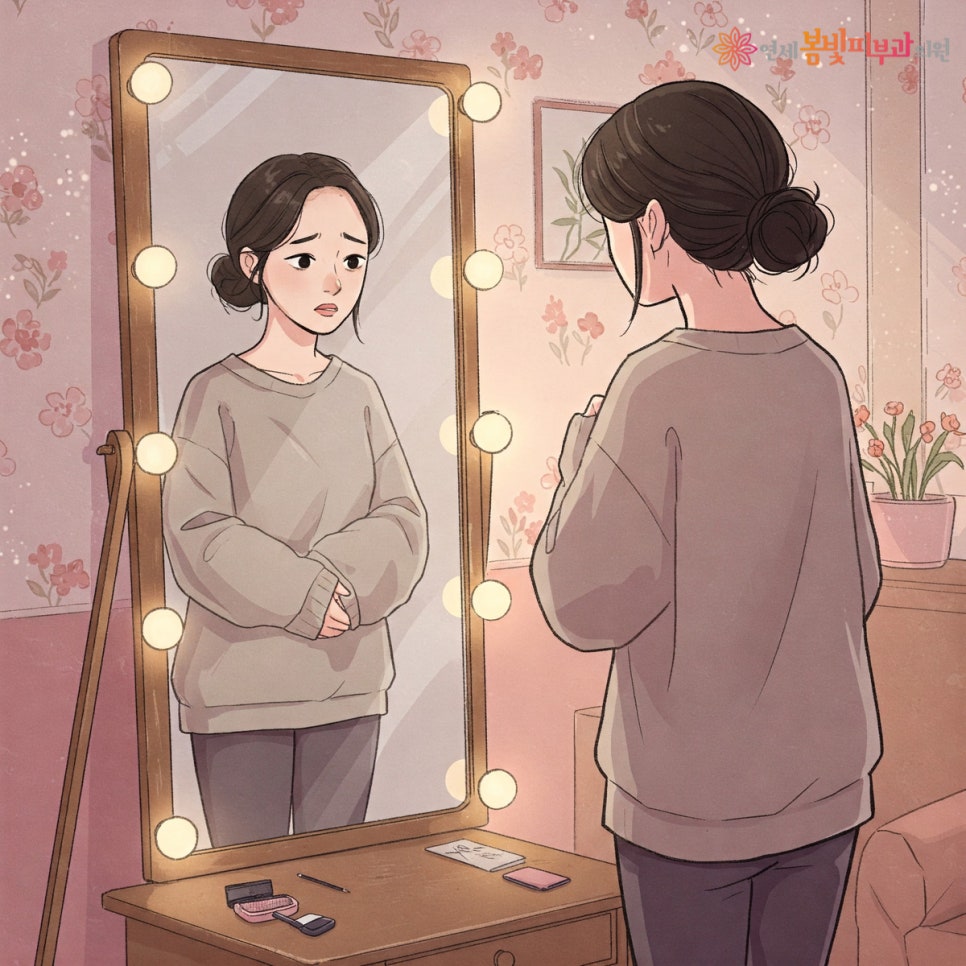
Telogen Effluvium vs. Female Pattern Hair Loss
🧯What is telogen effluvium?
As the name suggests, telogen effluvium is the phenomenon in which hair stops growing and sheds as it enters the resting phase.
-
It usually occurs after major changes to the body, such as childbirth, dieting, sudden weight loss, high fever, severe stress, or surgery.
-
About 2–3 months later, a large amount of hair suddenly begins to shed.
-
Losing more than 150 hairs a day is not uncommon,
-
and it typically progresses as diffuse shedding across the entire scalp.
Fortunately, telogen effluvium is temporary, and most cases recover once the cause is removed or time passes.
However, recovery may take several months, and some cases may not recover, so caution is needed.
🔄How is female pattern hair loss different?
Unlike male pattern hair loss, female pattern hair loss is mainly caused by hormonal and genetic factors.
-
It usually progresses gradually from the late 20s into the 40s and 50s,
-
and the hair slowly becomes thinner and less dense without any specific external trigger.
-
It is characterized by a pattern that starts at the crown and center part line and gradually spreads,
-
while the frontal hairline is relatively well preserved.
Female pattern hair loss is a chronic condition that is difficult to recover from naturally and requires continuous, systematic treatment.
If treatment is stopped, it may progress again, so steady management is necessary.
🔍Key points for distinguishing between the two
| Category | Telogen Effluvium | Female Pattern Hair Loss |
|---|
| Onset | Acute (within 2–3 months) | Chronic, gradual progression |
| Cause | Stress, childbirth, dieting, etc. | Genetics, hormonal changes |
| Area of hair loss | Diffuse across the scalp | Centered on the crown and part line |
| Possibility of recovery | Usually recovers naturally | Worsens without treatment |
| Change in hair thickness | Thickness remains the same | Becomes gradually thinner |
Because it is difficult to distinguish between these two conditions early on, professional examination and scalp diagnosis are important.
An accurate diagnosis makes the treatment direction clearer and also shortens the time needed.
✅ Treatment and management
Removing the cause is the most important thing.
-
For example, stress management, nutritional support, and improved sleep can help recovery.
-
If needed, topical products or supplements containing follicle-activating ingredients can be used as adjuncts.
-
Female pattern hair loss
Medication to maintain hair thickness and density
-
Injection treatments performed in dermatology clinics (follicle injections, autologous blood stem cell treatment),
-
LED/laser therapy, mesotherapy, and similar treatments can be helpful.
-
It is difficult to resolve on your own, and consistent treatment is necessary.
✨ Closing thoughts
Telogen effluvium may be a temporary phenomenon, while female pattern hair loss may be a chronic, progressive type of hair loss.
Although they may look similar, the causes, course, and treatment methods are different, so an accurate differential diagnosis is key.
Recently, more women have been experiencing early hair loss, so if you notice changes in your hair, we recommend visiting a dermatologist without delay.
Yonsei Bombit Dermatology provides care for the full course of female hair loss, from early diagnosis to procedures and long-term management.
Thank you.
📍 Yonsei Bombit Dermatology
📞 Inquiries 02-837-8275
#TelogenEffluvium #FemalePatternHairLoss #HairLossTreatment #HairLossSymptoms #HairHealth #FemaleHairLossManagement #CausesOfHairLoss #ScalpHealth #HairLossPrevention #HairLossInfo #YonseiBombitDermatology #GuroDigitalComplexDermatology #BoardCertifiedDermatologist #SeborrheicScalpDermatitis #HairCare #HairLossDistinction #HairManagementTips #HairLossConcerns #ScalpIssues #HairLossTypeAnalysis