Hello. This is Yonsei Bombit Dermatology.
One of the questions we often hear in the clinic is, “What kind of moisturizer is good?”
There are so many products on the market, and prices vary widely, so it can be confusing to know what to use.
Today, from the perspective of a dermatologist, I’ll explain the criteria for a “good moisturizer.”
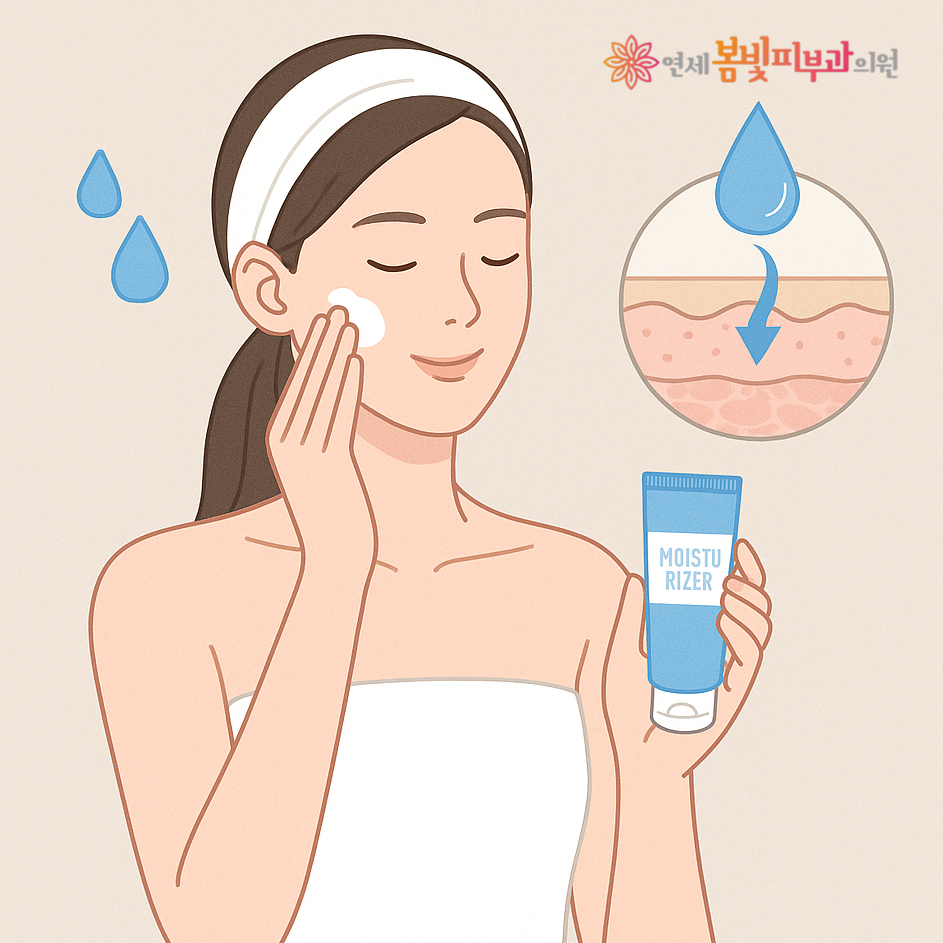
💡 Shall we start by understanding the basic role of a moisturizer?
The skin naturally has the ability to retain moisture on its own,
but this function can weaken due to dry weather, cleansing habits, skin conditions, age, and other factors.
At this time, a moisturizer serves three important roles.
-
Acts as a protective barrier to prevent moisture evaporation
-
Supplies ingredients that help restore the skin barrier
-
Draws moisture into the skin
🔍 What are the key ingredients in a good moisturizer?
The main ingredients in moisturizers can be broadly divided into three categories.
When choosing a product, it’s a good idea to check whether it contains any of these three ingredient types.
- Ingredients that attract moisture
-
Examples: glycerin, hyaluronic acid, propylene glycol, panthenol
-
Features: They draw moisture into the skin and improve hydration.
- Ingredients that strengthen the skin barrier
-
Examples: ceramides, cholesterol, fatty acids
-
Features: They are similar to the lipid components that make up the skin, so they are effective for barrier recovery.
- Ingredients that prevent moisture from escaping
-
Examples: shea butter, mineral oil, petrolatum, plant oils, and more
-
Features: They form a protective layer on the skin’s surface to prevent moisture evaporation.
→ Ideally, one product contains all three.
👶 It depends on your skin type and situation
When choosing a moisturizer, you shouldn’t look only at the ingredients; it’s important to choose one that fits your skin condition and the environment in which you use it.
-
Oily skin: gel-type products with less oil, water-based products
-
Dry skin: stronger moisturizing formulas such as cream or balm types
-
Sensitive skin: low-irritation products without fragrance, colorants, or alcohol
-
Atopic skin: skin-barrier-strengthening products with a high ceramide content
💬 Advice often given in dermatology consultations
-
Moisturizer ingredients and how it feels on the skin are more important than the price.
-
Applying it daily, generously, and over a wide area is much more effective.
-
It’s good to apply it at least twice a day, morning and evening, and within 3 minutes after showering.
-
You don’t have to apply it all over the body; it’s enough to focus on areas that are usually dry.
In closing
The standard for choosing a good moisturizer is not a product that becomes popular through word of mouth or one that is heavily advertised,
but whether it suits your skin well and whether you can apply it often enough.
Most hospital-grade moisturizers are well formulated with the three ingredients explained above.
If you combine an expert’s recommendation with your own experience, anyone can choose the moisturizer that is best suited to them!
📍 Yonsei Bombit Dermatology
📞 02-837-8275
#YonseiBombitDermatology #GuroDigitalComplexDermatology #Dermatologist #MoisturizerRecommendation #MoisturizerIngredients #GoodMoisturizer #SkinBarrierStrengthening #Ceramide #HyaluronicAcid #DrySkinMoisturizer #OilySkinMoisturizer #SensitiveSkinCare #AtopicMoisturizer #HealthySkinHabits #SkinMoisturizingRoutine #SkinCareTips #DermatologyConsultation #HowToUseMoisturizer #HowToChooseAMoisturizer #SkinMoisturizingBasics