Hello, this is Yonsei Bombit Dermatology.
As the season when the sun gets stronger approaches, there is one thing you should never forget: sunscreen.
But did you know that if you don’t apply sunscreen properly, its effectiveness can decrease?
Today, I’ll explain how to apply sunscreen properly and how to choose the right product according to your skin type.
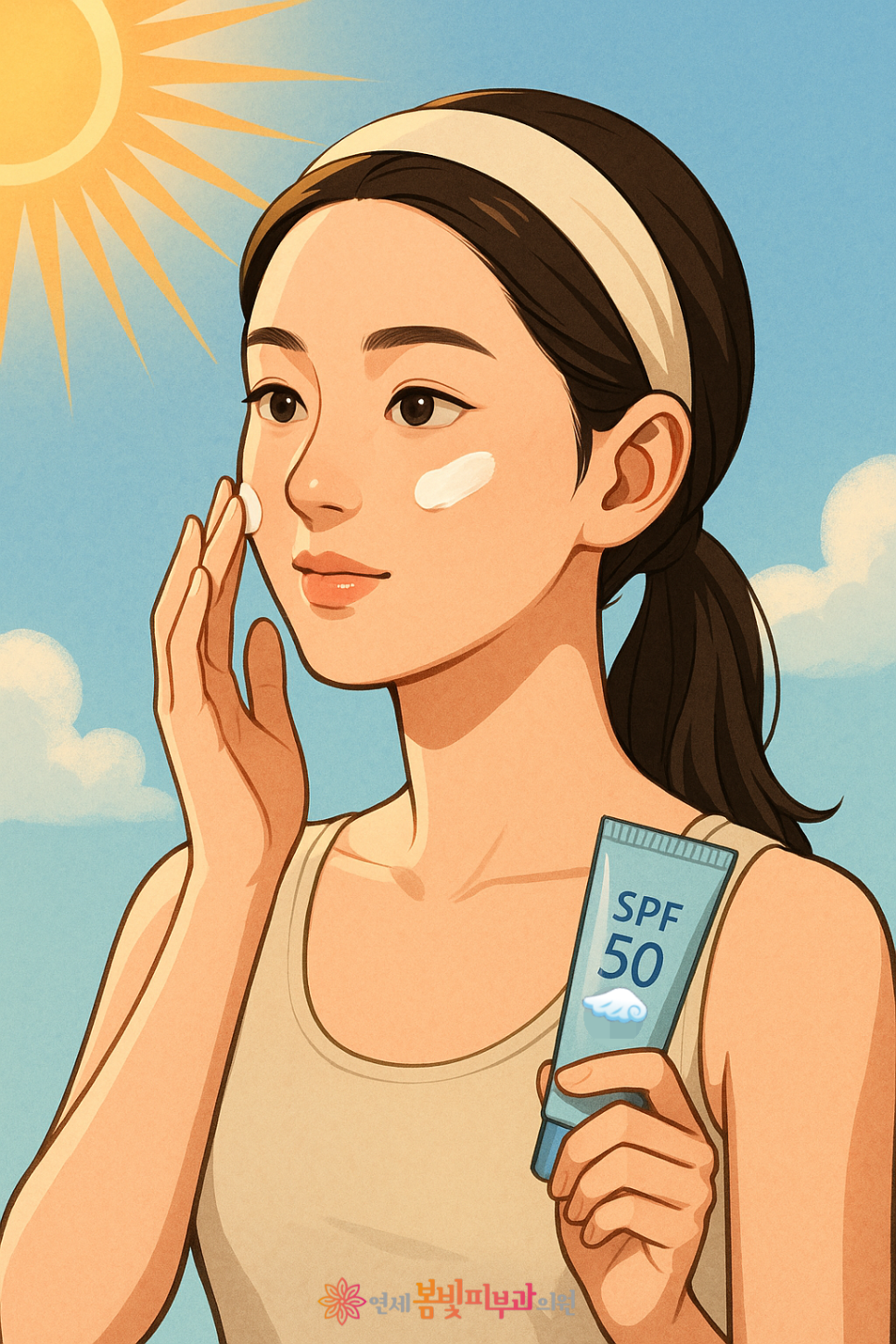
Are you applying sunscreen properly?
☀️Why do you need to apply sunscreen every day?
Ultraviolet rays reach the ground even on cloudy days.
They can even enter indoors through windows, so it’s important to apply sunscreen even on days when you do not go outside.
-
Ultraviolet A (UVA): Affects skin aging, melasma, and wrinkle formation.
-
Ultraviolet B (UVB): The main cause of sunburn and pigmentation.
Therefore, sunscreen is an essential basic product for anti-aging and skin cancer prevention.
✅Apply sunscreen like this!
The method recommended by dermatology specialists is as follows:
- Apply it as the last step of your skincare routine after cleansing
Usually, use it after the creams or lotions you apply in the morning.
For an adult, you should apply about the size of a 500-won coin to the entire face (about 1–1.2 g).
- Apply it 15–30 minutes before going outside
The sunscreen effect appears after it has been absorbed into the skin.
Since the effect can decrease due to sweat, sebum, friction, and more, regular reapplication is important.
💡How to choose sunscreen by skin type
Using a suitable sunscreen according to your skin type is a way to reduce irritation and improve effectiveness.
👩⚕️Sensitive skin
-
Choose a mineral sunscreen (physical blocker).
-
Zinc oxide and titanium dioxide are representative ingredients; they are less irritating and less likely to cause problems.
-
Products without fragrance, alcohol, or coloring agents are good.
😓Oily/acne-prone skin
-
Choose a lightweight gel type or emulsion type with little oiliness.
-
It’s good to check whether the product is non-comedogenic.
-
Products with an “oil control” function are also recommended.
🧴Dry skin
🌟Combination skin
-
It can also be a good idea to use a lightweight gel type for the T-zone and a moisturizing sunscreen for the U-zone separately.
-
Even among all-in-one products, a medium-texture “lotion-type sunscreen” often works well.
🌞Understanding PA and SPF properly
- SPF (Sun Protection Factor)
This is the UVB protection index. The higher the number, the stronger the protection, but for sensitive skin, a lower SPF may be more suitable.
- PA (Protection Grade of UVA)
The more + signs there are, the stronger the UVA protection.
- For ordinary outings, PA++ or higher is appropriate, and for outdoor activities, PA+++ or higher is suitable.
✨TIP from Yonsei Bombit Dermatology!
✔ Before makeup, apply sunscreen carefully, and if needed, after makeup, reapply with a cushion or powder that has sunscreen functions.
✔ Apply carefully around the eyes, neck, and behind the ears as well. These areas are frequently exposed to UV rays but are easy to miss.
✔ After laser procedures, using a physical sunscreen is good for skin recovery.
📌To summarize
Sunscreen is the most basic of basics for the health of all skin.
Choosing a product that suits your skin and building the habit of applying it properly is the surest way to prevent melasma, blemishes, and wrinkles.
So, after reading this post, are all subscribers ready to welcome a summer without blemishes?
📍 Yonsei Bombit Dermatology
📞 02-837-8275