Whiteheads and inflammatory acne: What’s different, and how should they be treated?
Hello, this is Yonsei Bombit Dermatology.
When you look in the mirror, there are days when you notice small white bumps or red, swollen pimples.
These two types of acne may look and feel different, but in fact they differ greatly in how they develop, how they are treated, and even in the risk of scarring.
Today, I’ll explain the differences between whiteheads and inflammatory acne in detail from a dermatologist’s perspective.
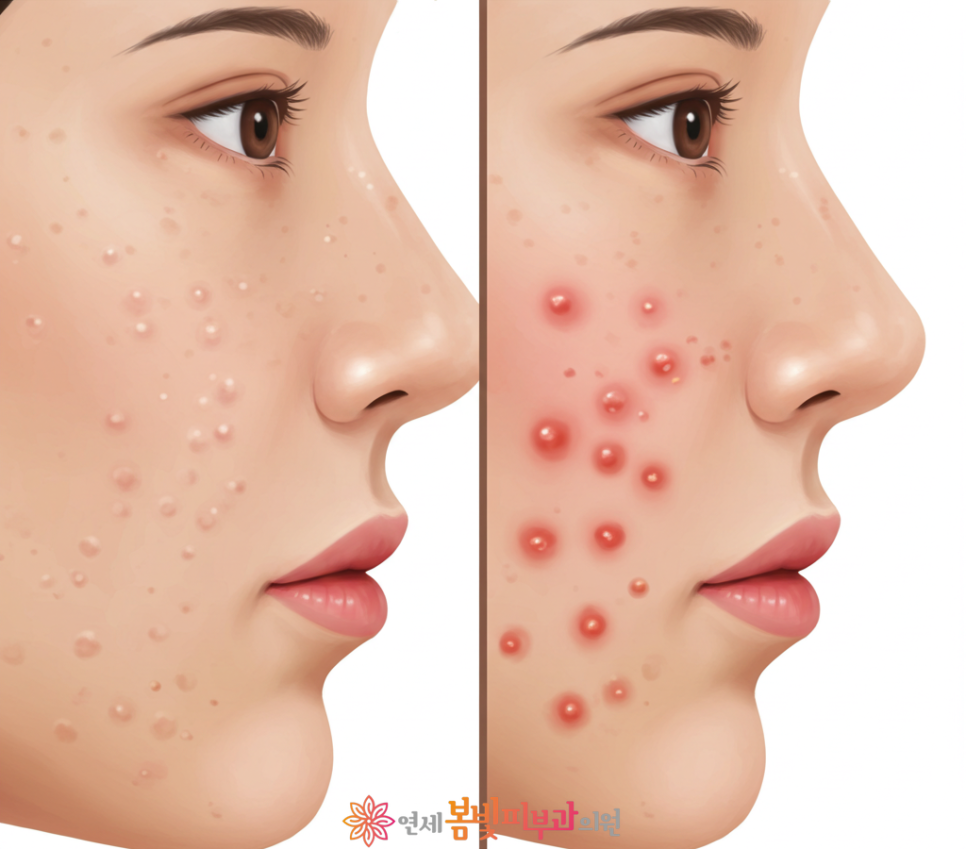
1️⃣ What is a whitehead (comedonal acne)?
Whiteheads are non-inflammatory acne caused when sebum becomes trapped in pores.
They appear as small, firm bumps that are white or slightly yellow, and they are an early-stage acne lesion with almost no inflammatory response.
✔ Main causes
• Excess sebum production
• When dead skin cells inside the pores do not shed properly and become clogged
• Hormonal changes, especially during puberty or around menstruation
• Improper cosmetic use or insufficient cleansing
✔ Treatment methods
• Keratolytic agents (for example, AHA, BHA, tretinoin)
• Acne-specific extraction and skin care
• If necessary, sebum-suppressing treatment such as sebum-reducing laser therapy or isotretinoin-based medication
• Avoid irritation, and be thorough with moisturizing and sun protection
➡ If managed properly at this stage, it can recover without scarring.
2️⃣ Why does inflammatory acne occur, and what are its characteristics?
Inflammatory acne develops when whiteheads trigger an immune response along with bacterial infection within the pores (P. acnes).
It becomes red and swollen, is accompanied by pain, and in severe cases, pus may form and the surrounding tissue can be damaged.
✔ Main causes
• Untreated whiteheads
• Excess sebum + bacterial growth + inflammation
• The habit of touching or squeezing with your hands
• Overactive immune response
✔ Treatment methods
• Antibiotics (topical or oral)
• Anti-inflammatory injection (triamcinolone)
• Anti-inflammatory lasers such as Clarity2
➡ If inflammation is not quickly calmed at this stage, it can progress to hyperpigmentation and pitted scars.
3️⃣ What is the difference in scar formation?
| Category | Whiteheads | Inflammatory acne |
|---|
| Skin damage | Almost none | Damage extends to the dermis |
| Risk of scarring | Low | High (pitting, hyperpigmentation) |
| When scarring occurs | Can happen with excessive extraction or irritation | More likely when inflammation is severe or repeated |
| Recovery speed | Fast | Slow and may require treatment |
Whiteheads cause almost no skin damage, so with proper care they can disappear without scarring.
Inflammatory acne, however, can damage the dermis over time, and in many cases it requires treatment for scars as well.
🧴 In closing
All acne may look the same, but the approach is completely different depending on the stage and type.
If you let whiteheads go untreated or ignore inflammatory acne, it can lead to scars and hyperpigmentation.
At Yonsei Bombit Dermatology,
• We accurately diagnose the type of acne and stage of progression
• Depending on the skin condition, we provide customized treatment combining extraction, lasers, medication, and injections
If you want to recover healthy skin without scars, we recommend getting examined early.
📍 Yonsei Bombit Dermatology
📞 02-837-8275
#YonseiBombitDermatology #GuroDigitalComplexDermatology #DermatologySpecialist #WhiteheadTreatment #InflammatoryAcne #AcneExtraction #AcneSkinCare #AcneLaser #AcneScars #DermatologyAcneTreatment #HyperpigmentationPrevention #DermatologySpecialistConsultation #EarlyAcneCare #ScarFreeTreatment