Why does skin feel stinging and sensitive when you apply a sunscreen with a high SPF?
Hello, this is Yonsei Bomvit Dermatology.
“I tried SPF 50 and my skin stung.”
“I heard that a lower SPF is gentler. Is that true?”
These are questions we often hear in the clinic.
Sunscreen is meant to protect the skin, but it can sometimes trigger trouble instead.
Today, I’ll clearly explain the relationship between SPF and skin irritation, and how to choose the right sunscreen.
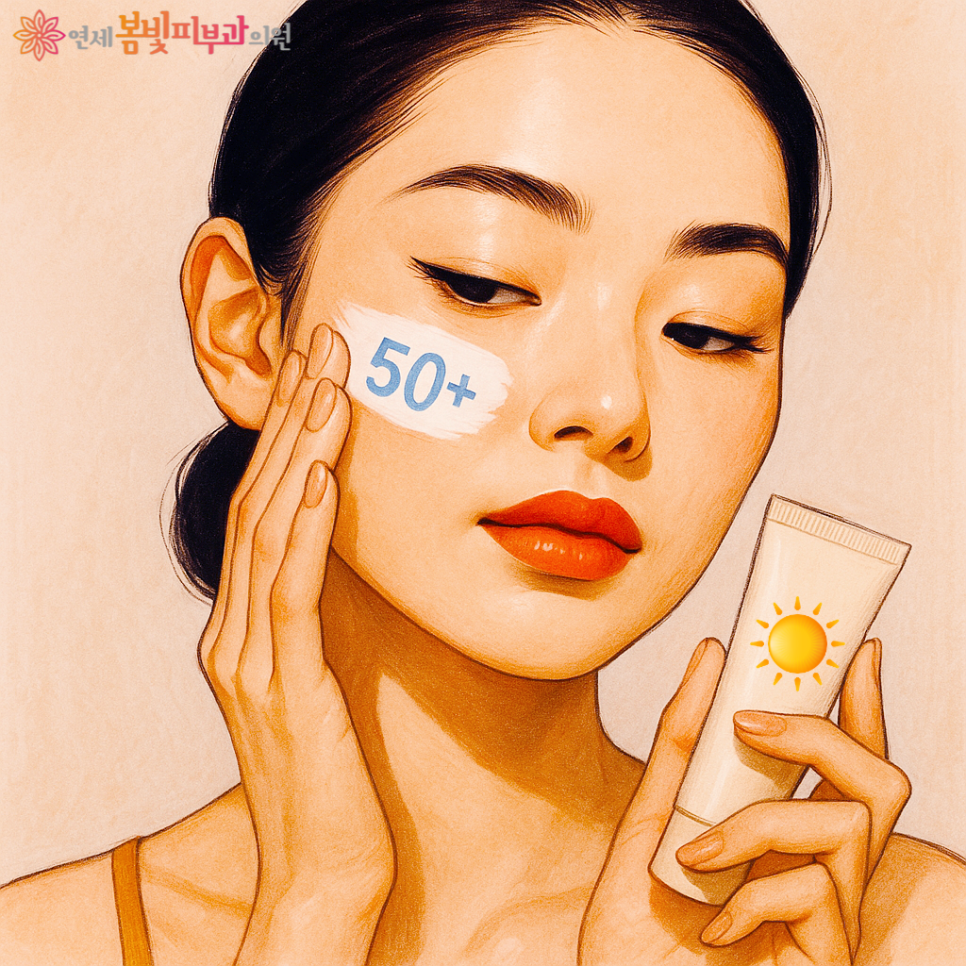
Sunscreen: Does a higher SPF mean more irritation?
1️⃣ What is SPF? ✔
SPF (Sun Protection Factor) is a measure of how long a product can block UVB (ultraviolet B) rays.
-
SPF 15: about 93% blocked
-
SPF 30: about 97% blocked
-
SPF 50: about 98% blocked
-
SPF 50+: more than 98%
In other words, the higher the number, the greater the protection rate, but once it goes above 30, the practical difference is minimal.
2️⃣ A higher SPF does not necessarily mean stronger irritation 🔬
✔ The SPF value itself is not the cause of irritation.
Whether irritation occurs is more closely related to the sunscreen ingredients, formulation, and skin type.
- Mineral sunscreen (physical sunscreen)
→ Based on titanium dioxide and zinc oxide
-
→ Reflects light to block it, causing less irritation
-
→ But it may leave a white cast and cause dryness
-
Chemical sunscreen (organic sunscreen)
→ Such as oxybenzone, avobenzone, octocrylene, etc.
→ High-SPF products are usually made with a higher concentration of chemical sunscreen ingredients, or as a hybrid of mineral and chemical filters, so people with sensitive skin may feel irritation because of the ingredients.
3️⃣ When are high-SPF products really necessary? ☀️
✔ If the following apply, SPF 50 or higher may be needed.
-
When going out between 10 a.m. and 3 p.m.
-
For long outdoor activities such as hiking, going to the beach, or golf
-
When suddenly exposed to strong sunlight, such as during overseas travel
-
When UV protection must be strict after laser treatment
However, if you mostly stay indoors in daily life, SPF 30 to 40 is sufficient.
4️⃣ Tips for reducing irritation while still getting protection ✨
✔ Even when you need a high-SPF product, you can reduce irritation by following these tips.
-
Choose products centered on mineral sunscreen rather than chemical sunscreen alone
-
Avoid solid forms such as sunscreen sticks and spray formats. Cream and lotion textures are recommended.
-
Avoid irritating ingredients such as fragrance, alcohol, and parabens whenever possible
-
Apply a small amount in 2–3 thin layers, then gently pat to absorb
📌 In closing
Saying that a higher SPF means stronger irritation is half right and half wrong.
The issue is not the number itself, but what ingredients it contains and what kind of formulation it has.
If you choose a sunscreen based on your skin type and lifestyle,
you can use SPF 50 or higher safely without irritation.
📍 Yonsei Bomvit Dermatology
📞 02-837-8275
#YonseiBomvitDermatology #GuroDigitalComplexDermatology #DermatologySpecialist #SunscreenRecommendation #SunscreenRecommendation #SPF50Irritation #MineralVsChemicalSunscreen #SunscreenBySkinType #ChoosingAnSPF #UVProtectionForSensitiveSkin #SunscreenIngredients #SunscreenWithoutIrritation #UVProtectionBasics #IsSPF30Enough #SunscreenForOutdoorActivities #WhiteCastFromSunscreen #PreventSunscreenTrouble #SunscreenIngredients #DermatologySunscreenConsultation #SunscreenIrritation #HowToChooseSunscreen