As the demand for nose surgery, which is positioned at the center of the face and determines the overall impression of the face, continues to increase, the proportion of people who complain of side effects and choose revision surgery is also rising.
When an artificial implant inserted into the nose presses on the skin tissue and causes an inflammatory reaction, the tip of the nose can become hard, or capsular contracture can occur, causing the nose to gradually turn up like a snub nose. In severe cases of capsular contracture, the implant may protrude through the skin surface. If inflammation continues due to capsular contracture, prompt revision rhinoplasty becomes inevitable, but using an implant again may lead to even more severe side effects. To prevent such complications, implant-free rhinoplasty using autologous tissue instead of artificial implants is becoming increasingly common.
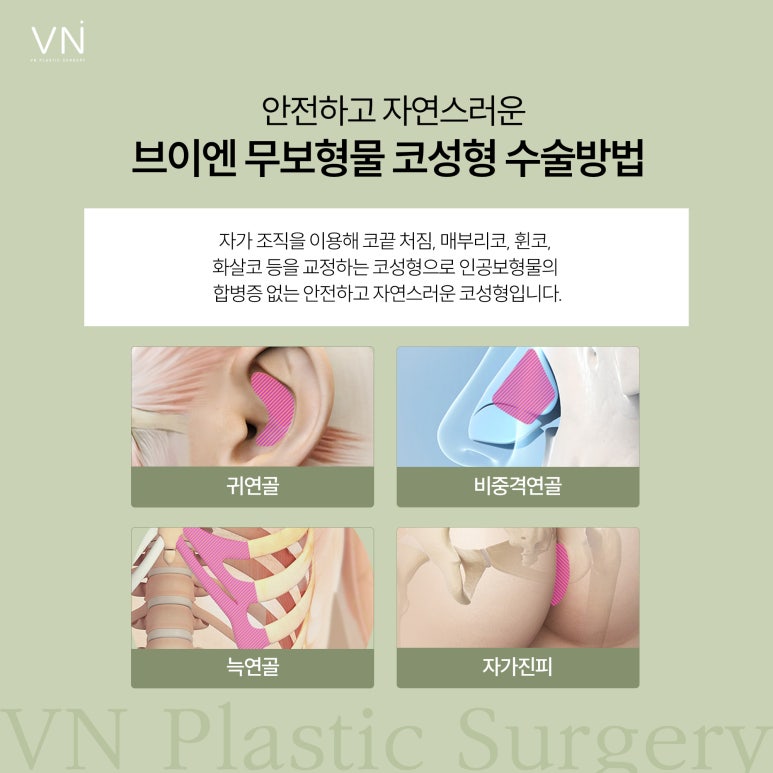
Implant-free rhinoplasty is a surgical method that uses autologous tissue to correct a drooping nasal tip, a hump nose, a crooked nose, or a hooked nose.
Because autologous tissue has excellent biocompatibility, the likelihood of side effects caused by artificial implants, such as implant visibility through the skin or inflammation due to capsular contracture, is low. It can also improve the nose with a more natural shape and line. Materials used in implant-free rhinoplasty include ear cartilage, septal cartilage, costal cartilage, and autologous dermis.
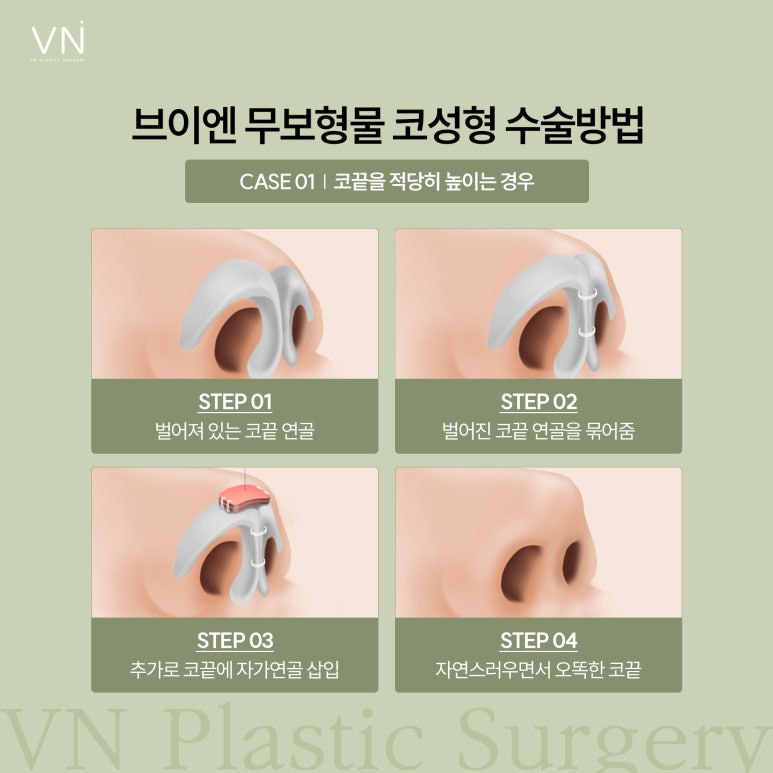
Let’s look at the surgical methods for each case of implant-free rhinoplasty at VN Plastic Surgery.
First, the first case is when the nasal tip is raised moderately. In this case, the separated nasal tip cartilages are tied together, and additional autologous cartilage is inserted into the nasal tip to help improve it into a natural yet refined tip.
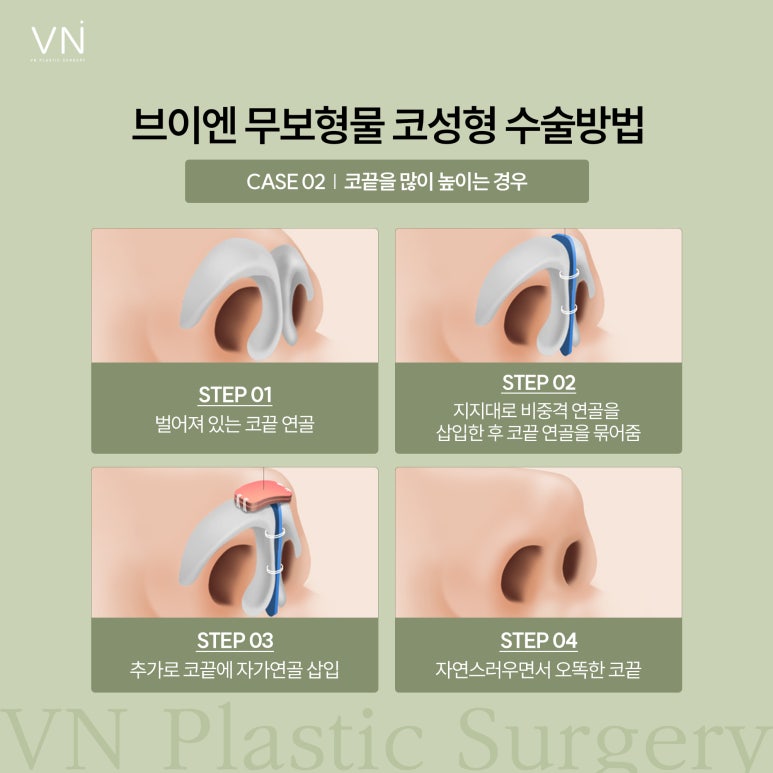
The second case is when the nasal tip is raised significantly. In this case, septal cartilage is inserted as a support to hold the separated nasal tip cartilages together, and additional autologous cartilage is inserted into the nasal tip to help improve it into a natural yet refined tip.
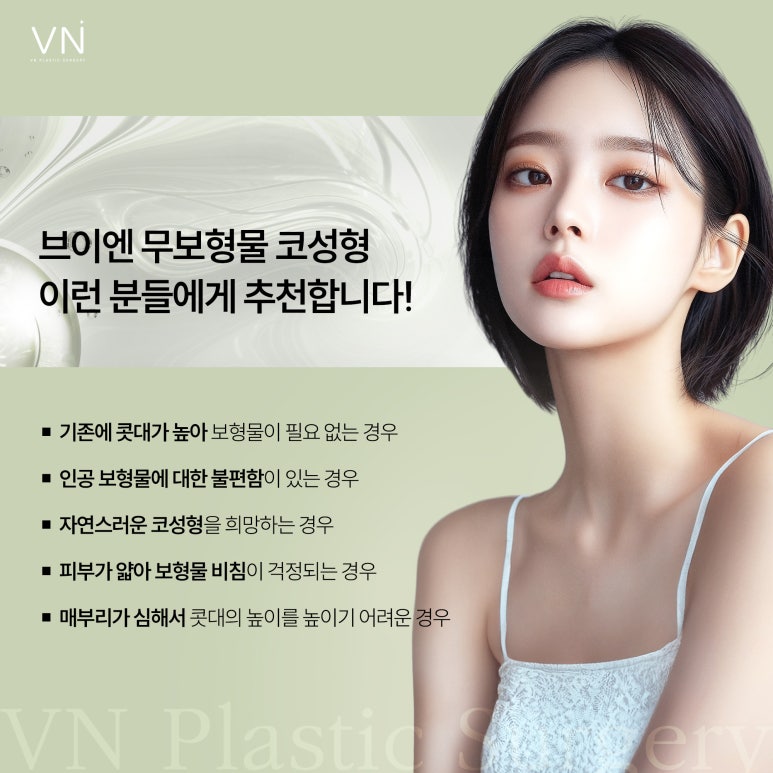
Then, who is VN Plastic Surgery’s implant-free rhinoplasty recommended for?
-
When the existing nasal bridge is already high and an implant is not needed
-
When there is discomfort with artificial implants
-
When natural-looking rhinoplasty is desired
-
When the skin is thin and implant visibility is a concern
-
When the hump is severe and it is difficult to increase the height of the nasal bridge
VN Plastic Surgery’s implant-free rhinoplasty is recommended for the above cases.
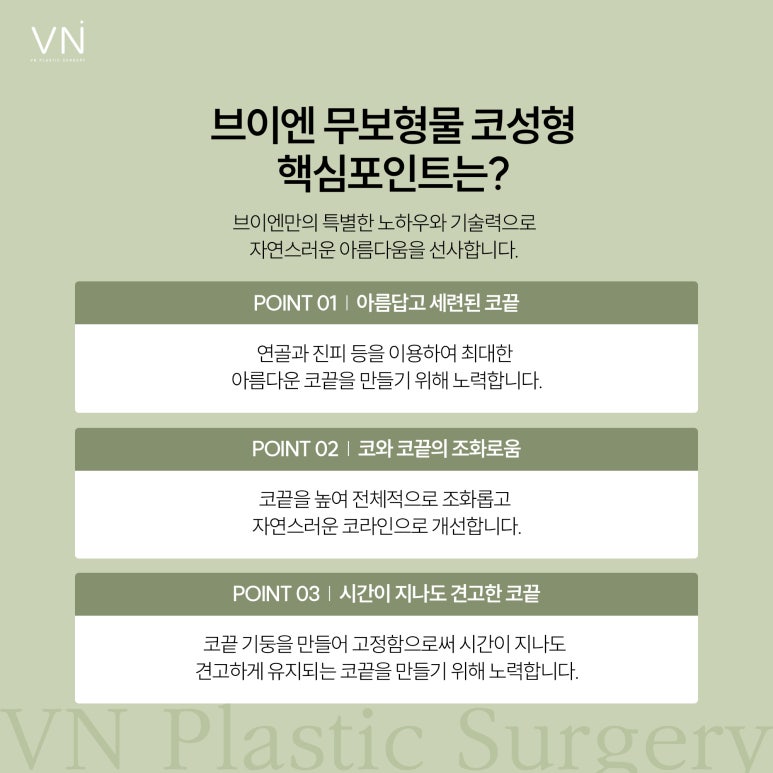
In the case of implant-free rhinoplasty at VN Plastic Surgery, we strive to create the most beautiful and refined nasal tip possible using cartilage, dermis, and other materials, and to improve the overall nose line into a harmonious and natural shape by raising the nasal tip. In addition, by creating and fixing a columellar strut, we work to create a nasal tip that remains firm over time.
Before proceeding with implant-free rhinoplasty, the external shape of the nose, the inside of the nose, and the condition of the autologous tissue must be thoroughly diagnosed. Based on the diagnosis, appropriate autologous tissue should be selected for each surgical area, and then implant-free rhinoplasty should be performed to reduce the risk of complications.
Because this is a highly complex procedure that requires harvesting and applying the appropriate autologous tissue according to the patient’s nose type and condition, it is important to receive surgery from a rhinoplasty specialist with extensive clinical experience and know-how to achieve safe and satisfying results.
At VN Plastic Surgery, we continue to conduct research and make efforts to provide more satisfying results, and a plastic surgery specialist who graduated from Seoul National University, equipped with both know-how and skill, demonstrates this through highly satisfying outcomes. If you are considering implant-free rhinoplasty, we encourage you to visit for a one-on-one consultation with a specialist and, through VN Plastic Surgery, obtain a more satisfying surgical result.