My eyes look heavy...
I like my double eyelid line, but what is the problem...?
If you have a double eyelid line but still feel like your eyes look tightly closed and lack a bright, open look,
you may want to consider canthoplasty.
Canthoplasty is not limited to just one area;
it can be divided into inner canthoplasty, upper canthoplasty, outer canthoplasty, and lower canthoplasty depending on the area.
Today, let’s take a look at the characteristics of each canthoplasty area, the surgical methods, and the effects of canthoplasty!
Are you concerned about “small, tightly closed eyes”? Pay attention!
I understand that many people are looking into canthoplasty because their eyes seem blocked at the inner and outer corners, creating a heavy impression.
In general, eyes that give the feeling of being blocked at the inner and outer corners are commonly called "kkotmalk eyes," but
"kkotmalk eyes" actually refer to eyes where the outer corners sit slightly higher than the inner corners.
People with this eye shape often show a strong interest in canthoplasty.
To address these concerns together,
VN performs the procedure after accurately analyzing facial shape, the proportions of the eyes, and the eye shape through a precise eye plastic surgery analysis system,
then proceeding with a canthoplasty method tailored to each individual.

Inner canthoplasty? Upper canthoplasty?
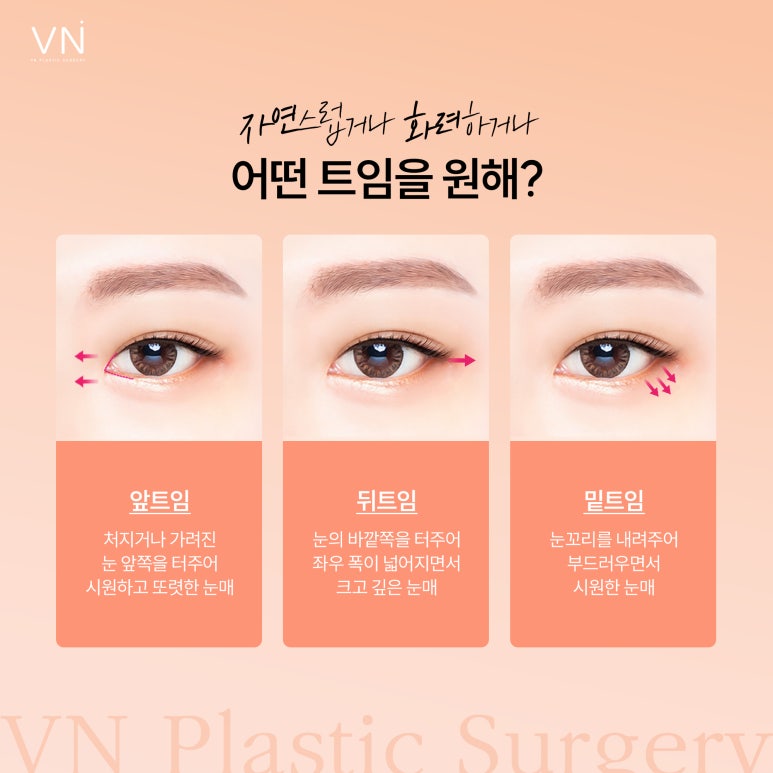
First, if the inner corners of the eyes look tight, you may want to consider inner canthoplasty or upper canthoplasty.
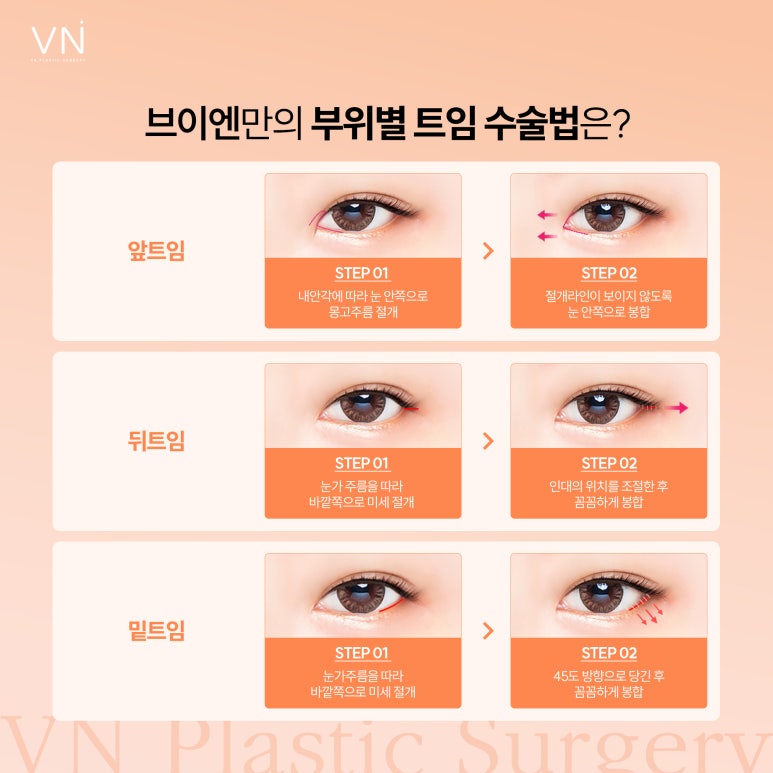
Inner canthoplasty is a procedure in which the incision follows the shape of the inner corner of the eye, the skin is dissected,
then the epicanthal fold is repositioned or removed, and the incision is sutured from the inside of the eye so that the scar line is not visible.
Upper canthoplasty is a procedure in which the epicanthal fold is incised inward toward the eye to open the front part of the eye by 45 degrees upward and improve the shape,
then the incision is sutured from the inside of the eye so that the scar line is not visible.
Outer canthoplasty? Lower canthoplasty?
There are also procedures such as outer canthoplasty and lower canthoplasty, which can improve eyes that appear short and outer corners that look heavy into a brighter, more open-looking eye shape.
Outer canthoplasty is a procedure in which an incision is made so as not to injure the ligament that determines the shape of the outer corner of the eye,
and the surgery is performed by adjusting the position of the ligament and carefully suturing it.
Lower canthoplasty is a procedure in which the eye line is lowered by shortening the fascia under the eye through an incision in the inner conjunctiva beneath the eye,
then pulling it at a 45-degree angle and suturing it.

What is dual canthoplasty?
VN’s dual canthoplasty, which performs outer canthoplasty and lower canthoplasty at the same time,
extends both the horizontal length and the vertical length to create a larger, brighter-looking eye shape.
Because it is a procedure that combines outer canthoplasty and lower canthoplasty,
it has the advantage of delivering the effects of both procedures at the same time.
At VN, we design the procedure to match the overall proportions of each person’s eye shape,
so visit us and check which canthoplasty method is right for your eyes!
VN canthoplasty key point!
VN accurately analyzes each customer’s eye shape
and provides customized canthoplasty accordingly.
After canthoplasty, delicate suturing helps reduce concerns about scarring,
and we do our best to improve the eyes into a softer, gentler impression.
In the case of canthoplasty, each person has different eye shapes and lengths,
so a proper understanding of your own eyes is required first,
and it is important to perform the canthoplasty that suits your eye shape.
If you are worried about heavy-looking eyes but do not know what the problem is,
don’t keep worrying alone anymore.
Why not find a solution through a consultation for VN canthoplasty?