Due to dissatisfaction with the shape, functional issues, and other reasons,
more and more people are looking into revision rhinoplasty.
Because all of them are planning a second surgery due to dissatisfaction with the results of the first surgery,
they tend to check the surgical method and the materials used in the nose more carefully than before.
So today, let’s take a look at what materials are used in revision rhinoplasty,
and discuss which material may be appropriate for surgery!

VN Mini Autologous Rib Revision Rhinoplasty?
When it comes to revision rhinoplasty, this is a material that cannot be left out.
Autologous rib cartilage is autologous tissue obtained from our own body, and when processed and used,
it serves as a strong support structure,
which is why it is widely used in revision surgery.
Even in cases of severe inflammation, contracture, or collapse of the nasal tip,
if surgery is performed using durable autologous rib cartilage,
a satisfactory shape can be expected for a long time
with only a small sense of foreign body sensation.
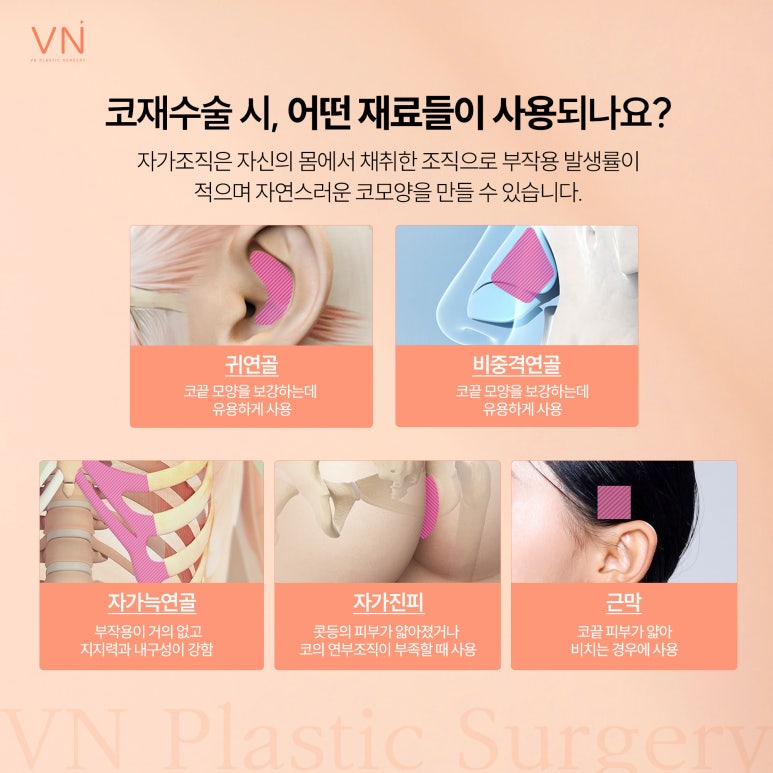
Materials Used in Revision Rhinoplasty
In addition to autologous rib cartilage, there are several other materials used in revision rhinoplasty.
Ear cartilage, septal cartilage, autologous rib cartilage, autologous dermis, and fascia
are representative autologous tissues that can be harvested from our body.
When surgery is performed using autologous tissue,
the risk of side effects is low and a natural nose shape can be created,
which is why it is also preferred by many patients planning revision surgery.
So how is mini autologous rib revision surgery performed?
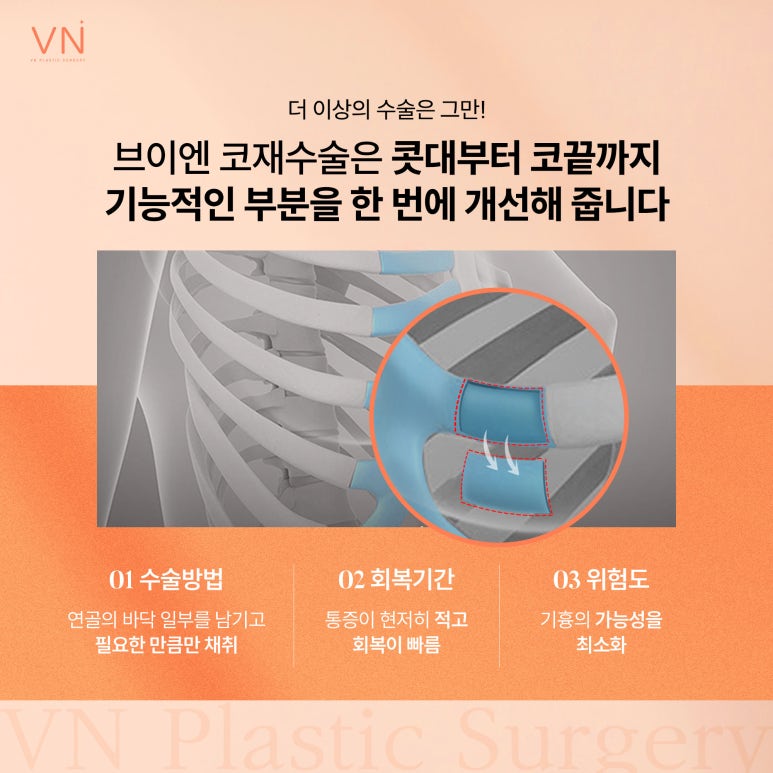
From the Bridge to the Tip Without Problems
VN Mini Autologous Rib Revision Rhinoplasty
is performed by harvesting only as much cartilage as needed while leaving part of the base of the cartilage intact,
unlike the conventional method, which cuts out the entire cartilage.
Because of this, pain is significantly reduced,
faster recovery can be expected,
and it also shows a high level of satisfaction in terms of shape, such as the length, angle, and design of the nose.
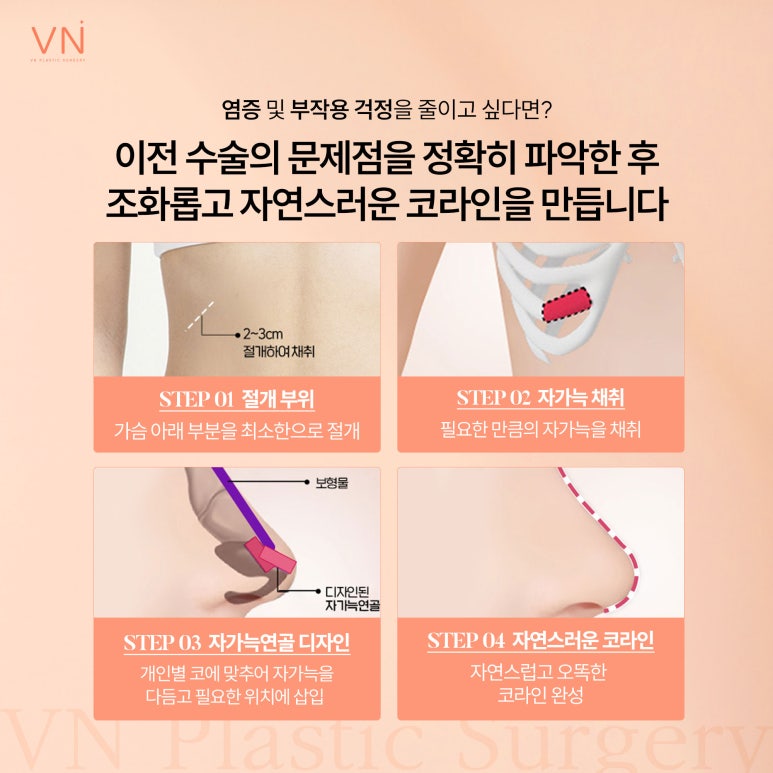
Accurately Identifying the Problem Is Key
It is also important to accurately identify the problems from the previous surgery
and create an appropriate surgical plan using the right materials.
Mini autologous rib revision rhinoplasty involves making a minimal incision in the lower part of the chest,
harvesting the needed amount of autologous rib cartilage,
shaping the autologous rib cartilage to fit each individual nose,
and inserting it into the necessary areas to complete a natural and refined nasal line.

With VN’s Own Technical Skill and Know-How!
In this way, VN uses know-how and skill suited to various cases
to complete a natural nasal line that harmonizes with the entire face.
In the case of autologous rib cartilage,
it can be expected to have a lower absorption rate than other autologous tissues,
so it can be maintained for a long time without shape distortion,
and because it uses the patient’s own cartilage,
a side effects such as inflammation can be minimized.
Since delicate dissection is required when harvesting the material,
it is important to plan a surgical strategy through a one-on-one consultation with medical staff who have extensive clinical experience.
If you are unsure about which material to use for revision rhinoplasty,
or if you are considering revision rhinoplasty due to dissatisfaction with the shape,
and do not know how to look into it,
please visit VN and work together to resolve your concerns!