To improve appearance,
more and more people are choosing rhinoplasty.
As the number of people choosing rhinoplasty increases,
the number of people choosing revision rhinoplasty is also
increasing.
When undergoing revision rhinoplasty,
many people prefer surgery using autologous rib cartilage.
The reason is that
autologous rib cartilage has excellent support and durability,
and when it is used in rhinoplasty,
the risk of side effects is low.
However, even when surgery is performed using
autologous rib cartilage,
the shape of the nose can sometimes become distorted.
This is called warping.
From here on,
let’s look at what warping is
and how it can be prevented.

After surgery using autologous rib cartilage,
the bridge or tip of the nose may change shape,
as if it has become bent.
This is called warping.
Warping occurs when
autologous rib cartilage bends after being harvested,
soaked in normal saline,
and then taken out again.
This warping phenomenon
cannot necessarily be considered a side effect in every case,
but when performing rhinoplasty using autologous rib cartilage,
efforts to prevent warping from occurring are important.
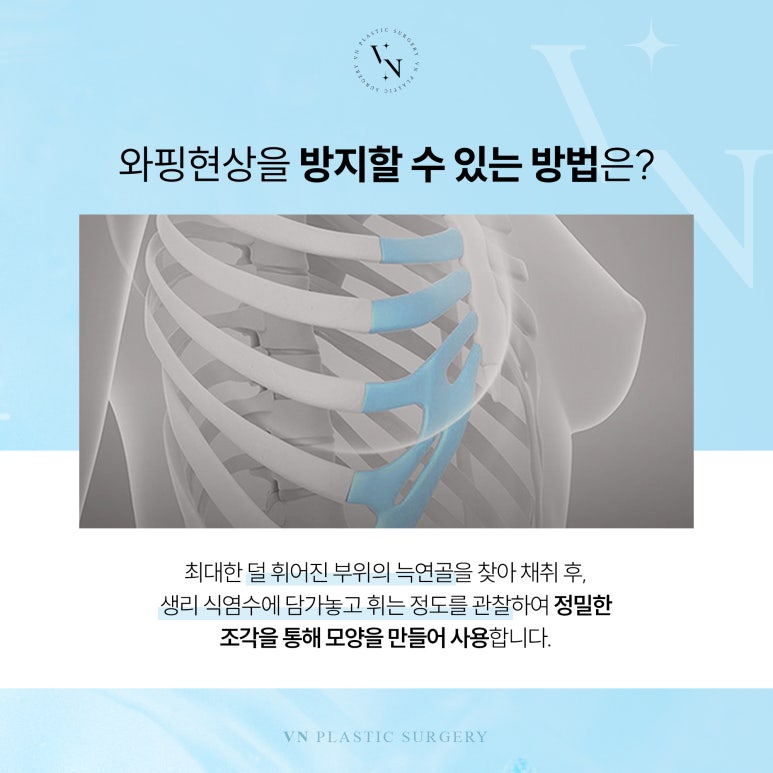
Methods to prevent warping include:
First,
locating and harvesting autologous rib cartilage
from an area that is as unbent as possible,
and
Second,
after soaking it sufficiently in normal saline,
checking the degree of bending,
and then designing and using it through precise carving.
The most important thing is
a clear understanding of autologous rib cartilage as a material
and of surgical methods using autologous rib cartilage.
During revision rhinoplasty using autologous rib cartilage,
if a problem occurs while harvesting the cartilage,
complications such as pneumothorax may occur.
Only by understanding the material and the surgical method
can other complications, side effects,
and warping be prevented,
and a satisfying surgical result be achieved.
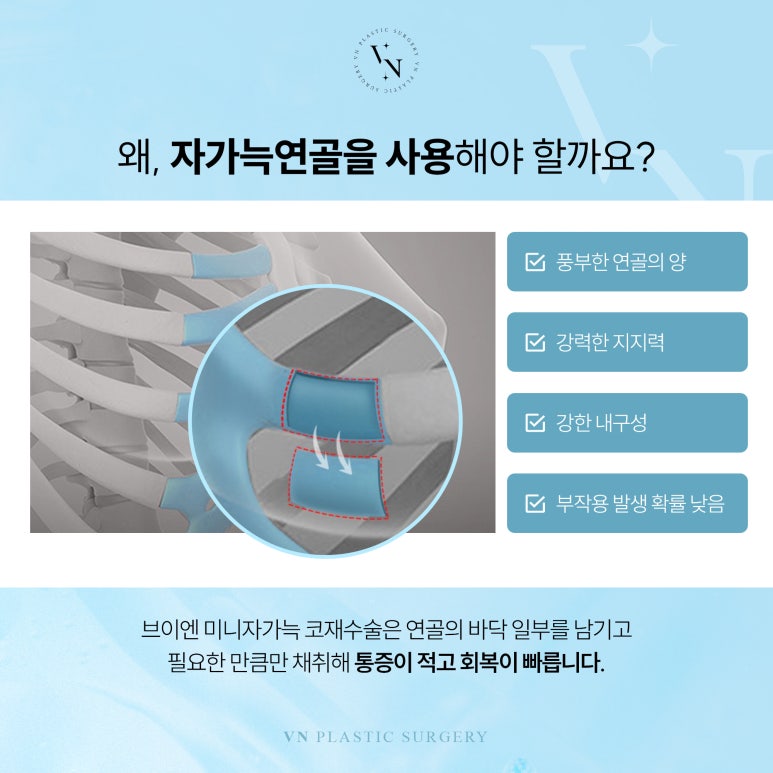
Why is autologous rib cartilage preferred when undergoing revision rhinoplasty?
Autologous rib cartilage has
more abundant cartilage than other autologous tissues,
strong support,
and excellent durability,
so when revision rhinoplasty is performed,
the likelihood of side effects recurring is low.
VN Mini Autologous Rib Revision Rhinoplasty
removes only as much cartilage as needed,
while leaving part of the base of the cartilage in place,
which means less pain
and faster recovery.

Also, when undergoing revision rhinoplasty,
compared with the first rhinoplasty,
many different factors must be considered along with the overall design of the nose,
so the procedure must be performed with delicacy and precision.
VN Mini Autologous Rib Revision Rhinoplasty
finds proportions that suit your face
from the bridge of the nose to the tip.
Through this,
you can achieve a more three-dimensional
and refined look.
If you are considering revision rhinoplasty,
or if you want to undergo revision surgery using autologous rib cartilage,
please visit
VN Plastic Surgery.
We will carefully diagnose the condition of your nose
and establish an accurate revision rhinoplasty plan
so that you can achieve a more natural and beautiful nose line.