The nose plays a role in balancing the entire face,
so it has a strong influence on one’s impression and overall mood.
For this reason, more people have recently been considering nose surgery,
and as the number of people choosing nose surgery increases,
more people are also undergoing revision rhinoplasty due to dissatisfaction with the shape of the nose or side effects such as contracture or inflammatory reactions.
The problem is that revision rhinoplasty is much more difficult than primary rhinoplasty.
There are various reasons why revision rhinoplasty is more difficult than primary rhinoplasty.
First,
there is tissue damage and deformity caused by surgery.
When performing surgery again on tissue that has been damaged and deformed compared with before the operation,
careful attention is required.
Second,
there is the implant inserted into the nose.
If a silicone implant was used in the first rhinoplasty,
the implant must be carefully removed so as not to damage the skin tissue, and the capsule around the implant must also be neatly removed.
Third,
there is the cause of the failure of the first rhinoplasty.
Because the surgical method used for revision varies depending on the reason the first surgery failed,
it is important to accurately identify the cause of the initial surgery’s failure.
Then what are the causes of rhinoplasty failure?
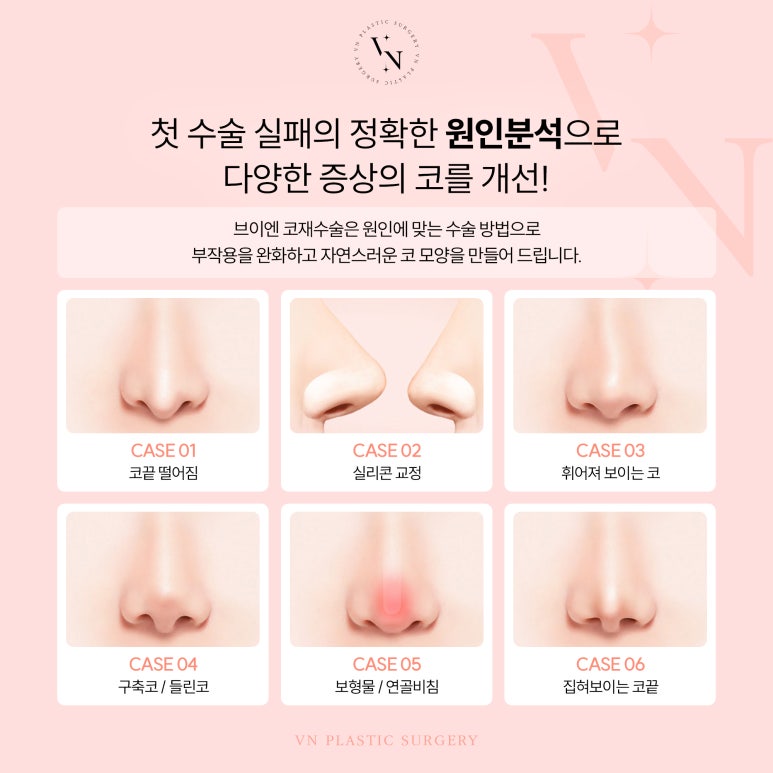
The causes of failure in the first rhinoplasty include
inflammation
implant rejection
unstable implant position
contracture
and similar reasons.
For a successful revision rhinoplasty,
these causes must be accurately identified and analyzed before proceeding with surgery.
At
VN Plastic Surgery Clinic,
we improve noses with various symptoms based on an accurate analysis of the cause of the initial surgery’s failure.

VN revision rhinoplasty
identifies the type of implant used in the previous surgery
and plans the operation by determining the appropriate surgical method
and timing of surgery.
In addition,
we perform surgery with expertise in revision rhinoplasty
and extensive know-how,
so we can create safer and more natural results.
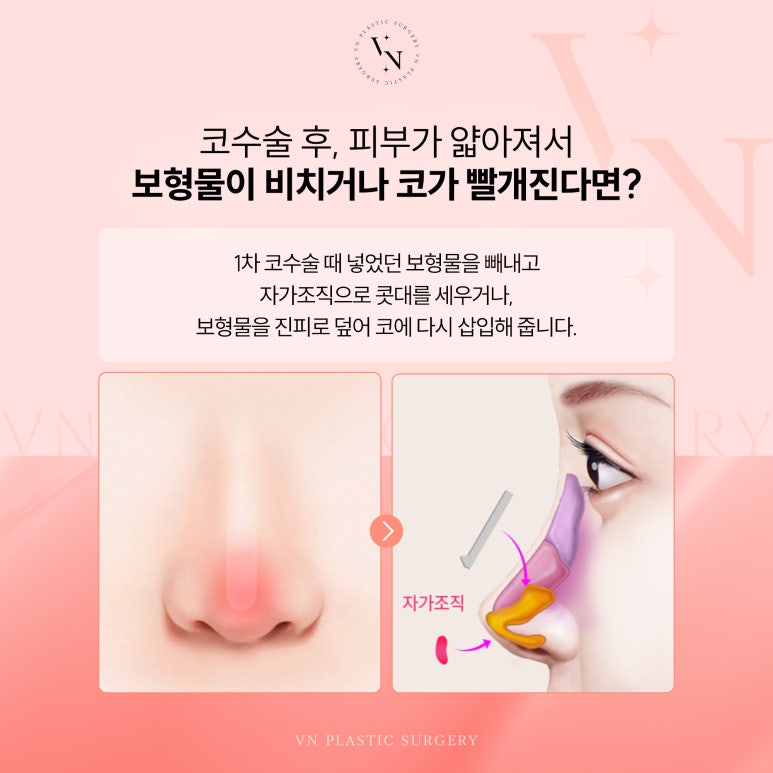
A typical example of revision rhinoplasty is when the implant becomes visible or the tip of the nose turns red.
In such cases,
the implant inserted during the first rhinoplasty is removed,
and revision rhinoplasty is performed by either building up the nasal bridge with autologous tissue
or covering the implant with dermis and reinserting it into the nose.
Also, revision rhinoplasty has a suitable timing for surgery.

If revision rhinoplasty is performed before 6 months have passed since the first rhinoplasty,
the condition of the nose may actually worsen,
so it is better to undergo revision rhinoplasty 6 months to 1 year after the first surgery.
Also,
because the time needed for recovery differs from person to person,
the exact timing is best decided after visiting the clinic and consulting with a specialist.
In addition,
when performing revision rhinoplasty,
many people want to use autologous rib cartilage, which has excellent durability and retention.

At
VN Plastic Surgery Clinic,
a customized revision rhinoplasty can create a more natural nose line,
and because it has strong support,
any nose line is possible.
In addition,
with a low absorption rate,
it can remain sturdy over time.
VN Mini Autologous Rib Cartilage Revision Rhinoplasty improves both aesthetic and functional issues according to each person’s nose shape and structure,
creating more satisfying results.
If you are considering revision rhinoplasty,
please visit VN Plastic Surgery Clinic.