Hello,
this is VN Plastic Surgery.
There are patients who visit the clinic saying that after rhinoplasty,
their nasal tip seems to have drooped,
and they are considering revision surgery.
The nasal tip is an area that must
withstand the force of gravity and the pressure
of the skin, so drooping can occur.
Even if they were satisfied at first after rhinoplasty,
as time passes,
the nasal tip may start to droop,
and in severe cases, the number of people
undergoing revision surgery is also increasing.
Nasal tip drooping refers to a phenomenon in which,
as the name suggests, the tip of the nose sags downward,
making the overall shape of the nose look unnatural.
Today, we will explain the causes of nasal tip drooping
and revision rhinoplasty using autologous rib cartilage,
which can help resolve it.

There are various reasons why the nasal tip may droop after rhinoplasty,
but the representative cause is that the support at the nasal tip is insufficient,
so over time it cannot withstand the skin’s tension
and the nasal tip sags again.
If the nasal tip is slightly lifted upward due to swelling right after surgery,
as time passes and the swelling subsides,
it will naturally come down within 1 to 2 months.
In such cases, it is part of the normal recovery process,
so if the intended angle or nasal tip shape is achieved,
you do not need to worry too much.
However, there are cases where the nasal tip seems to drop further
even after the swelling has gone down.
It can occur within a year,
or it can happen slowly over several years,
so it may be difficult to notice right away.
If the support loosens before it settles in place
while healing with the surrounding tissue,
or if the support bends even after it has healed well,
causing the height to decrease,
or if the support weakens as it is absorbed,
the nasal tip will droop.

If you want to resolve nasal tip drooping,
When the nasal tip support is firm,
cartilage and dermal tissue can be additionally grafted to the nasal tip
to supplement the tip height.
If the nasal tip support is weak or has collapsed,
the support must first be rebuilt firmly using septal cartilage or rib cartilage,
and then ear cartilage, dermal tissue, and other materials
should be additionally grafted to create the nasal tip height.
VN Plastic Surgery checks the cause of nasal tip drooping
and performs customized revision rhinoplasty suited to each patient.
Using autologous rib cartilage, which has a lower absorption rate
than other autologous tissues,
it is possible to maintain the desired line
for a long time.
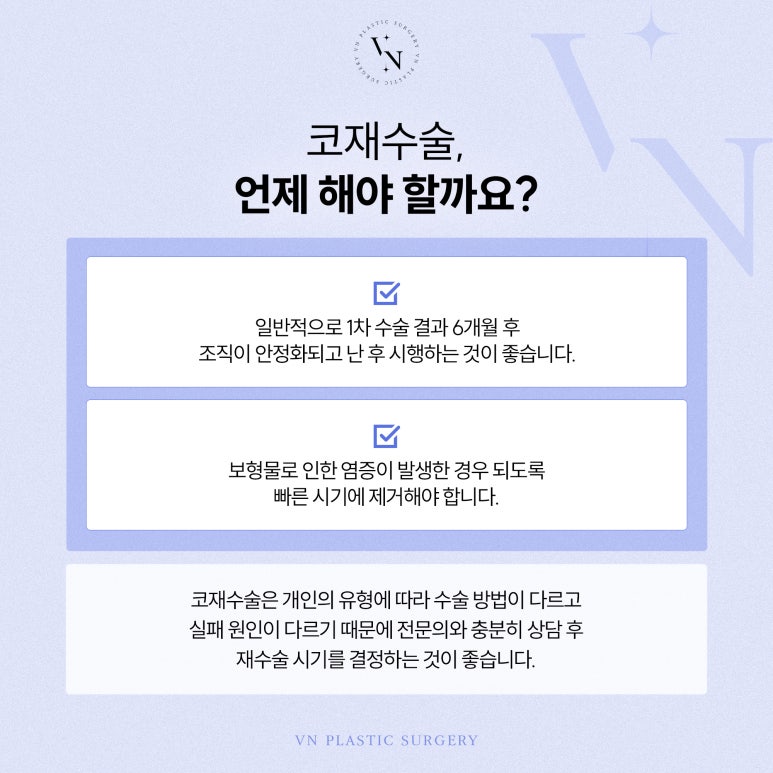
When should revision rhinoplasty be done?
It is understandable to want to proceed right away
due to the urgency caused by nasal tip drooping,
but in general, it is better to perform it after the tissue has stabilized,
about 6 months after the first surgery.
However, if inflammation caused by an implant occurs,
it should be removed as soon as possible.
Revision rhinoplasty differs in surgical method depending on the individual’s type,
and the cause of failure also differs,
so it is best to determine the timing of revision surgery
after sufficient consultation with a specialist.
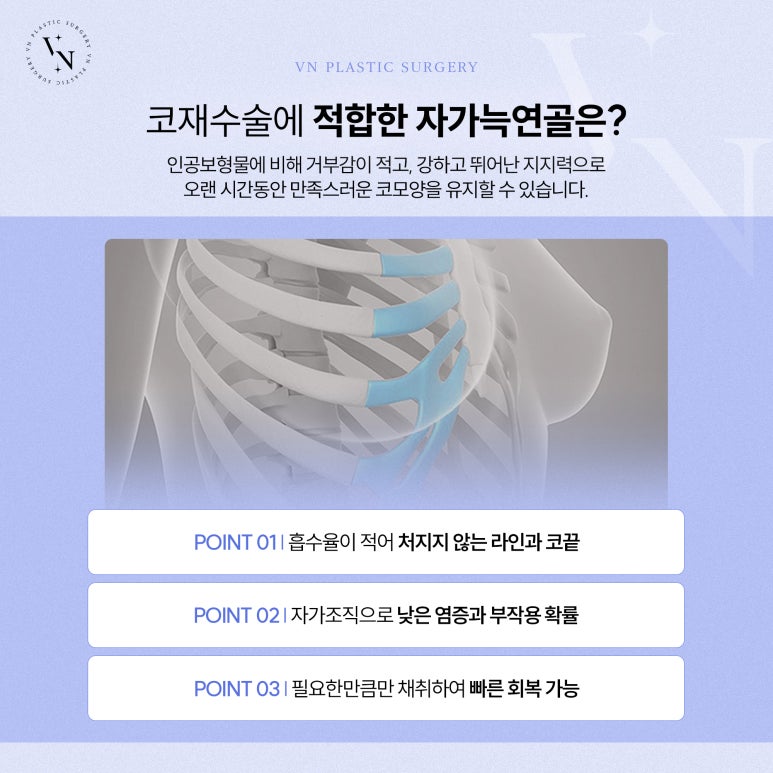
What is autologous rib cartilage
suitable for revision rhinoplasty?
In revision rhinoplasty,
autologous rib cartilage is often used.
Compared to artificial implants,
it causes less resistance in the body,
and with its strong and excellent support,
it can maintain a satisfactory nose shape
for a long time, which is why it is often used in revision surgery.
In addition, because it has a low absorption rate,
it helps maintain a line and nasal tip that do not droop,
and since it is autologous tissue,
the likelihood of side effects is low
and the possibility of inflammation is low.
At VN Plastic Surgery, only the amount needed is harvested,
so recovery is faster and pain is significantly reduced.

VN Plastic Surgery’s
VN Mini Autologous Rib Revision Rhinoplasty
addresses both shape and height at the same time,
finding proportions that suit the facial features from the bridge of the nose to the tip,
improving the face into a more three-dimensional and refined image,
while offering a strong and high level of support
that allows any line to be achieved and maintained for a long time.
With the Safe Plastic Surgery Principle,
we diagnose the exact condition of the nose and analyze the cause of failure,
and after personalized consultation,
we provide a solution.