Hello,
this is VN Plastic Surgery.
After primary rhinoplasty, some people decide to undergo revision rhinoplasty for various reasons.
However, after making that decision,
you may wonder when the best time for revision rhinoplasty would be.
Today, we will explain this part!

The cases in which revision rhinoplasty may be needed
can be explained in six main categories.
First, when an implant is visible or the tip of the nose looks red
Second, when the bridge or tip of the nose appears crooked
Third, when the implant is tilted or moving
Fourth, when the bridge height is unsatisfactory
Fifth, when the shape of the nose has changed due to inflammation or contracture
Sixth, when the overall nose shape is unsatisfactory
If any of these six cases apply,
it is a good idea to consider revision rhinoplasty.

So, if you are considering the right timing after deciding on revision rhinoplasty,
usually after 6 months to 1 year
is considered the most suitable.
The reason is that during this period, the damaged tissue
has become stable and skin elasticity has recovered,
and early revision surgery
carries greater risk.

Revision rhinoplasty is not simply the process of
having surgery again; it must be planned by considering
all factors, including the soft tissue damaged by the first surgery,
scar tissue, and even whether cartilage is present.

For revision rhinoplasty, which involves so many considerations,
VN carries out the procedure through one-on-one personalized consultations.
Through analysis of the cause of the problem,
we identify the results of the first surgery and the reasons for dissatisfaction,
check the current cartilage condition and skin state,
and examine the internal structure of the nose.
We then plan a revision design tailored to the individual's facial shape
and skin characteristics.

Even after revision rhinoplasty is performed,
VN does not neglect aftercare.
With a safety system and aftercare in place,
we help support a speedy recovery.
The aftercare consists of four programs.
We provide post-procedure care through swelling laser and radiofrequency care,
a customized regeneration program,
and a scar treatment solution.
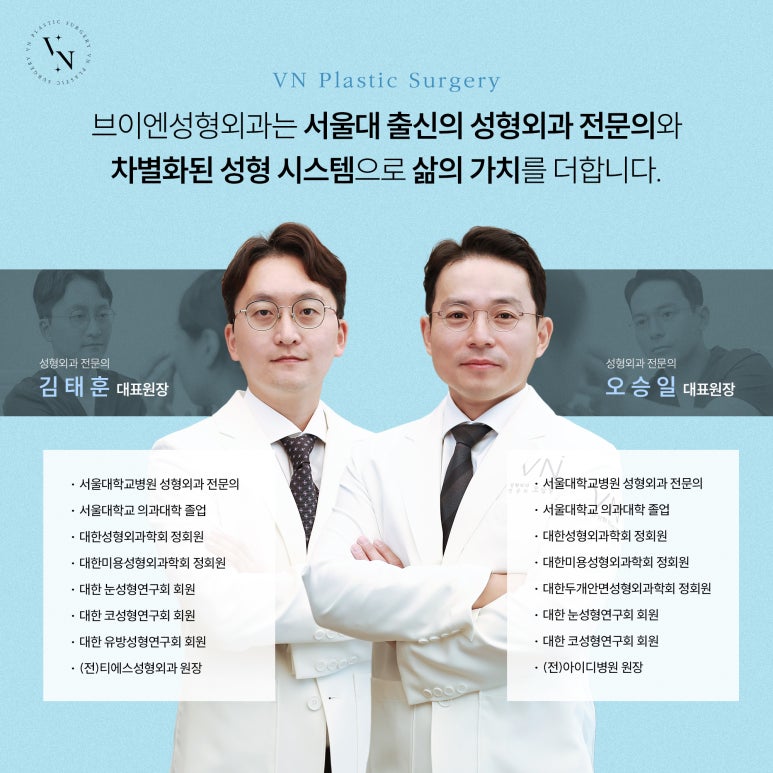
The more careful revision rhinoplasty needs to be,
why not consider VN, where accurate judgment and thorough aftercare are possible?