Hello,
this is VN Plastic Surgery.
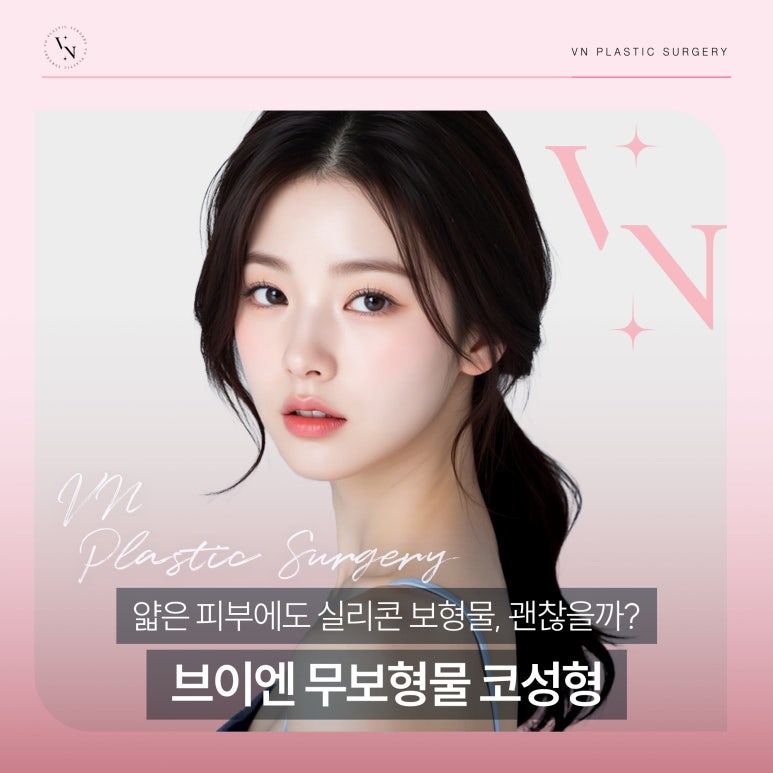
Some people may feel that their skin is thin.
In such cases, it is natural to worry about whether silicone implants can still be used for nose surgery.
For those concerns, a type of rhinoplasty that can be considered is VN’s no-implant rhinoplasty,
and we will explain that in this post.
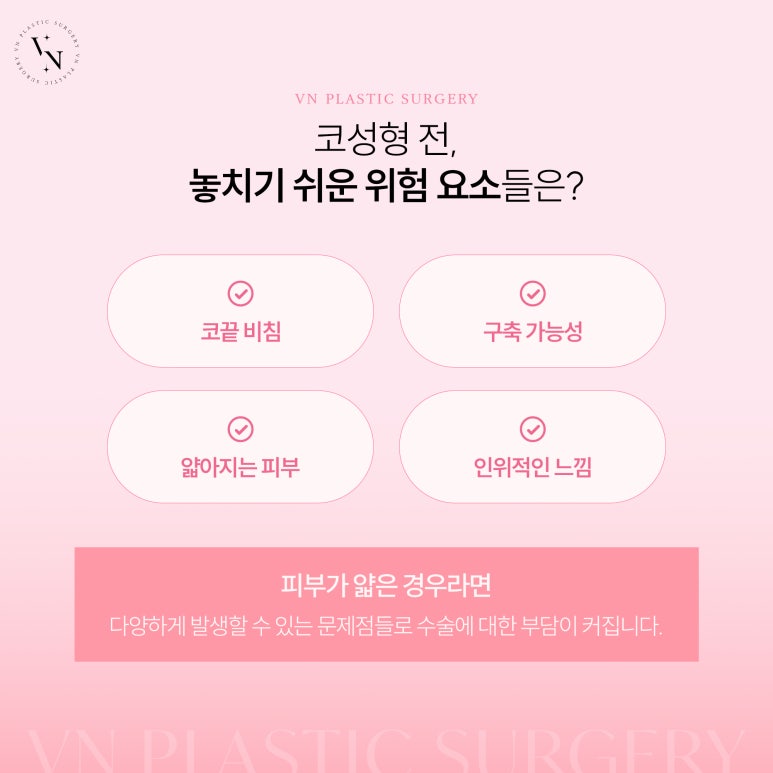
First, before undergoing rhinoplasty,
some easily overlooked risk factors include
showing of the nasal tip, the possibility of contracture, thinning skin,
and an artificial-looking result.
Among these, when the skin is thin,
various potential issues can increase the burden of surgery.
That is why VN’s no-implant rhinoplasty is available
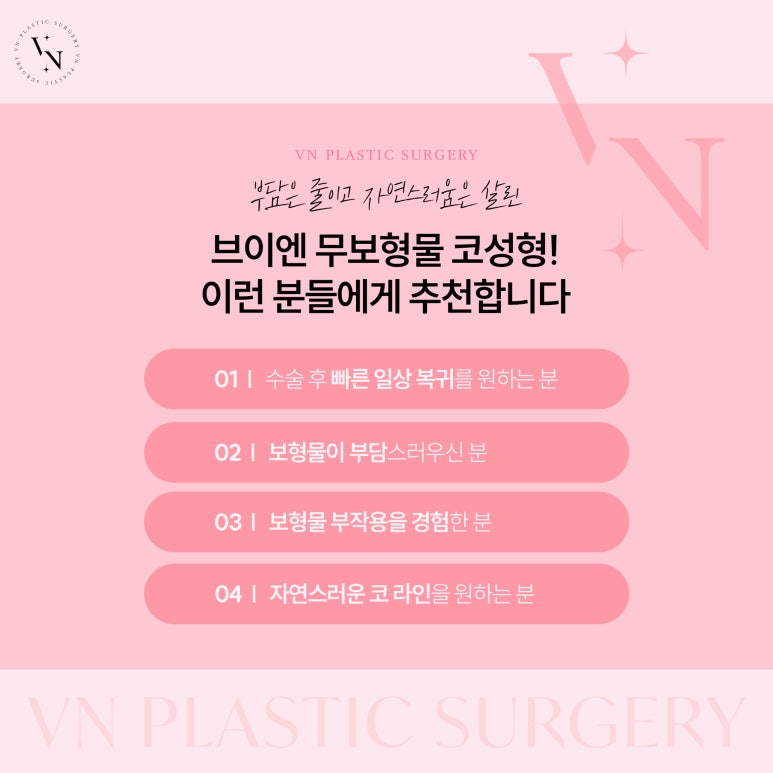
as an option that reduces 부담 while enhancing naturalness,
and it is recommended for the following people.
First, those who want a quick return to daily life after surgery
Second, those who find implants burdensome
Third, those who have experienced implant-related side effects
Finally, those who want a natural-looking nasal line
may consider this option.
Then, when performing no-implant rhinoplasty,
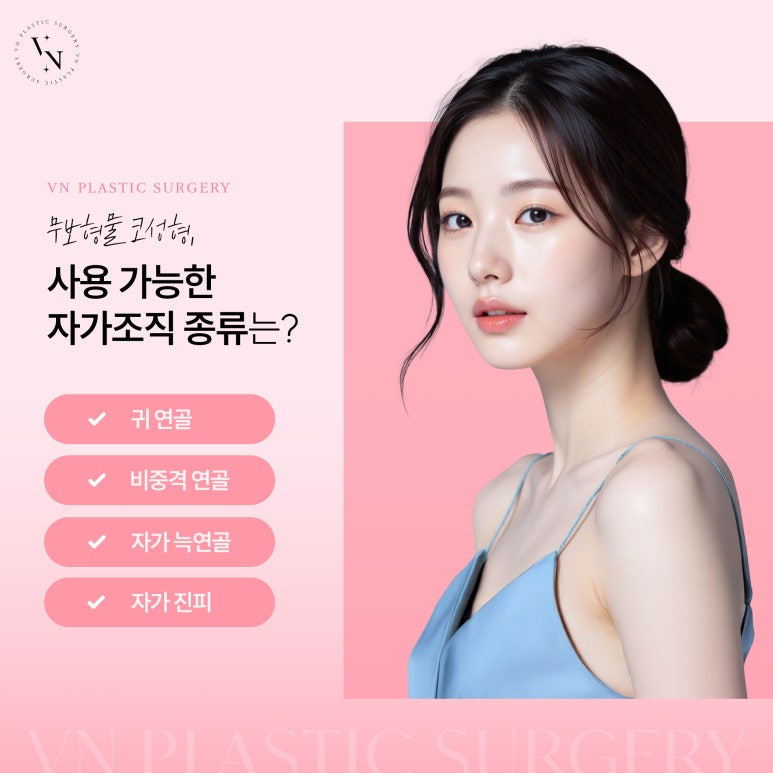
the types of autologous tissue that can be used are as follows.
☑️ Ear cartilage
☑️ Septal cartilage
☑️ Autologous costal cartilage
☑️ Autologous dermis
In total, these four types of autologous tissue can be used
for no-implant rhinoplasty.

VN’s no-implant rhinoplasty takes into account each person’s skin condition
and facial proportions to create satisfying results,
and if the skin is thin,
careful selection is important.
VN uses crushed cartilage grafting
and no-implant rhinoplasty using ear cartilage and septal cartilage.
In the case of crushed cartilage grafting,
autologous cartilage is ground into particles and grafted into the nose.
In the case of using ear cartilage and septal cartilage,
cartilage is used to correct the nasal bridge,
the columella, and the nasal tip.
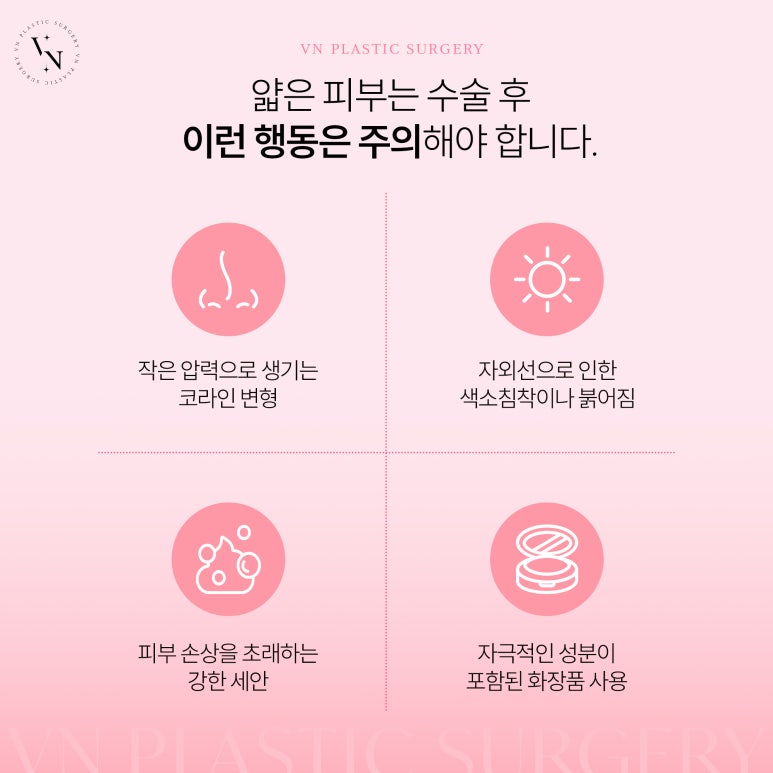
Also, if you have thin skin, it is a good idea to be careful about these behaviors after surgery as well.
Be cautious of changes in the nasal line caused by even small pressure,
as well as pigmentation or redness caused by ultraviolet rays, and
avoid vigorous cleansing that can damage the skin and
using cosmetics that contain irritating ingredients.
If you go through all of these steps with VN,
you may be able to undergo a personalized no-implant rhinoplasty,
so we hope you make the best choice for yourself.