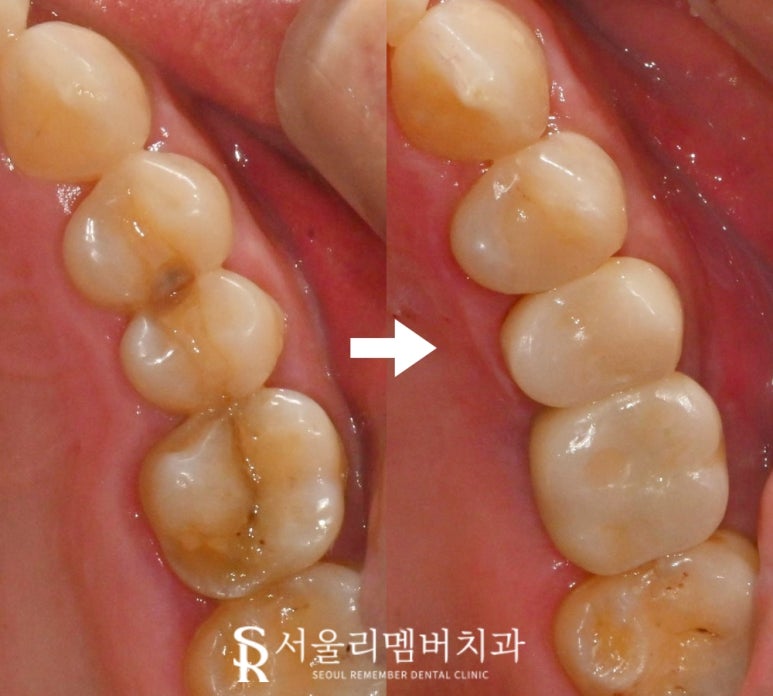
I am Director Park Jeong-gi of Remember Dental Clinic at Seoul National University Entrance.
Although they may look strong, teeth can actually be damaged much more easily than we think.
While chewing hard foods,
or due to habits such as teeth grinding
or clenching,
sometimes, without even knowing why,
suddenly a tooth may crack or part of it may break.
That is why we always explain at the clinic
that you should be careful with hard foods
and what you eat.
Because natural teeth are among the strongest hard tissues in the body,
at first it is often only part of the crown that breaks off.
But one day, while chewing, you may hear a sharp "crack"
and feel a hard fragment in your mouth.
At this point, how much of the tooth has fractured is important.
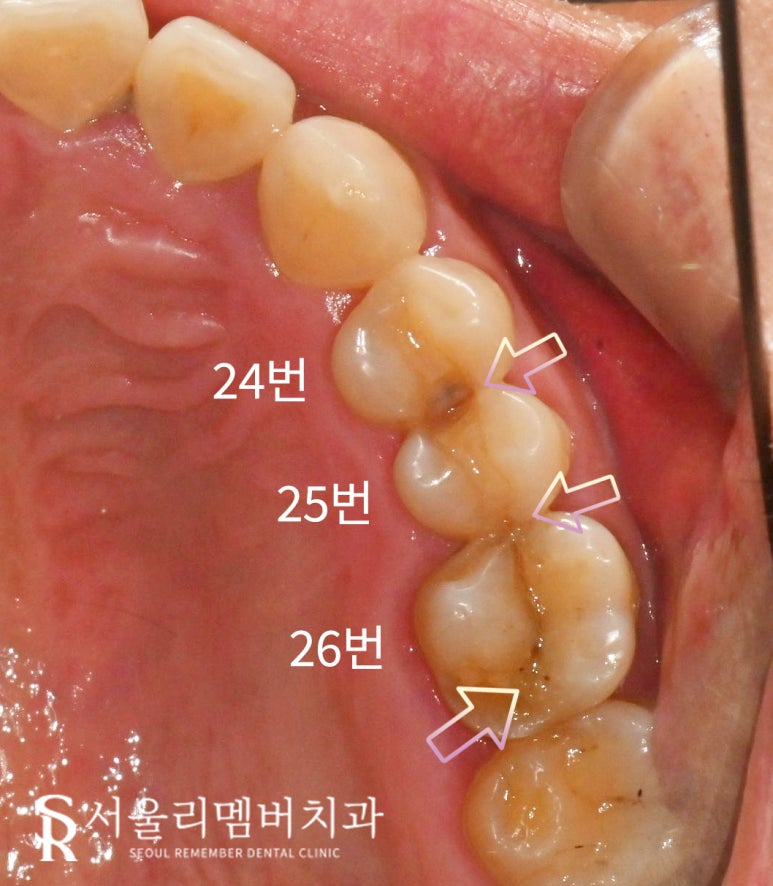
In today's Seoul National University Entrance dental clinic case,
there is some fracture extending from the first premolar (tooth #24)
to the first molar (tooth #26).
Fortunately, the nerve was not damaged,
but I imagine it must have been very upsetting.
What we need to look at carefully here,
however, is not simply the crown fracture on tooth #24,
but the fact that a crack was also found in the adjacent tooth #25.
Although it may look fine on the surface,
a hidden crack was found upon detailed examination.
If left untreated,
it could lead to a bigger problem,
so root canal treatment was performed and a crown placed over it
to protect it from the crack widening further.
After root canal treatment,
to reinforce the weakened tooth,
a resin core is placed before fitting the crown.
The treatment process takes at least 3 to 5 visits,
and at Seoul National University Entrance Dental Clinic,
when a crack is found,
we tend to try root canal treatment quite often,
out of a desire to preserve the natural tooth.
In this case as well, although a crack was present,
it has been protected with a crown,
so the patient should be able to use their own tooth for a little longer.
But there was another bigger problem.
At first, there was only occasional discomfort,
but over time, there was a tooth that hurt every time the patient chewed.
The first molar (tooth #26),
which performs the most chewing function,
became sensitive even to hot or cold stimuli,
and hard foods could no longer be chewed at all.
After conducting several examinations at Seoul National University Entrance Dental Clinic,
it was ultimately diagnosed that the crack had progressed deep inside the tooth,
making recovery impossible.
Because the crack had gone very deep,
there was persistent pain,
and considering the possibility of inflammation,
extraction was unavoidable.
Also, if the empty space after extraction were left as is,
adjacent teeth could shift
and problems with the bite could occur,
so we decided to proceed with an implant.
This is the best way to restore a lost natural tooth
without affecting the adjacent teeth.
Including the period needed for bone integration,
it took a few months,
but it was completed successfully.
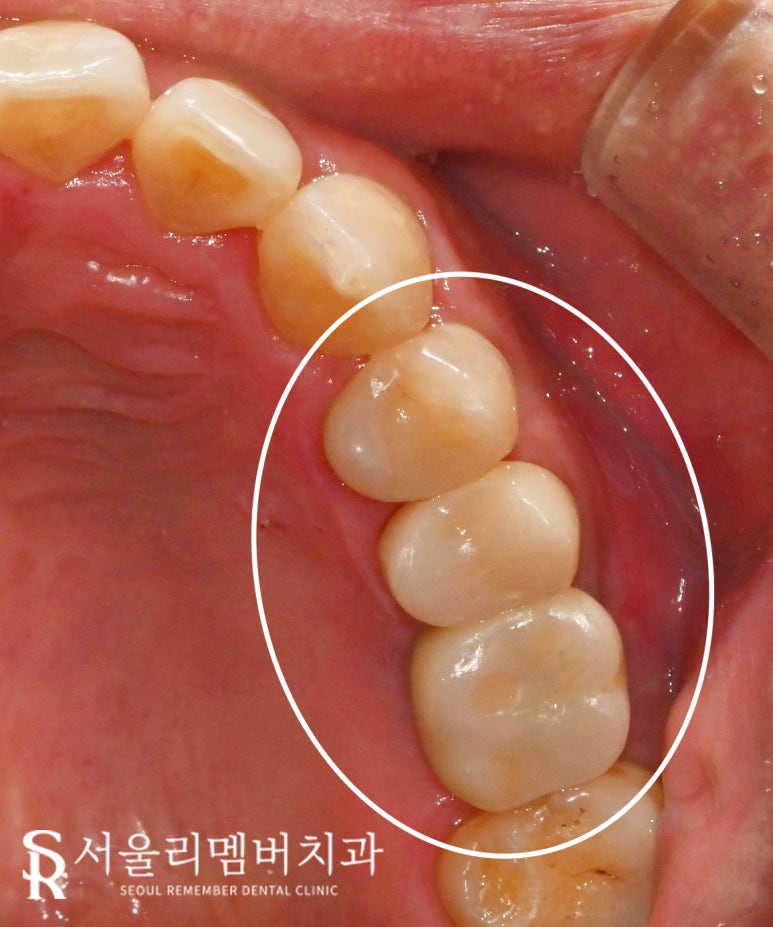
Today, at Seoul National University Entrance Dental Clinic,
we showed a case in which three molars developed problems one after another
because of fractures or cracks.
Once a fracture starts, it cannot be reversed,
and a small crack can gradually progress deeper,
eventually causing you to lose a valuable tooth.
That is why it is important to be careful with hard foods in daily life,
and if you have a habit of grinding or clenching your teeth,
you should have regular checkups
so that invisible cracks can be detected early.
Also, if treatment is needed,
it is best to restore and protect the tooth promptly.
A tooth does not recover on its own once it has been damaged.
So you should pay attention to your oral health,
and never ignore even minor discomfort or pain.
That is all for today.
Thank you for reading.
This was Director Park Jeong-gi of Remember Dental Clinic at Seoul National University Entrance.
Treatment period: 2025.02.22 ~ 2025.08.10