Hello,
I’m Dr. Park Jeong-gi, director of Remember, a dentist near Seoul National University Station.
The area we commonly call the front teeth is known in dentistry as the “anterior region.”
Central incisor = central incisor = #1
Lateral incisor, the second tooth from the midline = lateral incisor = #2
Canine = canine = #3
Together, these refer to a total of six teeth on the left and right, and they are also classified by dental notation.
Among them, the lateral incisors in particular are often subject to congenital absence, where they are not formed from birth, or shape abnormalities such as microdontia, in which the teeth are smaller than normal.
Today at the Seoul National University Station dentist, I’ll look at a related case and explain how it can be treated.
These are clinical photos used to help with understanding, and this post has been written in compliance with the Medical Service Act based on objective information.
- Initial visit
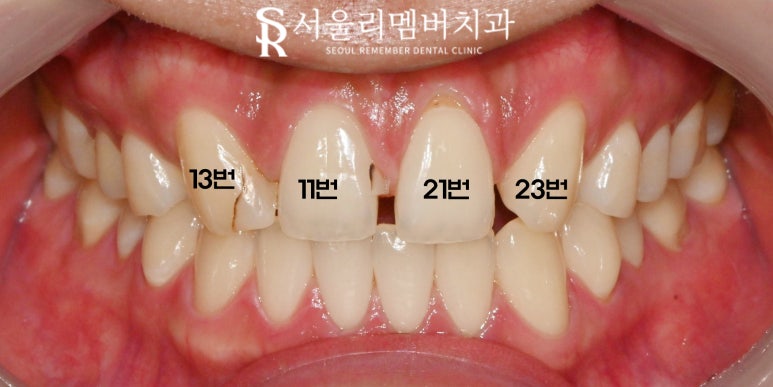
As you can see,
this case involves teeth #12 and #22 not being present congenitally.
Because the space where the lateral incisors should be is missing,
the gaps between the teeth have widened,
making the teeth look sparse.
Naturally, this lowers the aesthetics, so it may have been a source of stress every time the patient looked in the mirror, and it may also have functioned as a complex when meeting people or going about daily social life.
From the perspective of the Seoul National University Station dentist,
air and saliva may also have leaked through the spaces,
which could have affected pronunciation
and caused several additional inconveniences.
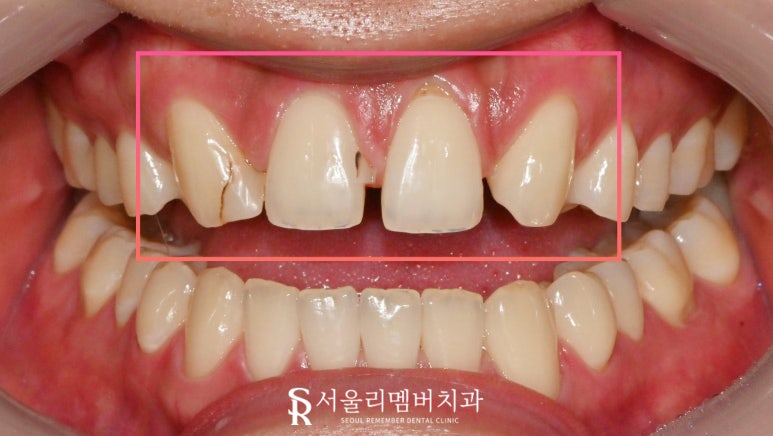
In addition,
some of the teeth had previously been restored with resin,
but now staining had developed at the boundary between the material and the natural tooth.
Because of that,
it could look as if decay had developed
or as if the tooth had chipped,
so this area also needed improvement.
- Diagnosis
At the Seoul National University Station dentist,
when problems arise in the anterior region, we consider several alternatives.
First, resin
Second, crown
Third, laminate veneer
This is decided by the attending doctor according to the patient’s oral condition,
and if there is no major difference no matter which method is chosen,
then the patient can decide based on several factors such as time, cost, and number of visits.
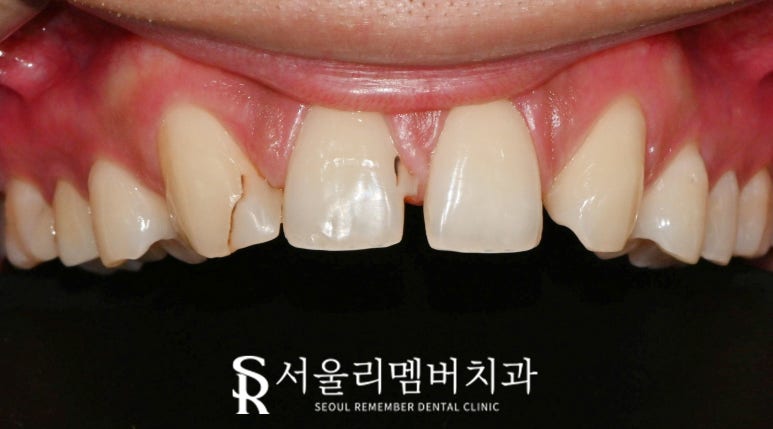
In this case,
because the interproximal space was too large, resin was ruled out due to the high possibility of the material coming off,
and crown treatment was put on hold because it felt like it would be a waste to shave the teeth down and cover them completely.
Taking both of those points into account,
the third option, laminate veneer, was recommended because it could provide a satisfying result.
A laminate veneer that fills the open spaces with prosthetic material while minimizing tooth reduction is a very suitable option for this case.
- Treatment process
At the Seoul National University Station dentist,
patients are given enough time to think about which treatment method to choose.
The anterior region is highly visible, and above all, patient satisfaction is extremely important in this area, so it should be decided carefully.
In this case,
a laminate veneer was chosen as a prosthetic that feels like a real tooth and can also restore the area where the lateral incisor was lost, as well as the old discolored resin.
At the Seoul National University Station dentist,
because it looks so natural, we also call it “Real Nate.”
- Prosthetic completion
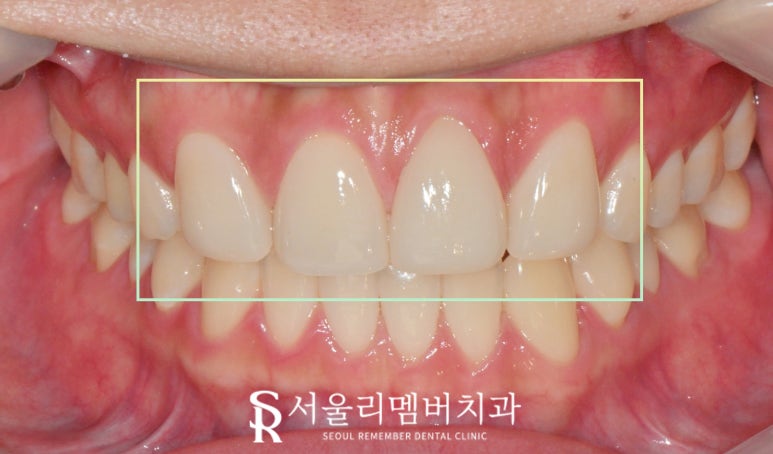
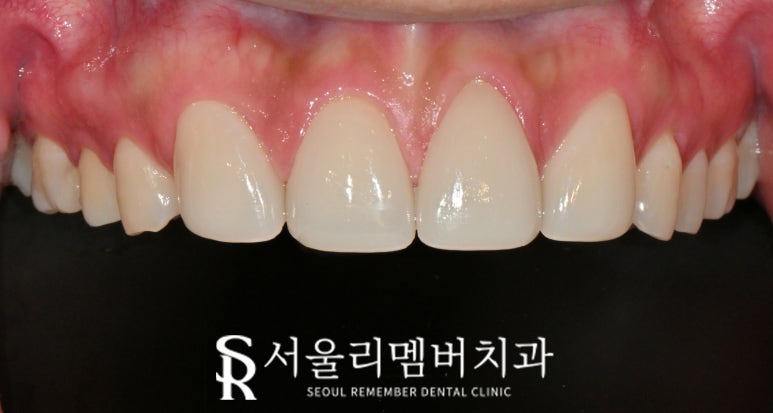
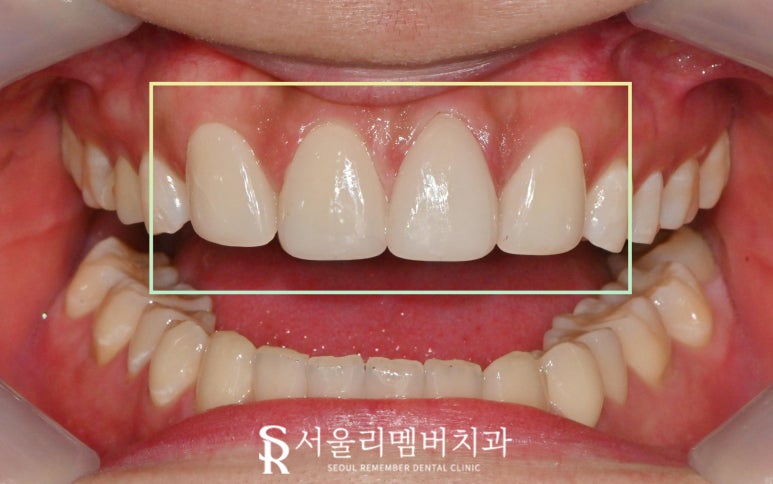
Looking at the state after all treatment was completed,
excluding the missing #12 and #22,
we restored a total of four anterior Real Nate units at #13 and #23,
and each prosthetic for the front teeth was made slightly larger
so that just four units could function as if they were six front teeth.
Especially in a case like this,
when there are missing teeth but not enough space for implants,
being able to replace them in this way would be a very big advantage because it can be resolved quickly, right?
The anterior Real Nate treatment explained today at the Seoul National University Station dentist is very useful for many people who value aesthetics,
so if there is anything you would like to improve in a visible area,
please consult a nearby medical institution.
Thank you for reading.
This was Dr. Park Jeong-gi of Remember, a dentist near Seoul National University Station.
Treatment period: 2026.01.05 ~ 2025.01.17