홍대점제거 시술 전
What Should You Know Before the Procedure?
�
�
�
�
'I thought mole removal would be simple..
It doesn't seem like it is..'
�
These days, mole removal procedures are very common, so many people think they are simple.
�
However, there are also many cases where people remove a mole based only on the price, and later end up with scarring or the pigmentation returning.
�
Even for a small mole, it is important before the procedure to know exactly "what kind of mole it is," "how deep it is," and "what method will be used to remove it."
�
Today, let’s talk about the points you should definitely know before having a mole removal procedure.
�
홍대점제거 시술 전
What Should You Know?
-
Not all moles are the same
-
What is the principle of CO₂ laser?
-
How should you care for it after the procedure?
�
홍대점제거
Not all moles are the same
�
Although they may all look similar from the outside, there are differences between moles.
�
Moles close to the skin surface are called epidermal nevi,
moles located deeper in the skin are called dermal nevi,
and those made up of both layers are called compound nevi.
�
Why does this difference matter? Because the deeper the mole is, the energy used, irradiation time, and number of treatment sessions all become completely different.
�
�
Moles in the epidermal layer can be removed at once with shallow energy, but for moles in the dermal layer, using a laser that is too strong can leave scars, while using one that is too weak may leave pigment behind or cause it to return.
�
Also, even if something looks like a mole, it may actually be another lesion such as milia, flat warts, age spots, or hemangiomas, so
before the procedure, it is essential to distinguish the type of lesion.
�
홍대점제거
What is the principle of CO₂ laser?
�
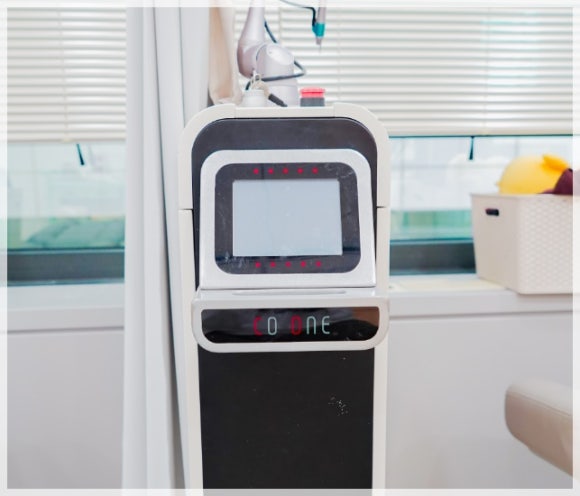
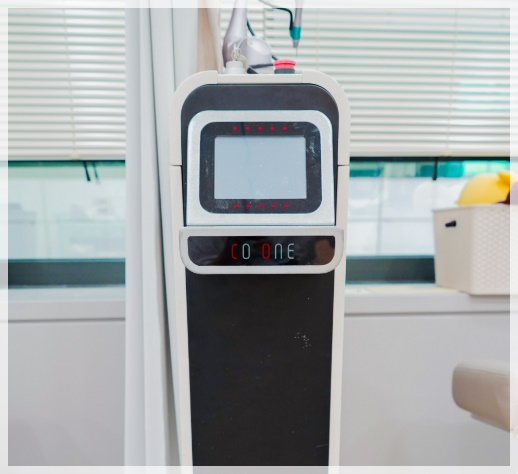
The device most commonly used for mole removal is the CO₂ (carbon dioxide) laser.
�
The CO₂ laser is not simply a light that "burns"; it precisely "vaporizes" tissue by using water molecules inside the skin.
�
�
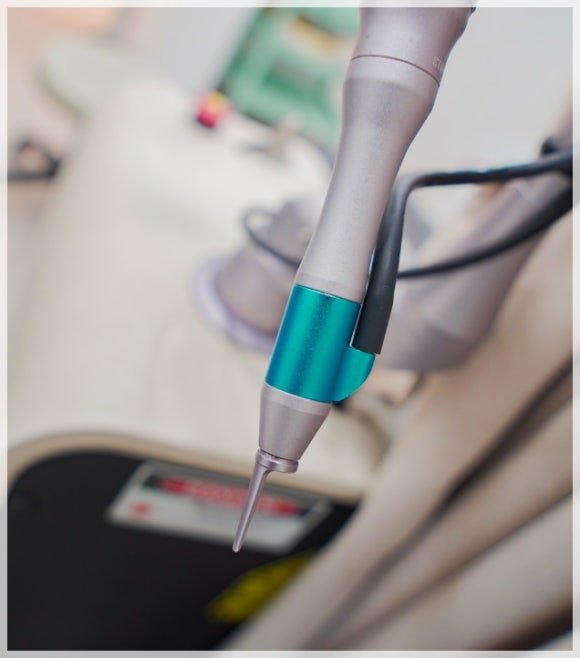
To explain in a little more detail, the CO₂ laser emits infrared light with a wavelength of 10,600 nm.
�
This light is strongly absorbed by water (H₂O) in skin cells. The absorbed energy instantly turns into heat, vaporizing the water.
�
As a result, only the mole tissue is selectively removed, while the surrounding normal cells are damaged as little as possible.
�
�
What matters here is how precisely the laser’s intensity, pulse duration, and spot size are adjusted.
�
If it is directed too deeply, the fibrous tissue in the dermal layer can be damaged, creating a depressed scar. If it is directed too superficially, pigment cells may remain and the lesion may recur.
�
So based on the mole’s color, diameter, and depth, the laser energy and number of pulses must be finely adjusted to determine how much energy is needed to vaporize only the pigment cells while leaving the surrounding tissue intact.
�
Also, if you try to remove a deep mole all at once with strong energy,
not only melanin cells but also collagen tissue can be damaged,
causing the skin to sink in.
�
For deep moles, it is better to remove them gradually over 2 to 3 sessions.
�
홍대점제거
How should you care for it after the procedure?
�
Care after mole removal is also important.
�
A thin scab forms on the area where the mole was removed, and this is not a "wound" but a protective layer as the skin regenerates.
�
If you forcibly remove the scab, the dermal layer becomes exposed again,
which can lead to hyperpigmentation or indented marks.
�
Usually, the scab falls off naturally within 5 to 7 days, and new skin grows underneath.
�
At that point, the skin may look slightly red, which is a normal part of the regeneration process, so not removing the scab is the simplest way to avoid leaving a scar.
�
�
Today, I wrote about the things people considering a mole removal procedure at the Hongdae branch should know beforehand.
�
Although mole removal may look like a simple procedure on the surface,
when the deeper layers of the skin are taken into account, it is a treatment that requires precise diagnosis and adjustment.
�
�
Therefore, it is better to carefully diagnose the moles within the skin, and if there are many moles or they are deep, remove them in stages rather than all at once.
�
Please remove moles while taking your skin’s condition into consideration so that it can recover without strain.
�
Thank you. This was UNNI Hongdae Sinchon^^
�
< Stories from the Hongdae Sinchon branch over the past 10 years>
�
�
< UNNI Hongdae Sinchon Clinic Hours >
�
Weekdays: am 10:00 ~ pm 08:00
Saturday: am 10:00 ~ pm 05:00
(Treatment provided without lunch break)
�
< Directions >
�
UNNI Clinic Hongdae Sinchon Branch is
located near Hongik University Station.
�
�