Hongdae Thermage vs Ulthera,
Which lifting treatment is right for my face?
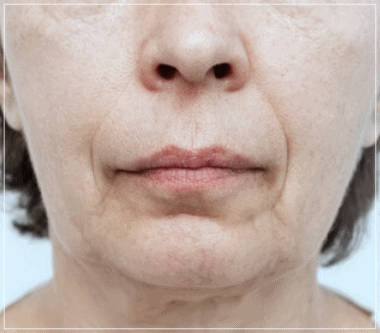
'Which is better, Thermage or Ulthera?
Is the pain different too?
When the jawline in the mirror starts to sag and nasolabial folds deepen, anyone may start thinking, 'Should I get lifting now?'
But if you choose a procedure based only on online reviews,
it often doesn’t suit your actual skin condition, and you may not get the results you hoped for.
So today, I’ll go over the differences, effects, and selection criteria for Thermage and Ulthera, which are the treatments patients most often confuse, one by one.
Hongdae Thermage vs Ulthera,
Which lifting treatment is right for my face?
Hongdae
Radiofrequency Thermage vs ultrasound Ulthera
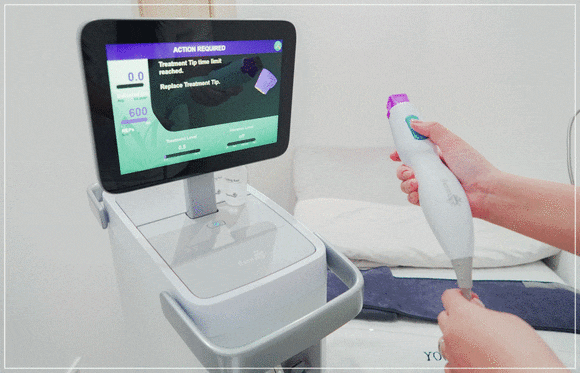
Many people ask, “Aren’t both of them basically the same kind of lifting?” But Thermage and Ulthera are completely different in terms of the treatment layer and the type of energy used.
Thermage is a procedure that uses radiofrequency (RF) energy to deliver heat throughout the dermis, the layer inside the skin, and regenerate collagen.
This heat rises to about 60–65°C, causing collagen fibers to contract instantly,
and promoting new collagen production to help rebuild the structure of the skin from within.
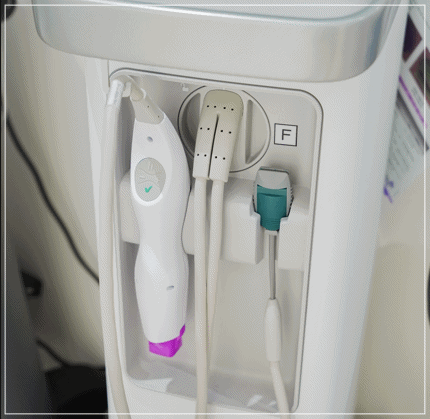
At present, Thermage FLX is mainly used,
and thanks to the device’s even heat distribution and enhanced cooling function, it can selectively stimulate only the dermis (the inner layer of the skin) while minimizing damage to the epidermis (the outer layer).
On the other hand, Ulthera (Ulthera) directly stimulates the SMAS layer with high-intensity focused ultrasound (HIFU).
This is the layer actually pulled during facelift surgery, so it is excellent for improving structural sagging of the face.
In summary,
Thermage is strong for improving skin texture, firmness, pores, and fine wrinkles,
while Ulthera is effective for jawline lifting and improving sagging in the lower face.
So in your early 30s, when overall skin texture has become loose, Thermage is often suitable,
and after your 40s, when the jawline has begun to sag, Ulthera is often more appropriate.
Of course, combining the two procedures can stimulate both the dermis and the SMAS layer at the same time, creating a synergistic lifting effect.
Hongdae Thermage vs Ulthera
Pain and recovery speed
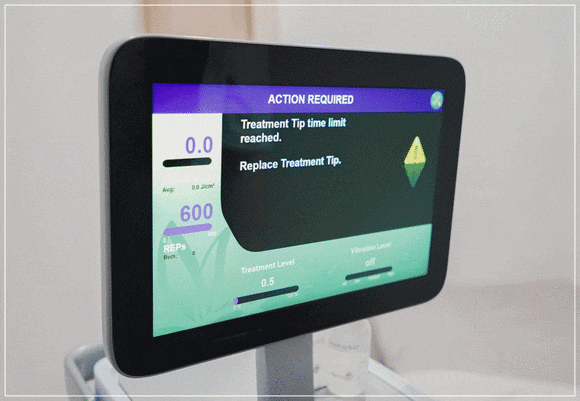
“I heard Thermage hurts less than Ulthera—is that true?”
This is a question many people ask.
Because Thermage applies heat with radiofrequency, you may feel a bit of warmth or a tingling sensation during the procedure,
but thanks to FLX’s vibration and cooling functions, most people can undergo it with only a numbing cream.
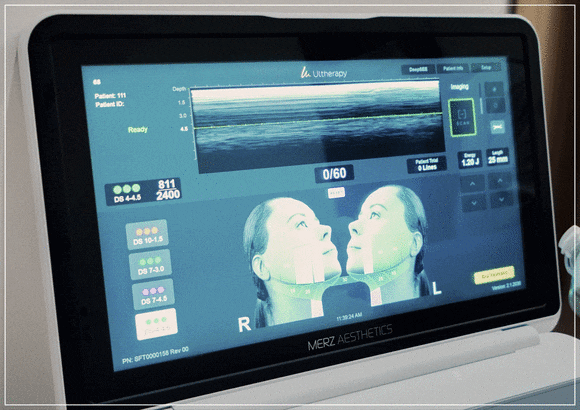
In contrast, because Ulthera’s ultrasound energy reaches deep into the SMAS layer, you may feel a brief throbbing pain around the jawline or cheekbones.
In such cases, depending on the situation, painkillers or sleep anesthesia may be used.
There is also a difference in recovery speed.
After Thermage, redness or stinging usually fades within half a day to one day, and makeup is possible the next day.
In contrast, after Ulthera, the face may remain swollen for 2–3 days, or you may feel something like muscle soreness, so if you have an important schedule, it is best to have the procedure at least two weeks in advance.
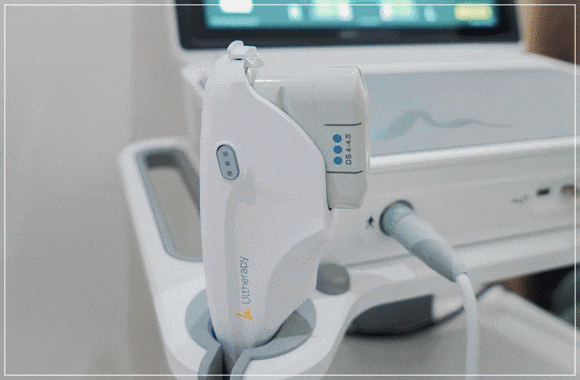
In other words, if you want a lifting treatment with quick return to daily life and less burden, Thermage is suitable,
while if you want a lifting treatment with clear contour improvement even if you can tolerate some pain, Ulthera is the right choice.
These points can be adjusted individually depending on the patient’s pain tolerance, schedule, and skin thickness.
Hongdae Thermage vs Ulthera
Results and duration
Lifting is not something that “ends after one treatment.”
Whether it is Thermage or Ulthera, the skin needs time to regenerate.
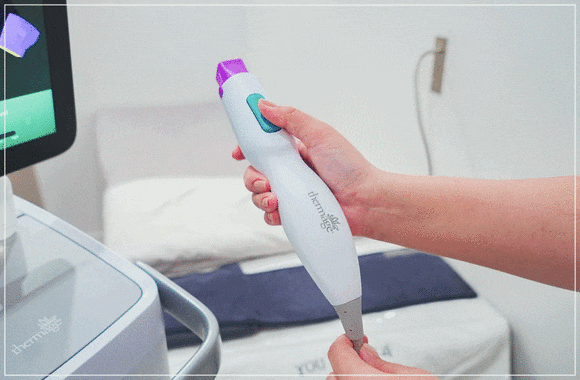
Thermage may feel slightly tightening right after the procedure, but the real effect appears after 2–3 months, as new collagen is reorganized.
The average duration is about 6 months to 1 year, and if you receive it regularly once a year, collagen accumulates and the firmness lasts longer over time.
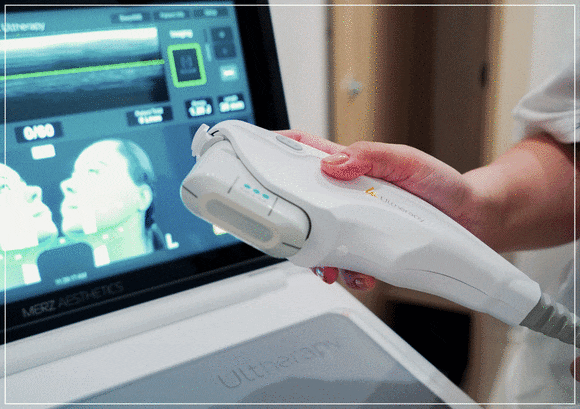
Ulthera varies by individual, but from about 2–5 weeks after the procedure, you may gradually feel the facial line becoming more defined, and it settles slowly over 2–3 months.
During this period, new collagen is formed and the structure inside the skin becomes firmer.
The final result is most clearly seen after 3–6 months,
and the duration tends to be a bit longer, averaging 1 year to 1.5 years.
However, the most important thing is the treatment plan, not the device.
Even with the same 300 shots, the results can differ completely depending on the shot density by area, the degree of overlap, and the output strength.
Before the procedure, be sure to carefully diagnose your skin condition,
and check whether the clinic provides customized settings suited to your face.
Also, make sure to check whether genuine tips are used.
Thermage tips are single-use and include a cooling function, so if they are not genuine, there is a risk of burns or fat atrophy.
Checking the serial number before the procedure is basic, so please be sure to verify that as well.
Here is how to choose between Hongdae Thermage and Ulthera.
① If your goal is to improve skin texture, firmness, and pores
→ Thermage FLX
② If your concern is sagging and jawline lifting
→ Ulthera
③ If both are concerns
→ A combined treatment plan that targets different layers
Before the procedure, be sure to check the following:
-
whether genuine tips are used,
-
diagnosis of skin thickness and firmness,
-
the doctor’s experience with customized settings.
If an accurate diagnosis and delicate adjustment are carried out,
it is fully possible to achieve a facial line that looks younger than your age.
Thank you. This was Hongdae Sinchon U&I^^
< The story of the Hongdae Sinchon branch built over 10 years >
< Hongdae Sinchon U&I clinic hours >
Weekdays: am 10:00 ~ pm 08:00
Saturday: am 10:00 ~ pm 05:00
(Consultation available without a lunch break)
< Directions >
U&I Clinic Hongdae Sinchon Branch is
located near Hongik Univ. Station.