“ I want to get thread lifting...
But I’m worried side effects might happen.”
This is one of the most common things we hear during thread lifting consultations.
Thread lifting is a procedure that can provide an immediate lifting effect without incisions, so many people who have significant sagging but are afraid of surgery look for it.
However, because threads are inserted under the skin, people also worry about whether there could be side effects.
In fact, side effects from thread lifting usually arise from approaches that ignore the skin’s structure.
In other words, if the procedure is done without understanding the principles of thread lifting, the skin layers may be damaged, the thread may show through, or dimples may form.
Today, let’s talk about how side effects can be minimized during thread lifting procedures, focusing on the two threads most commonly used recently: Jember Thread and Blue Rose.
How Can You Avoid Side Effects from Thread Lifting in Hongdae?
-
Why do side effects happen?
-
How can they be prevented?
-
Post-procedure care is also important
Hongdae Thread Lifting
Why Do Side Effects Happen?
Most side effects from thread lifting occur when the “layer” and “direction” are not properly set.
Thread lifting is not simply about pulling the skin upward; it is a procedure that uses the facial fat layer and the SMAS layer to secure the facial contour.
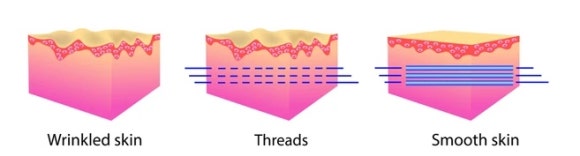
If the thread is inserted too superficially, the skin surface may ripple or the thread may show through; if it is inserted too deeply, the lifting effect decreases.
Typical side effects include bruising, swelling, dimpling, and asymmetry.
Bruising and swelling occur relatively often. In particular, because the area where the thread is inserted is punctured with a needle, minor bruising or swelling can occur, so these are better understood as downtime after the procedure rather than side effects.
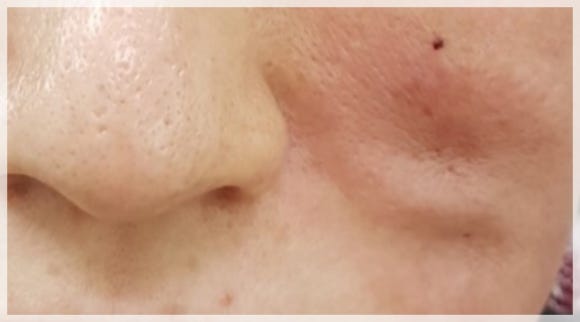
A representative side effect of thread lifting is the dimple phenomenon, where the skin becomes uneven and indented.
This is likely to occur when the thread is inserted too superficially or pulled too tightly.
Simply put, the key to thread lifting is to insert the thread delicately into the correct layer. Let’s talk more about that while explaining the threads.
Hongdae Thread Lifting
How Can Side Effects Be Prevented?
There are several types of threads used in thread lifting, and among them, let’s talk about Jember Thread and Blue Rose Forte.
Jember Thread
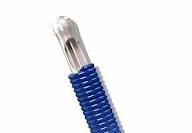
Jember Thread is a spring-like (screw-type) volume thread made of PDO.
Rather than pulling the skin upward, it plays the role of filling and supporting sunken areas from within.
It is mainly used under the eyes, for Indian bands, nasolabial folds, and around the cheeks and lips. As an alternative to filler or as a filler support, it naturally creates volume and helps induce collagen remodeling to firmly define the facial line.
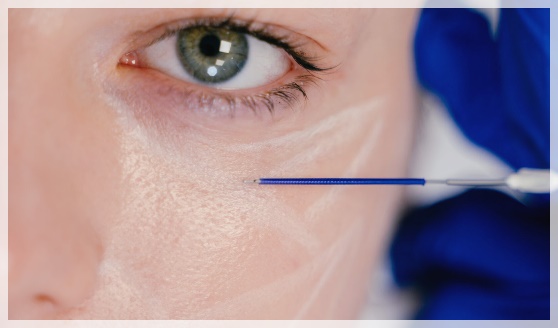
Because Jember Thread has a certain thickness, if it is inserted too superficially in an area with very thin skin, the thread may show through.
Therefore, it must be inserted at an appropriate depth to prevent such side effects.
Blue Rose Forte

Blue Rose Forte has a cog structure molded like rose thorns in 360 degrees.
Three-dimensional projections are arranged around the entire surface of the thread, strongly engaging the skin tissue and creating a powerful “pull-and-fix” force.
It is used to lift and secure the entire facial line, including the jawline, deep cheek area, upper nasolabial folds, V-line, side cheeks, and forehead and eyebrow lifting.
Since Blue Rose Forte works by pulling sagging tissue upward, pulling too strongly can cause side effects such as the dimple phenomenon, where the skin becomes uneven.
Therefore, it is important to pull only as much as can be done without side effects while observing the skin tissue.
Hongdae Thread Lifting
Post-Procedure Care Is Also Important
Side effects may appear depending on post-procedure care. That is why you must strictly follow the things that are prohibited.
Immediately after the procedure (within 48 hours), avoid vigorous cleansing, alcohol, exercise, and saunas. Cold compresses can help relieve swelling.

Within 1 week after the procedure, avoid lying on your side, as well as massage or manual therapy treatments. The threads have not yet settled in place, so strong stimulation may cause them to move.
After 2 to 4 weeks, collagen regeneration becomes active, so it is important to keep the skin well moisturized and protected from UV rays.
It takes about 3 to 4 weeks for the threads to fully settle. During that time, the best care is to leave the skin alone and let it rest.
Today, we talked about how to reduce side effects from thread lifting in Hongdae.
Most side effects from thread lifting come from an imbalance in the skin layer, thread type, and post-procedure care.
If the skin is thin or the cheeks are sunken, a spring-type volume thread like Jember Thread
If the contour has collapsed and elasticity has decreased, a cog-type lifting thread like Blue Rose should be selected to achieve natural results without side effects.
Please remember that thread lifting is not a procedure that “pulls a lot,” but rather a balanced procedure that “supports and lifts in a way suited to your face.”
Thank you. This was Hongdae Sinchon UNNI^^
< The story of the Hongdae Sinchon branch built over 10 years>
< Hongdae Sinchon UNNI Clinic Hours >
Weekdays: am 10:00 ~ pm 08:00
Saturday: am 10:00 ~ pm 05:00
(Consultations available without a lunch break)
< Directions >
UNNI Clinic Hongdae Sinchon branch is
located near Hongik Univ. Station.