홍대울쎄라피프라임 효과,
Has the precision changed?
"Ulthera Prime has been showing up a lot lately,
Is it more effective than the existing Ulthera?"
When looking into lifting procedures,
you may have this kind of question.
There are often not enough details to determine
whether this is simply marketing with a new device name,
or whether there are actual technical changes
that affect the procedure results.
Today, we’ll look at where Hongdae Ulthera Prime
has changed technically,
and how those differences relate to procedure results,
along with recently published clinical data.
| Hongdae Ulthera Prime effects: Has the precision changed? |
|---|
| 1. Why do effects differ from person to person? 2. How much has the precision changed? 3. So, for whom would the effects be more noticeable? |
- Hongdae Ulthera Prime
Why do effects differ from person to person?
The effect of ultrasound lifting depends on
whether thermal coagulation points can be created
accurately in the SMAS layer.
The problem is that the depth of the SMAS layer
differs from person to person,
and it can also differ between the left and right sides
of the face in the same person.
For some people, the left SMAS may be at a depth of 3 mm,
while the right side may be at 4.5 mm.
If these differences are not detected accurately during the procedure,
energy can be delivered to the wrong layer,
which may result in poor effects or hollowing in the cheeks.
In the end, how precisely the SMAS layer can be seen
is the key factor that determines the result.
There has been a recently published paper
on the precision of Ulthera and Ulthera Prime,
so let’s take a look.
- Hongdae Ulthera Prime
How much has the precision changed?
A comparative analysis paper was published on Research Square in 2025.
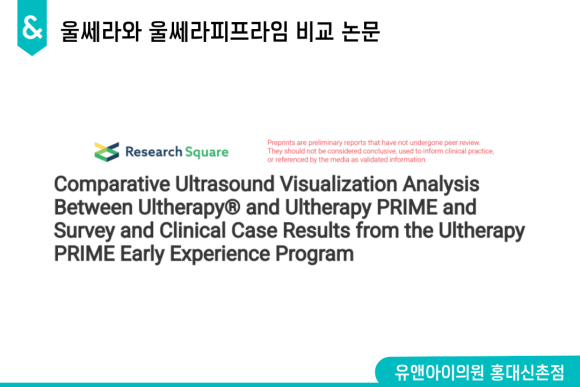
It quantitatively measured the ultrasound visualization performance
of the existing Ulthera (MFU-V 1.0)
and Ulthera Prime (MFU-V 2.0).
First, let’s look at how much clearer the screen became.
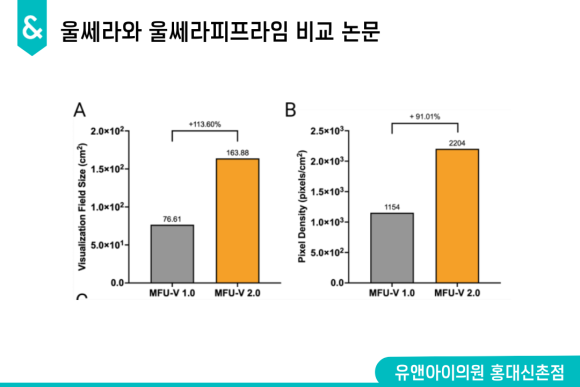
Compared with the existing Ulthera,
the visualization field increased by 113.6%,
and pixel density increased by 91%.
What matters is that while the screen became more than twice as large,
it also lets you see the same area with denser dots.
If the resolution is low, the boundary between
the SMAS layer and surrounding tissue appears blurry,
but when the resolution improves,
it becomes clearer where the target ends
and where it does not begin.
The paper went one step further and also measured image noise.
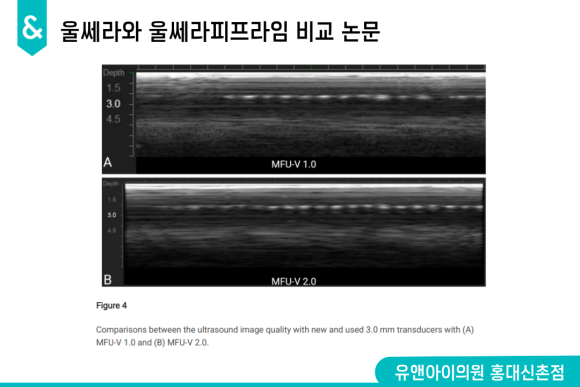
The top image shows the existing Ulthera,
and the bottom image shows the same-depth ultrasound image
taken with Hongdae Ulthera Prime.
Based on the 3 mm transducer,
noise decreased by 53%,
and with the 4.5 mm transducer,
it decreased by as much as 72%.
The 72% figure may seem impressive,
but there is something even more noteworthy.
Even after the transducer had been used to some extent,
the noise reduction rate remained at 64%.
Why does this matter? In actual clinical settings,
transducers are not used only when they are brand new.
The existing Ulthera tended to show a decline in image quality
as transducer use accumulated,
but Ulthera Prime means that image quality is relatively maintained
even after repeated use.
In the end, the meaning of improved precision is not
simply that it is good because it is a new device,
but that it reduces the chance of energy being delivered to the wrong place
because the SMAS layer can be seen clearly throughout the procedure.
- Hongdae Ulthera Prime
So, for whom would the effects be more noticeable?
The paper also included survey results
completed by nine clinicians after treating 68 patients over two months.
It stated that the average procedure time decreased by 19.7%,
and that all respondents evaluated the image quality as "better."
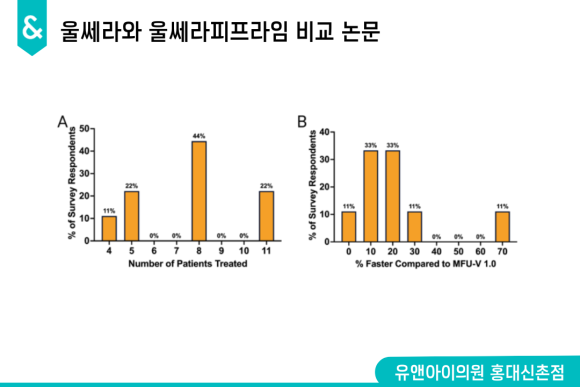
A shorter procedure time does not necessarily mean
that the same number of shots can be distributed more quickly;
it is closer to meaning that the time needed to decide
where and how to deliver the shots became shorter.
However, there is something to keep in mind here.
Rather than concluding from the paper alone that Ulthera Prime
is more effective, it would be better to view it as
an objective improvement in visual precision.
It is not an exaggeration of effects,
but it is true that with improved visual precision,
it has become easier for medical staff to make decisions.
What makes Hongdae Ulthera Prime meaningful is not that
a new device has been released,
but that the SMAS layer can be seen more clearly during the procedure.
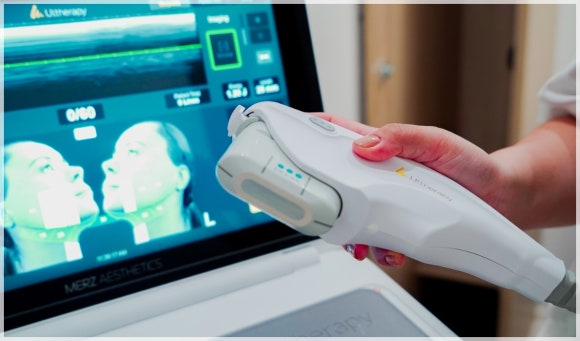 Hongdae Ulthera Prime
The data in the paper—113.6% expansion of the visualization field,
91% increase in pixel density,
and 64–72% reduction in noise—
all point in the same direction.
When targeting the SMAS layer,
it means being able to see more accurately
and deliver energy at a more precise depth.
However, device performance does not guarantee procedural success.
How the difference in SMAS depth between the left and right sides is diagnosed,
how the number of shots is distributed,
and in which direction the tissue is lifted
ultimately depend on the judgment of the medical staff performing the procedure.
The device is only a tool that helps make that judgment more accurate.
Rather than which device is used,
it is more important to remember
on what basis that device is being operated.
If you have any questions,
we recommend checking the procedure plan that fits your skin condition
through a consultation with medical staff.
Thank you. This was Hongdae Sinchon U&I^^

U&I Clinic Hongdae Sinchon Branch
< Stories from the Hongdae Sinchon Branch built over 10 years>
<Directions to U&I Clinic Hongdae Sinchon Branch>