Hongdae Dermatology Hair Removal,
Why Personalized Care Matters
Department : Dermatology

Hongdae Sinchon U&I Clinic
"I'm thinking about getting laser hair removal.
Where should I go?"
"Why are there such big price differences
between hair removal treatments?"
In fact, hair removal is one of the treatments that can take a long time to decide on.
Shaving or waxing every time can be difficult, but many people still spend a lot of time wondering whether they should undergo a treatment.
When you start looking into it, you may wonder why prices differ so much from one medical institution to another, and you may also come across reviews saying that someone saw no results even when the same equipment was used.
That is why quite a few people find themselves wondering whether to receive Hongdae dermatology hair removal (Department: Dermatology).
In this article, I will explain step by step why hair removal has to be repeated, how lasers work, and what you should check before treatment.^^
Hongdae Dermatology Hair Removal,
Why Personalized Care Matters
-
What are the limitations of shaving and self-hair removal?
-
Laser hair removal: How it works and the number of treatments
-
Things you should 반드시 check before treatment
Hongdae Dermatology Hair Removal (Department: Dermatology)
What Are the Limitations of Shaving and Self-Hair Removal?
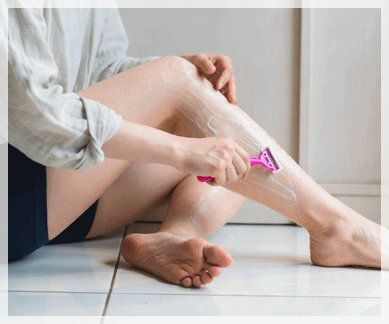
Shaving
Hair continues to be produced deep inside the skin, rather than on the skin's surface where we can see it.
A structure resembling a factory that produces hair is located inside the skin.
Shaving physically removes only the hair that has grown out, while leaving this factory intact.
Therefore, no matter how cleanly you shave, the root remains intact, and the hair grows again from the cut area.
"Then isn't waxing, which pulls the hair out by the root, different?" Many people ask this question.
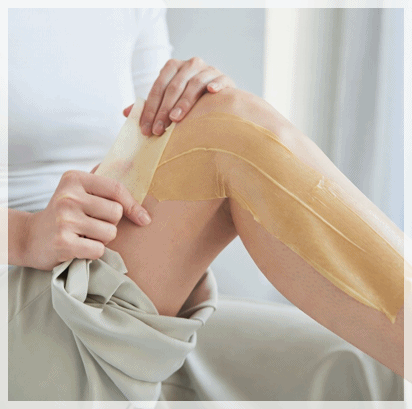
Waxing
Waxing generally lasts longer than shaving because it pulls the hair out from the root.
However, even when the hair is pulled out, the structure called the hair follicle—the hair pocket that produced it—remains inside the skin.
As long as the follicle remains active, new hair is produced in the same spot over time.
That is why many people seriously consider laser hair removal.
Hongdae Dermatology Hair Removal (Department: Dermatology)
Laser Hair Removal: How It Works and the Number of Treatments
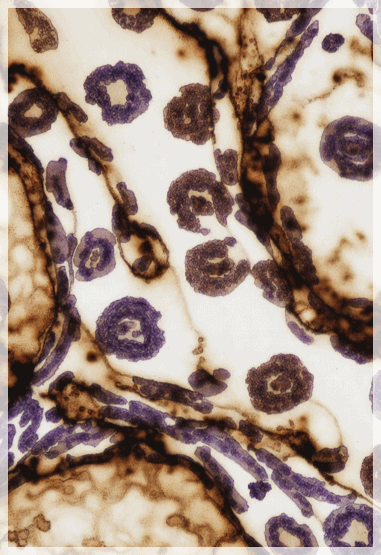
Melanin
To understand laser hair removal, you need to know about melanin pigment.
Hair is black because of a pigment called melanin, and lasers are designed to selectively react with this black melanin.
When laser light is absorbed by melanin, it turns into heat, and that heat is delivered to the hair follicle deep inside the skin.
The number of treatments varies depending on the treatment area and the characteristics of the hair. In general, treatment is often repeated about 5–10 times at intervals of approximately 4–6 weeks.
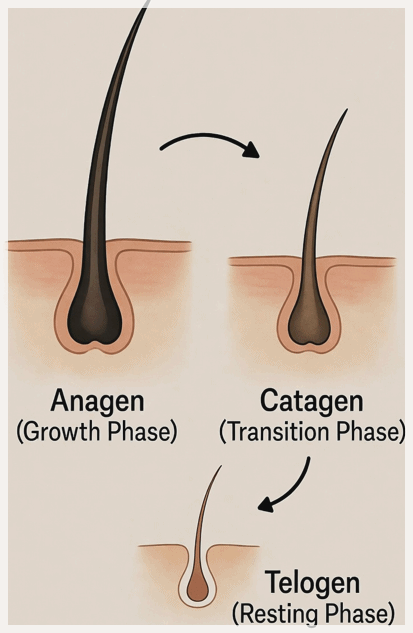
Hair Growth Cycle
"Isn't it over after one treatment? Why does it have to be repeated several times?" This is a question I am asked very often.
The answer is that hair has a growth cycle.
The three stages of hair are the anagen, catagen, and telogen phases. Lasers respond effectively only to hair in the anagen, or growth, phase.
However, only a portion of all hair is in the growth phase at any given time.
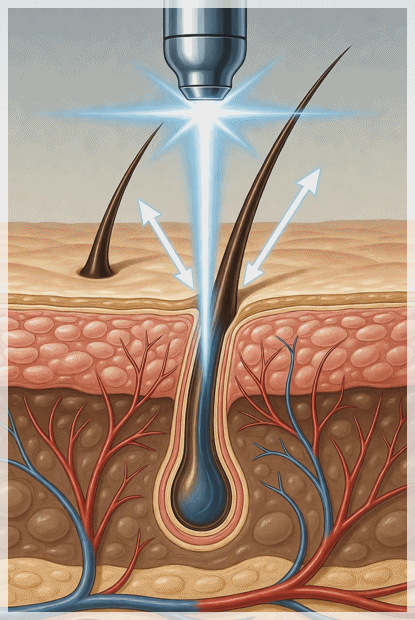
Laser Hair Removal
The rest is in the catagen or telogen phase, so it does not respond at that moment even when the laser is applied to the same area.
Therefore, it is important to develop a treatment plan suited to you by considering your hair characteristics and skin type together.
Hongdae Dermatology Hair Removal (Department: Dermatology)
Things You Should 반드시 Check Before Treatment
If you are considering where to receive hair removal treatment, be sure to check the following two conditions.
- Do they create a personalized plan for each individual?

Hongdae Sinchon U&I Clinic
Many people focus only on the equipment name before receiving laser hair removal.
Of course, which equipment is used is also important.
However, you should focus even more on whether they properly create a personalized plan for each individual.
No matter how good the tool is, the process of planning how to use it should not be omitted.
You should check whether they can carefully consider your hair and skin characteristics and provide treatment in an appropriate manner.
- Do they avoid applying the same treatment intensity to everyone?
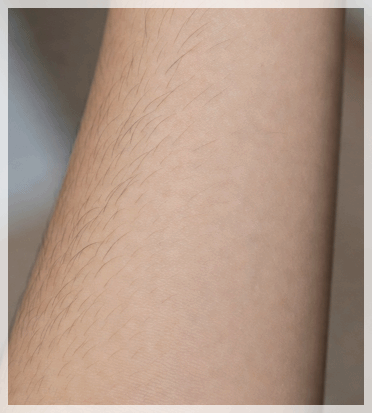
Treatment Intensity Varies Depending on Hair Characteristics
Some people believe that laser hair removal should be performed at a high intensity.
However, the appropriate intensity varies from person to person depending on skin type and hair thickness.
Applying an excessive intensity uniformly to someone with darker or sensitive skin may instead cause irritation.
Conversely, if thick hair is always treated at too low an intensity, it may be difficult to notice a change.
Therefore, rather than applying the same settings to everyone, the intensity should be adjusted based on the skin's condition that day, the treatment area, and the state of the hair.
After laser hair removal, side effects such as erythema, follicular swelling, and dryness may occur, and, rarely, blisters or hyperpigmentation may appear.
If these symptoms persist, you should consult a medical professional and take appropriate measures.
Hongdae Sinchon U&I Clinic
Today, I wrote this article for those who are wondering where to receive Hongdae dermatology hair removal (Department: Dermatology).
Ultimately, laser hair removal is less about finding a famous piece of equipment and more about clearly understanding the current condition of your skin and hair and creating a plan suited to them.
Please do not make a hasty decision. Carefully check whether the clinic provides treatment in a way that is suited to you.
Thank you. This was Hongdae Sinchon U&I.^^
< The Story of the Hongdae Sinchon Branch Built Over 10 Years >
< Hongdae Sinchon U&I Clinic Hours >
Weekdays : am 10:00 ~ pm 08:00
Saturday : am 10:00 ~ pm 05:00
(Closed Sundays)
< Directions >
U&I Clinic Hongdae Sinchon Branch
is located near Hongik University Station.