Sinchon Pico Toning,
What to Check Before Considering Its Effects
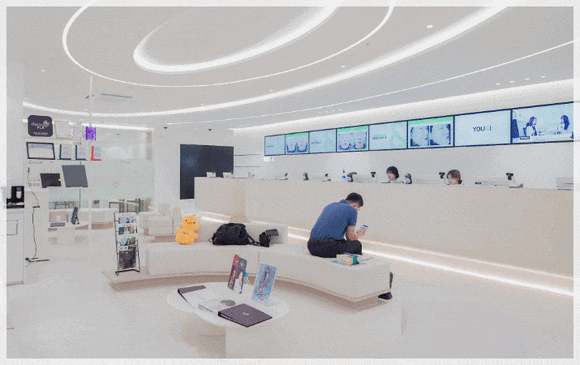
Hongdae Sinchon U&I Clinic
"I'm looking into Pico Toning
because of my melasma."
"I heard it can make melasma lighter.
Could I see results too?"
"How many sessions would I need?"
If you are looking into Sinchon Pico Toning, you are probably concerned about melasma, solar lentigines, freckles, or a dull-looking complexion.
Pico Toning is a treatment used to improve skin tone by breaking pigment into smaller particles, but it does not work in exactly the same way for every type of pigmentation.
This is because the approach may vary depending on the type of pigmented lesion, even when it appears to be the same kind of brown spot.
Therefore, if you are considering Pico Toning, it is a good idea to first identify what type of pigmentation you have rather than focusing on the treatment itself.
Today, I will explain in simple terms how Pico Toning works on pigmentation, when it may be helpful, and what you should know before treatment.^^
Sinchon Pico Toning,
What to Check Before Considering Its Effects
Sinchon Pico Toning
How does it work on pigmentation?
To understand Pico Toning, it is helpful to first briefly look at how pigmentation develops.
The reason pigmented lesions such as melasma appear on our skin is mostly due to a pigment called 'melanin.'
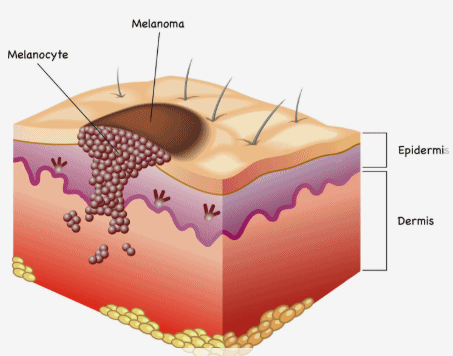
Melanin
Melanin originally helps protect the skin from ultraviolet rays, but when affected by ultraviolet exposure, hormonal changes, repeated irritation, and other factors, it can accumulate in one area and remain visible as pigmentation.
Therefore, pigment treatment is less about forcibly removing pigmentation and more about breaking up clumped melanin into smaller particles so that it can be naturally cleared.
'Pico Toning' is a treatment that delivers laser energy to this melanin for an extremely brief moment.
The 'picosecond' mentioned here means one-trillionth of a second.
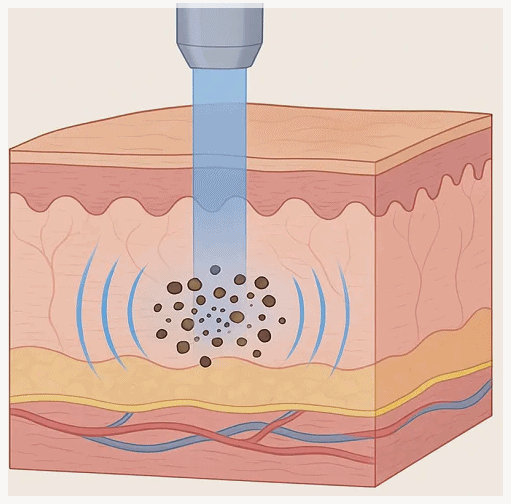
Pico Toning
While conventional toning gradually breaks down pigmentation using thermal energy, Pico Toning is characterized by breaking pigment particles into finer pieces with short, intense energy.
For this reason, it may help finely break down pigmentation while relatively reducing the thermal burden delivered to surrounding tissue.
This is why many people consider Pico Toning to improve melasma, hyperpigmentation, and a dull complexion.
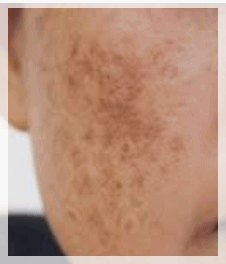
Responses Vary Depending on the Pigmented Lesion
However, although pigmentation may look like the same brown color on the surface, its response may vary depending on the type of pigmentation.
Therefore, before beginning treatment, it is necessary to clearly diagnose what type of pigmentation you have.
Sinchon Pico Toning
Cases Where It May Be Suitable vs. Cases Requiring Caution
Hongdae Sinchon U&I Clinic
In fact, when explaining Pico Toning, the most important point is distinguishing whether the pigmentation is suitable for treatment.
Rather than asking whether Pico Toning is a good treatment, it is more important to first determine whether your pigmentation is suitable for Pico Toning.
As mentioned earlier, pigmented lesions may appear similar on the surface but differ in location within the skin and in type.
The skin is broadly divided into the epidermis and dermis.
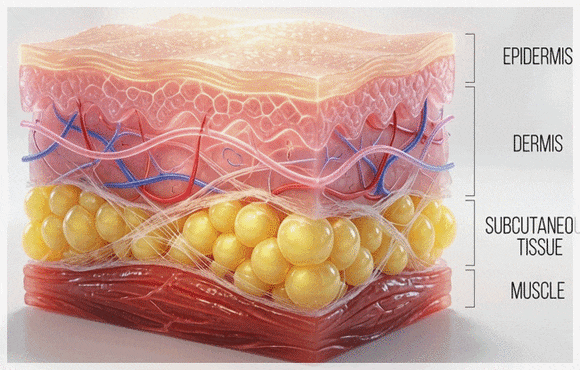
Skin Layers
The 'epidermis' is the outer layer of the skin, where relatively superficial pigmentation is located, while the dermis is the deeper layer.
In general, when pigmentation is located deeper, it may be difficult to address with toning alone.
For this reason, Pico Toning is often used for lightly diffused melasma, widely distributed freckles, post-inflammatory hyperpigmentation, and dull or uneven skin tone.
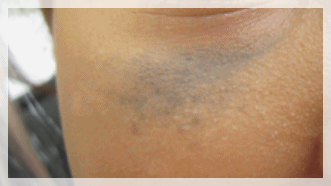
Nevus of Ota
On the other hand, darker pigmentation with clearly defined borders, deep pigmentation located in the dermis, and dermal pigmentation such as a nevus of Ota may require more careful consideration.
Rather than choosing Pico Toning without consideration, it is more important to check, 'What characteristics does my pigmentation have?'
Sinchon Pico Toning
Why Do Results Vary?
Hongdae Sinchon U&I Clinic
During consultations, many people ask, "My friend’s pigmentation became much lighter after five sessions. Why does mine seem unchanged?"
In fact, it is quite natural for results to differ even when people receive the same Pico Toning treatment.
For example, although pigmentation may look like the same brown color, it may be located relatively superficially in one person and deep in the dermis in another.
The speed of change may also vary depending on how sensitive the skin is and how much ultraviolet exposure a person usually gets.
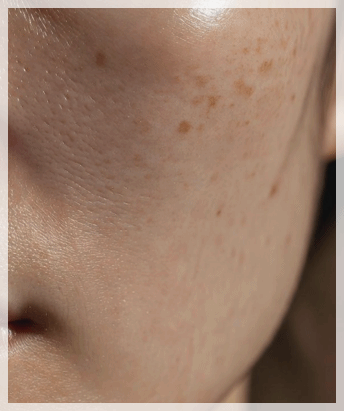
The Number of Sessions Varies Depending on Skin Condition
Therefore, receiving the same number of sessions with the same device does not mean that everyone will achieve similar results.
Even with the same Pico Toning treatment, adjusting the intensity and intervals according to the current condition of the skin may help support more satisfactory results.
Temporary redness, swelling, stinging, or dryness may occur after treatment. In rare cases, side effects such as blisters or hyperpigmentation may also occur.
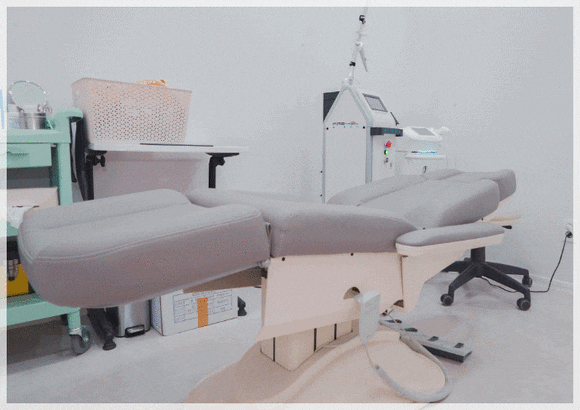
Hongdae Sinchon U&I Clinic
Today, I wrote this post for those considering Sinchon Pico Toning because of pigmented lesions.
When looking into Pico Toning, it is important to identify the type of pigmentation you currently have and proceed with an intensity and treatment interval suited to your skin condition.
You should have a thorough discussion and find the approach that is right for you.
Thank you. This was Hongdae Sinchon U&I.^^
< The Story Built Over 10 Years at the Hongdae Sinchon Branch >
< Hongdae Sinchon U&I Clinic Hours >
Weekdays: am 10:00 ~ pm 08:00
Saturday: am 10:00 ~ pm 05:00
(Closed on Sundays)
< Directions >
U&I Clinic Hongdae Sinchon Branch
is located near Hongik University Station.