Hello, this is Gangnam Claire Dental Clinic.
Today, I’d like to talk in a little more detail about one of the questions we often receive in the clinic: “retreatment”. Many people feel concerned and have questions when they hear that a tooth that has already had root canal treatment needs to be treated again.
Why does it hurt again after root canal treatment?
Root canal treatment (endodontic treatment) is a procedure that removes the nerve and inflamed tissue from inside the tooth, cleans and disinfects that space, and then seals it. However, the internal structure of a tooth is very complex, and there are tiny canals that are difficult to see with the naked eye.
The following situations can cause problems to arise again even after previous root canal treatment:
If the inside of the canal was not fully disinfected and filled
If bacteria re-entered through gaps in the prosthetic restoration over time
If there is a crack in the tooth root
If there was an additional canal that was not detected during the previous treatment
The treatment needed in these cases is retreatment.
Retreatment: how is it different from the first root canal treatment?
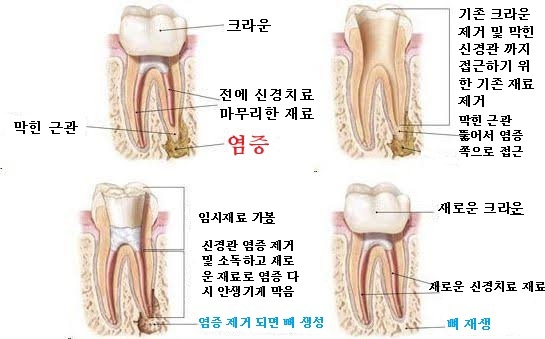
Retreatment is the process of reopening a tooth that has already been treated once, removing the existing filling material, disinfecting the infected area again, and resealing it.
The reason it is more difficult than the initial root canal treatment is as follows:
Existing filling material and post need to be removed
The tooth structure inside is weaker
Inflammation has often progressed to the root tip
That is why an accurate diagnosis and a delicate treatment process are more important than anything else.
Claire Dental Clinic’s approach to retreatment
At Claire Dental Clinic, when performing retreatment, we consider the following principles most important.
- Precise diagnosis first
Through 3D CT imaging, we accurately assess root structures and the extent of inflammation that cannot be seen with the naked eye. Rather than thinking of retreatment as simply “doing it again,” we see it as a process of first finding out why the previous treatment failed.
- Prioritizing tooth preservation
Our principle is to preserve the natural tooth whenever possible. Until extraction is deemed necessary, we thoroughly review the options for saving the tooth through retreatment.
- Careful attention to even the smallest details
Using the latest canal enlargement equipment, we carefully treat additional canals or tiny infected areas that are easy to miss. The success rate of retreatment is determined by these “invisible differences.”
How much pain is there after retreatment?
You may feel soreness or tenderness for a few days after treatment, but for most people, it is at a level that does not interfere with daily life. In fact, the pain that persisted before treatment often gradually decreases.
If the pain lasts a long time or swelling becomes severe, it is important to visit the clinic immediately for evaluation.
If you have these symptoms, we recommend a retreatment consultation
If a tooth that has had root canal treatment hurts again when chewing
If the gums repeatedly swell or pus forms
If you feel pain inside an old crown
If you were told that inflammation at the root tip is visible on an X-ray
The earlier the treatment, the easier the process is relatively, and the higher the chance of preserving the tooth.
A message from the doctor
Retreatment is not an easy procedure for either the dental team or the patient. But when done well, even an already damaged tooth can become a valuable tooth that can be used for a long time.
Claire Dental Clinic does not stop at simply “treating the tooth that hurts right now”; we also consider how long and how comfortably it can be used in the future.
If you are worried about a tooth that has already had root canal treatment, we recommend that you do not worry alone and instead get an accurate diagnosis at least once.
Thank you for reading.