Hello. This is Claire Dental Clinic, a well-regarded dental clinic in Seolleung.
Many people experience a sudden, sharp sensitivity in their teeth even when cold water or wind touches them. Today, from the dentist’s perspective, I’ll explain in detail about cervical resin and GI treatment, which are commonly used when tooth sensitivity occurs.
Why teeth become sensitive: it may not be a simple issue
Tooth sensitivity is often thought of as a temporary symptom and left untreated, but in reality, it can be a sign that the protective layer on the tooth surface has been damaged.
Common causes include:
-
The gums recede and the root portion of the tooth becomes exposed
-
The cervical area wears down due to excessive brushing
-
Teeth grinding or clenching habits
-
Weakening of the tooth surface due to acidic foods
When dentin becomes exposed because of this, external stimuli are directly transmitted to the nerve, causing sensitivity.
Tooth sensitivity: do you really need root canal treatment?
Many people worry, “If it feels sensitive, do I end up needing root canal treatment?” However, most tooth sensitivity can improve sufficiently with simple conservative treatment.
The representative methods are cervical resin treatment and GI treatment.
What is cervical resin treatment?
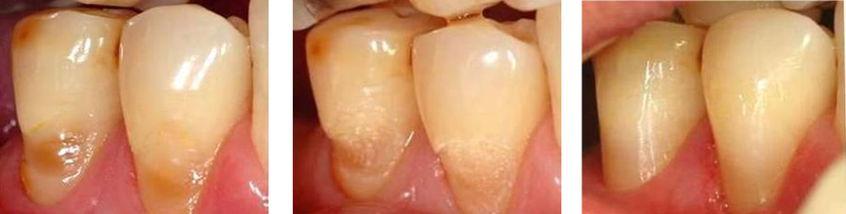
Cervical resin treatment is a procedure that fills worn or depressed areas near the tooth root with a tooth-colored resin material.
Advantages of cervical resin treatment
-
Excellent aesthetics with a color similar to natural teeth
-
Stronger than GI
-
Fast relief of sensitivity symptoms
-
Treatment possible on the same day
It is especially suitable for patients who place importance on aesthetics.
In what cases is GI treatment needed?
GI (glass ionomer) treatment uses a material that has advantages in adhesion to the tooth and fluoride release compared with resin.
GI treatment is considered in the following cases:
-
Severe wear near the gum line
-
Areas where moisture control is difficult
-
Cervical wear with a high chance of recurrence
GI material releases fluoride and has a tooth-protective effect, so it is also meaningful for long-term management.
Resin or GI: which treatment is better?
Both treatments have the same purpose, but the appropriate choice depends on the condition and location of the tooth.
At Claire Dental Clinic, rather than simply choosing a material that “looks better,” we comprehensively consider:
and recommend the most stable method.
Claire Dental Clinic’s treatment principles for tooth sensitivity
- Diagnose the cause accurately first
We do not stop at simply filling the tooth. We first identify why it is sensitive. If there is improper brushing or a teeth-grinding habit, we provide guidance on that as well.
- Minimal removal, maximum preservation
We do not remove unnecessary tooth structure. We treat only the necessary areas precisely to preserve natural teeth as much as possible.
- Explain post-treatment care as well
We also explain how to choose a toothbrush, how to brush, and daily habits so that sensitivity does not return after treatment.
If this applies to you, do not delay treatment
-
Sharp pain when eating cold or hot food
-
Sensitivity that repeats in a specific area only
-
Discomfort even when only wind touches the teeth
-
The root area of the tooth appears to be worn down
In the early stages, treatment may be simple, but if left untreated, the symptoms may worsen or lead to root canal treatment.
What I want to say as a dentist
Tooth sensitivity is not something you should just endure. It is also not something that can simply be dismissed as “inevitable with age.”
If you receive treatment at the right time and only as much as needed, the discomfort in daily life can be reduced sufficiently.
Claire Dental Clinic does not take even small symptoms lightly, and we aim to provide treatment that helps patients use their teeth for a long time.
If you are experiencing discomfort from tooth sensitivity, please feel free to come in for a consultation.
Thank you for reading.