
When teeth look dark or yellowish,
many people consider teeth whitening
for a brighter appearance.
Especially before an important schedule or a photo shoot,
it is common to look for whitening treatment
to improve one’s impression in a short period of time.
In this process, during consultations at Seolleung Whitening Dental Clinic,
there is a question that comes up often.

Isn’t teeth whitening
a procedure that ends in one session?
Tooth color is not determined only by
stains on the surface.
The color of the dentin inside the enamel
and the distribution of pigments accumulated inside the tooth
have a major effect.
Teeth whitening does not end in one session
not because the treatment effect is insufficient,
but because it is a treatment that proceeds step by step,
considering the tooth structure, the whitening principle,
and the safe range for tissues.
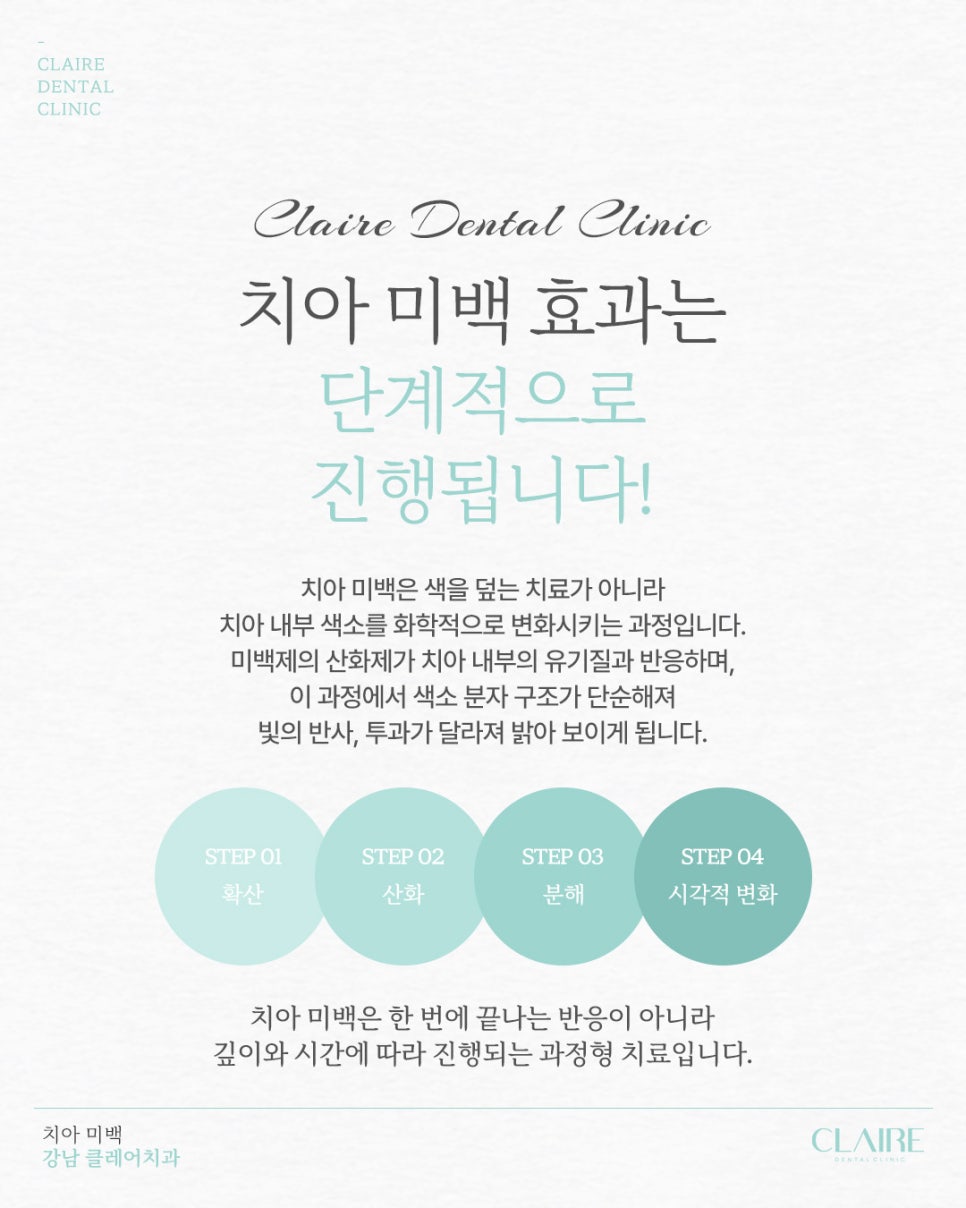
Why do the effects of teeth whitening
appear step by step?
Teeth whitening is not a treatment that covers color,
but a process that gradually changes the pigments inside the tooth.
The whitening agent does not stay on the tooth surface;
after diffusing through the enamel into the interior,
it reacts with pigments and gradually makes the tooth brighter.
Because the pigments inside the tooth exist in layers,
depending on depth and concentration,
the effect appears step by step.
The staining inside the tooth is not uniform.
It is distributed at different concentrations
in the layer near the surface, the middle layer,
and the deep dentin layer.
In addition, because the whitening reaction progresses
as oxidation accumulates,
all pigments are not completely broken down at once.
Therefore, whitening treatment is
a process-based treatment that progresses gradually
depending on depth and time.

If it is done strongly all at once,
doesn’t it become brighter faster?
If whitening is carried out too strongly,
it can place a greater burden on the teeth and gum tissues.
If the concentration of the whitening agent or the application time
is increased excessively,
the amount diffusing into the tooth increases rapidly.
At this time, stimulation of the nerve inside the tooth becomes stronger,
which can cause sensitivity or pain.
In addition, strong whitening
can worsen tooth dehydration.
A proper range of dehydration can recover naturally,
but excessive dehydration can increase sensitivity
and reduce color stability.
The gums and mucosal tissues can also
experience irritation or discomfort
when exposed to a high-concentration whitening agent for a long time.
Therefore, teeth whitening is best performed
over multiple sessions within a safe range
that the tissues can tolerate.
Repeated whitening treatment is not because the effect is weak.
What matters is proceeding step by step
while observing the condition of the teeth and the degree of color change.
If you are concerned about tooth color,
after accurately evaluating the current cause of discoloration and the condition of the teeth,
it is advisable to determine the appropriate whitening method and number of sessions.
Because the application method and the number of sessions needed may vary
depending on each person’s tooth structure and discoloration characteristics,
please consider a consultation through treatment at Seolleung Whitening Dental Clinic.