




Previous image
Next image

Right after teeth whitening,
many people think,
"It’s done now, so it should be fine."
However, as time passes,
quite a few people feel disappointed
when their teeth seem to become discolored again.
So why is it difficult to maintain whitening results?
And how much care is needed?

Post-whitening care is important
Teeth whitening is not a treatment
that stays the same for a long time after just one procedure;
rather, the results can vary
depending on how you care for your teeth afterward.
In particular, teeth after whitening
are temporarily more sensitive to pigments,
so early care is important.
Until the surface is fully stabilized,
pigments can penetrate more easily,
and care during the roughly 24 to 48 hours after the procedure
can affect the overall duration of the results.
Therefore, it is important to know in advance
that the whitening outcome can differ
depending on how you manage it.
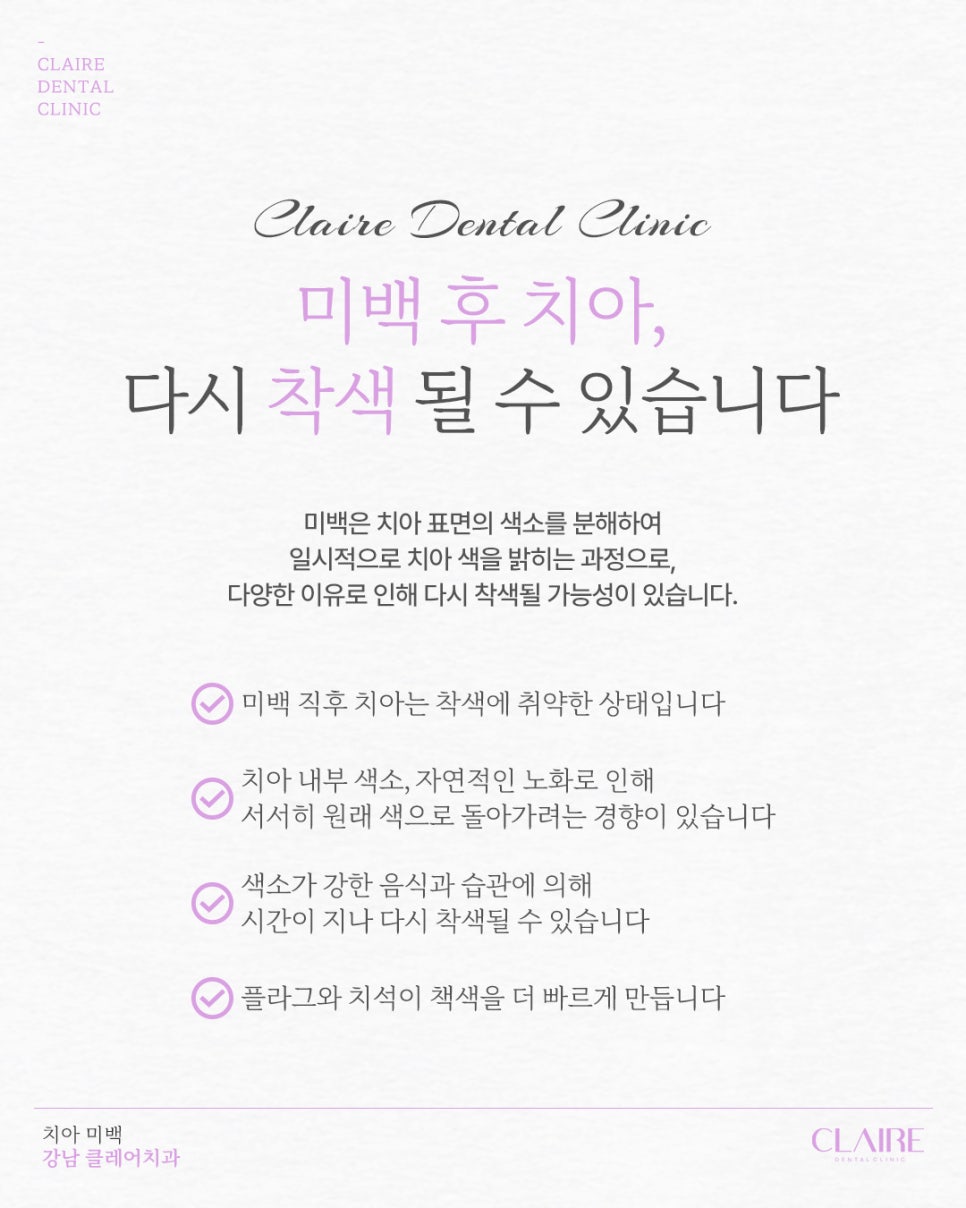
Why does tooth color
come back after whitening?
Teeth whitening
does not change the structure of the teeth themselves.
It works by breaking down the pigments present
inside and on the surface of the teeth,
making them appear brighter temporarily.
Because of this, as time passes,
the teeth’s natural color and outside factors
can gradually make them look darker again.
Also, immediately after whitening,
the tooth surface is not yet fully stabilized,
which creates an environment where it is easier to be exposed to external pigments.
If you repeatedly consume strongly colored foods
or smoke during this period without additional care,
discoloration can progress quickly.
In addition, if plaque and tartar build up,
the tooth surface can become rougher,
creating an environment where pigments adhere more easily.
The maintenance period can differ
Even if the same procedure is performed,
some people keep a bright color for a long time,
while others experience color changes relatively quickly.
This difference is often not simply a matter of constitution,
but rather a result of post-treatment care habits.
For example,
if you manage your teeth right after consuming staining foods,
or if you get regular scaling,
discoloration may progress more slowly.
On the other hand, if oral hygiene is insufficient
or if exposure to staining factors is repeated,
color changes may appear more quickly.
Ultimately, the result of whitening
can be seen as a process that includes not only the procedure itself
but also the care that follows.
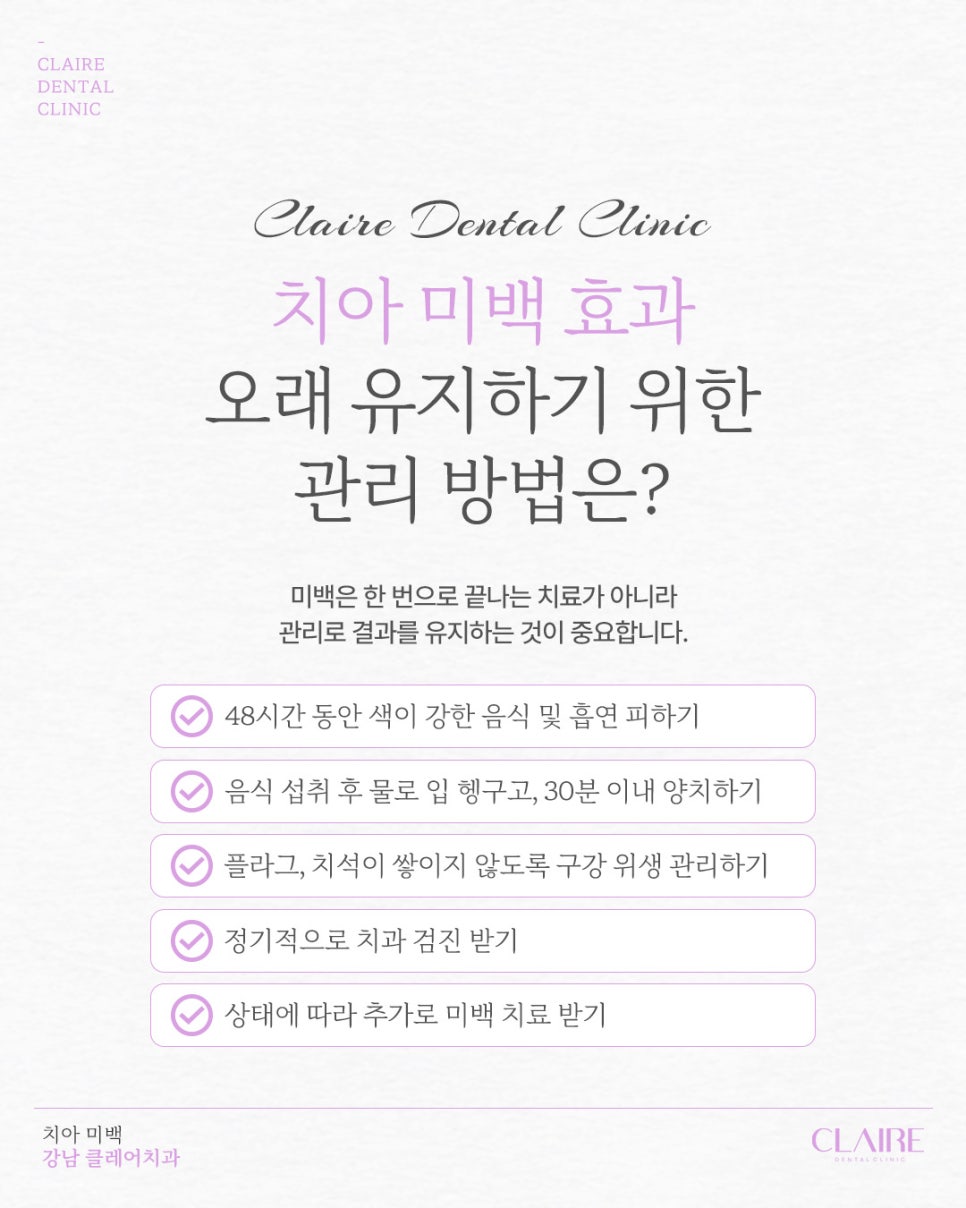
After teeth whitening,
how should you care for your teeth?
For about 48 hours after the procedure,
the teeth may react sensitively to pigments,
so it is best to avoid strongly colored foods
and smoking as much as possible.
If you do have to consume them,
rinsing your mouth with water or brushing within 30 minutes
can help prevent pigments from remaining for too long.
Also, foods that are too hot or too cold
can increase tooth sensitivity,
so it is better to reduce irritating intake.
Along with this,
it is also important to keep the tooth surface clean
through regular dental checkups and scaling.
If a mild touch-up whitening is performed depending on the condition,
it may help maintain the initial bright color for longer.
Considering each person’s dental condition and lifestyle habits,
it is important to choose an appropriate method
within a manageable range.
In these cases, additional consultation may be needed
Not all teeth respond to whitening in the same way.
For teeth that have had root canal treatment,
or when there are restorations such as crowns or resin,
general whitening may have limited effect on color change.
In such cases,
other treatment methods may be needed,
so it is important to make a plan
based on an accurate diagnosis.
Teeth whitening is not simply a one-time procedure.
It is a treatment whose duration of results
can vary depending on the care that follows.
In particular, early care,
oral hygiene, and lifestyle habits
all work together to create differences in the speed of discoloration.
At Daechi-dong Dental Clinic,
we provide procedures tailored to the condition of your teeth,
along with guidance on maintenance methods,
so that you can expect more stable results.
If you want to keep whitening effects for a long time,
it is important to plan not only the procedure itself,
but also the care that follows.