


Previous image
Next image

Recently, more and more people have been visiting the dentist to look into Seolleung teeth whitening for a bright and clean smile.
However, the joy of getting satisfying white teeth does not last long for some, as many also worry about tooth sensitivity after the procedure.
If your teeth feel sharp and tingly every time you drink cold water, or even a light cool breeze causes throbbing pain, it is natural to wonder whether your teeth may have suffered serious damage.
Why does this kind of sensitivity pain occur during the process of brightening yellowed teeth?
Today, let’s look at the causes of tooth sensitivity, which many people wonder about after the procedure.

Why do teeth feel sensitive after whitening?
The reason teeth become sensitive after whitening is a natural reaction caused by hydrogen peroxide, an ingredient in the whitening agent, entering the tooth through tiny pores on the tooth surface and moving into the interior.
The whitening agent penetrates through these tiny pathways into the dentin inside the tooth, oxidizes the yellow-stained substances, and breaks them down into a whiter color.
During this process, the whitening agent stimulates the dentin near the nerves, which can cause teeth to feel sensitive or tingly.
This is not a side effect of the teeth being shaved down or damaged, but a temporary reaction that appears as the medication works normally.
In particular, people who are usually sensitive to cold foods may feel this sensitivity more strongly.
Because tooth thickness and nerve sensitivity vary from person to person, the degree of sensitivity also differs.
If you avoid irritating foods and get some rest, the nerves that have become sensitive will settle down, and the symptoms will usually improve naturally within 1 to 2 days.
If the sensitivity is hard to bear, taking the prescribed pain reliever is recommended.
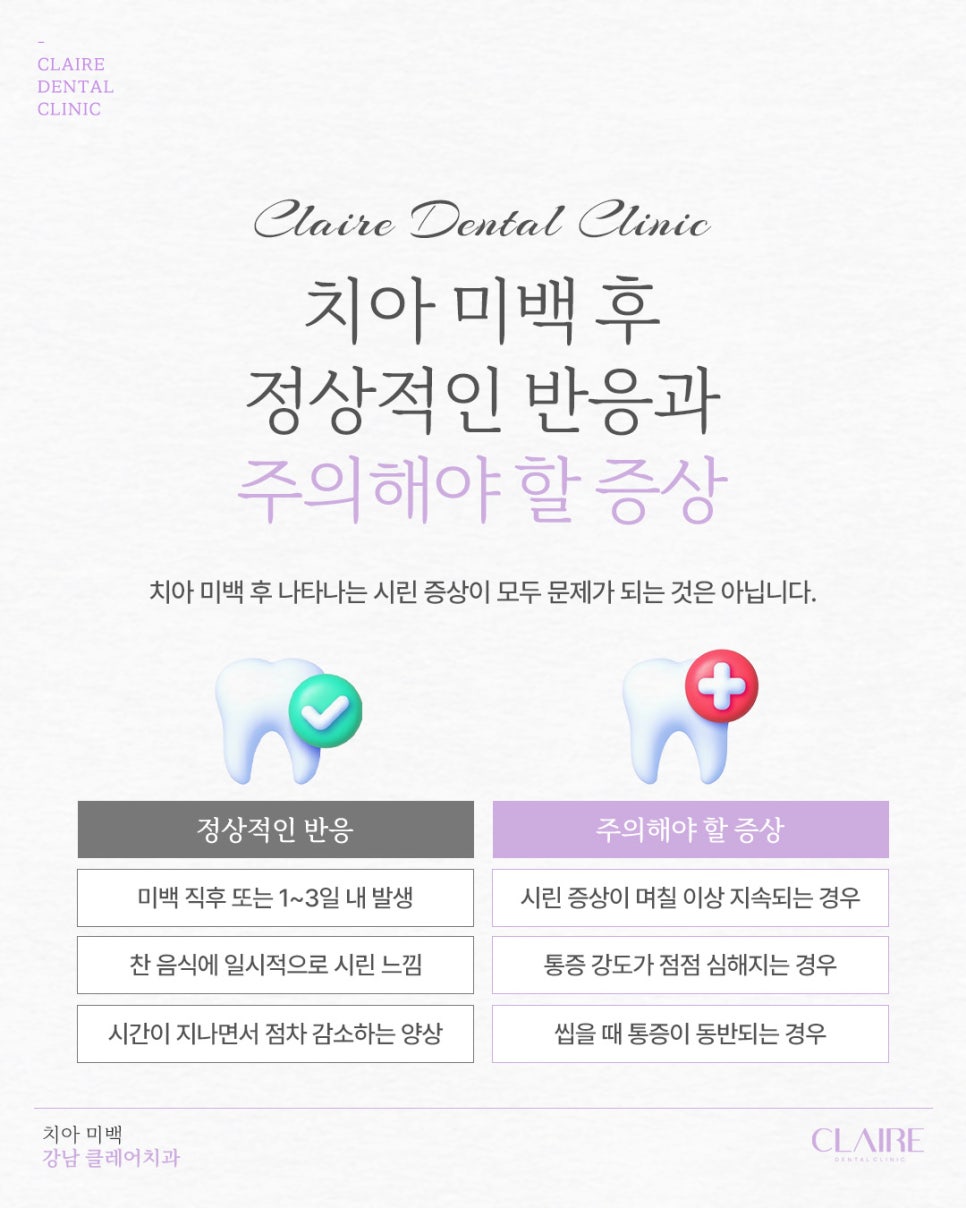
After whitening, what symptoms are normal and what symptoms require caution?
When you feel tooth sensitivity after whitening, the most important thing is to determine whether the symptom is within the normal range.
In general, feeling sensitive for about 1 to 3 days is a natural and normal reaction.
Usually, it gradually subsides after enough rest and time passes, so in many cases there is no need to worry too much.
Sometimes the gums may turn red or even whitish, but this is also likely to return to normal naturally within a few days.
However, there are certain symptoms that are not just temporary reactions and should be checked more carefully.
✔️ Severe pain that is hard to endure
If the sensitivity does not lessen and gets worse even 3 to 4 days after whitening, or if there is throbbing pain even when you are still, the exact cause may need to be identified.
✔️ White discoloration and soreness of the gums
Also, if the gums become raw, swollen, or bleed, the whitening agent may have irritated the gums excessively.
✔️ Severe staining or white spots on the tooth surface
If whitening progresses unevenly, mottled spots may appear on the tooth surface.
If they do not naturally fade within a few days, additional treatment by the medical team may be necessary.
In such cases, it is a good idea to visit the dentist for an examination, since the condition of the teeth needs to be checked.
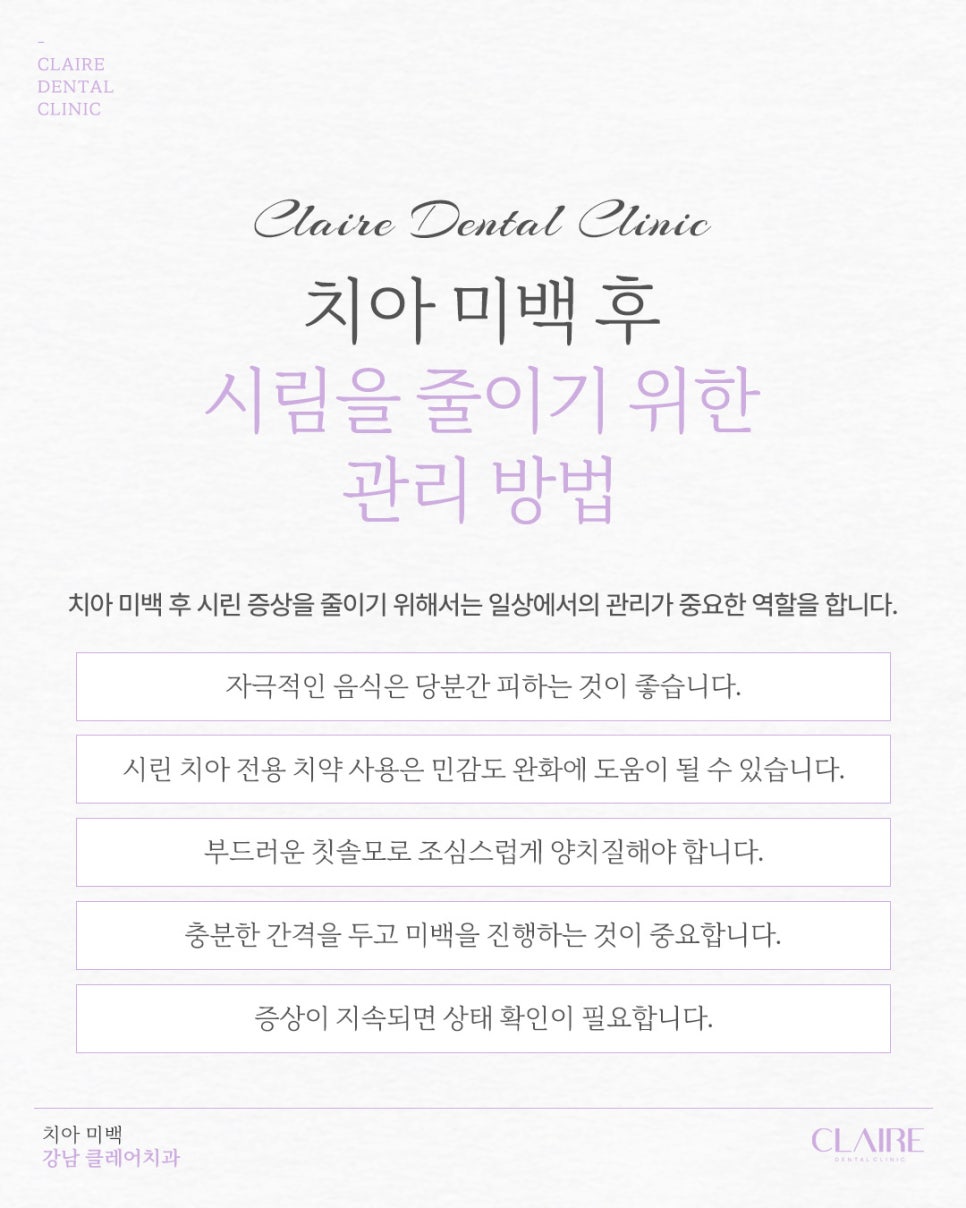
How can you manage sensitivity?
To relieve sensitivity after whitening, daily care plays an important role, so it is recommended to follow a few guidelines.
First, right after whitening, you should avoid foods that may irritate the teeth.
Because the tooth nerves are in a more sensitive state, foods that are too hot or too cold can be irritating.
It is also better to brush gently with a soft-bristled toothbrush and use less pressure than usual.
If the sensitivity bothers you, using a toothpaste made for sensitive teeth may also help.
If pain is interfering with your daily life, you do not need to endure it; taking a pain reliever can also be an option.
Most importantly, while symptoms are present, avoid additional whitening treatments that may be too much for the teeth.
It is advisable to proceed with the next treatment only after the teeth have stabilized sufficiently.
Tooth sensitivity after whitening can be a natural reaction that may occur in anyone.
However, not all sensitivity can be assumed to be normal, so it is important to distinguish the condition based on the intensity and duration of the symptoms.
If the sensitivity is mild and temporary, it can often be relieved enough through daily care.
But if gum discoloration or unbearable pain continues despite careful care and 충분한 rest, please do not hesitate to visit the dentist.
If you keep the precautions shared today in mind and manage things well, it may help reduce discomfort.
Because teeth are a structure that is difficult to recover naturally once damaged, checking even small changes without overlooking them can help protect long-term oral health.