



Previous image
Next image

Tooth decay is
one of the common oral diseases
that many people experience at least once.
However, because it is so common,
it is easy to take it lightly.
In particular, early tooth decay may not be easily visible
or may progress without any noticeable pain,
so it is not uncommon for people to miss the right time for treatment.
Then, at some point, they may experience sensitivity when eating cold foods
or discomfort when chewing.
In severe cases, it can lead to throbbing pain at night,
prompting them to visit the dentist only after the condition has progressed.
Because tooth decay does not naturally heal
as time passes,
it is important to detect and manage it early.
If tooth decay is left untreated for a long time,
inflammation may spread to the nerve inside the tooth,
making root canal therapy or crown treatment necessary.
Today, for those considering Seolleung cavity treatment,
we will take a detailed look at
the process of root canal therapy
and the importance of care after treatment.

Root canal therapy is needed
when tooth decay becomes deep!
Tooth decay is a condition in which the tooth is damaged
by acids produced when bacteria in the mouth
break down sugars in food.
Plaque and food particles can easily remain
in areas that are not brushed properly.
If this environment persists,
the tooth surface may gradually weaken,
and tooth decay may begin.
Although teeth appear hard,
nerve and blood vessel tissue is present inside them.
Tooth decay begins in the enamel,
the outermost layer of the tooth,
and gradually progresses inward.
As the decay becomes deeper,
it can progress more quickly,
so early detection and treatment are important.
At this point, many people may think,
“Isn’t it okay if it doesn’t hurt?”
However, in its early stages,
tooth decay often progresses without noticeable pain,
so detection may be delayed.
As tooth decay deepens,
inflammation may spread through the dentin and toward the nerve.
From this point onward,
it becomes difficult to improve the condition with simple cavity treatment alone.
In particular, if the infection spreads to the nerve,
symptoms such as severe pain, swelling,
or discomfort when chewing may occur.
Therefore, rather than waiting until the pain becomes severe,
it may be necessary to have the current condition examined.
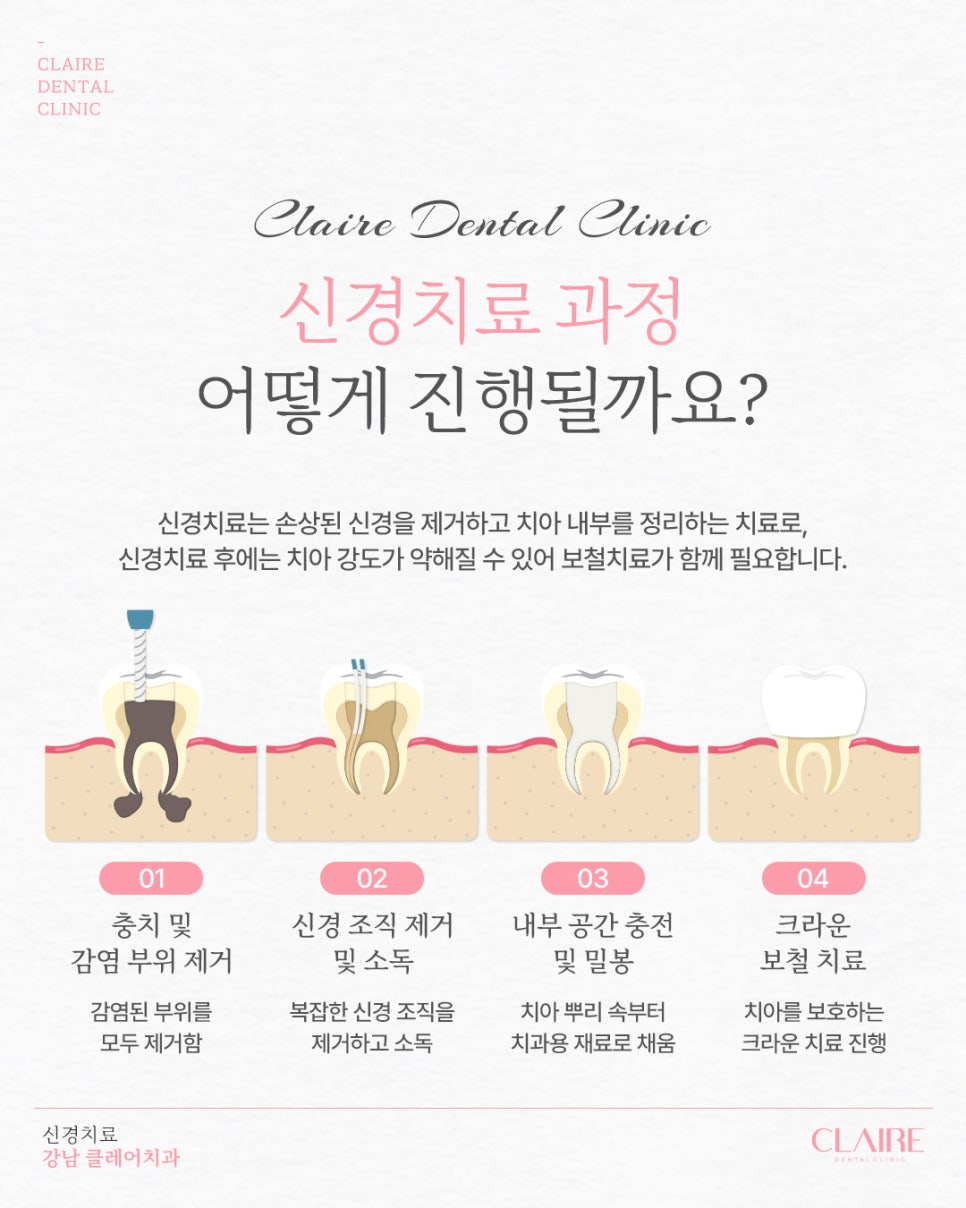
How is root canal therapy performed?
Root canal therapy is a treatment process that removes
damaged or infected nerve tissue
and cleans the inside of the tooth.
It is not a treatment that necessarily involves extracting the tooth.
Rather, it can be considered one of the treatments performed
to preserve the natural tooth.
Root canal therapy is performed through the following steps.
01 Removal of decay and infected tissue
The areas damaged by decay are removed,
and the condition inside the tooth is examined.
02 Removal and disinfection of nerve tissue
Inflamed nerve tissue is removed,
and the internal canals of the tooth are cleaned.
The inside of the tooth is then repeatedly rinsed and disinfected
to reduce the bacteria and inflammatory material remaining inside.
03 Internal filling and sealing
The empty internal space is filled
with dental filling material
and carefully sealed.
04 Crown restoration
Because a tooth that has undergone root canal therapy
may become weaker,
crown restoration may also be performed
to protect it from chewing forces.
However, the number of appointments and the treatment process
may vary depending on the condition of the tooth.
If the area of inflammation is extensive,
additional care may be necessary,
so it is important to be aware of this.
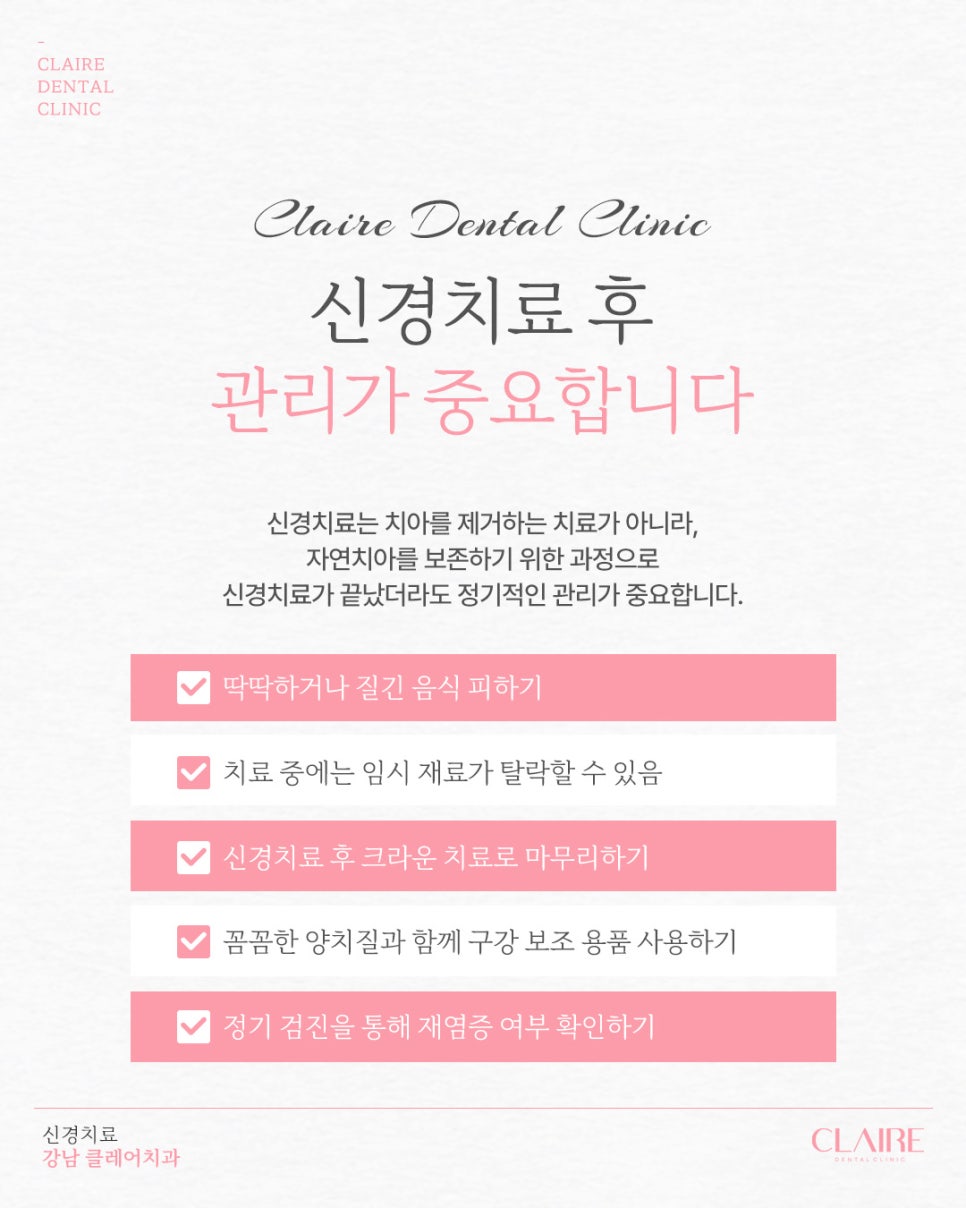
Care after root canal therapy is also important
Root canal therapy removes inflammation from inside the tooth
as part of the process of preserving the natural tooth.
However, completing treatment does not mean
that the tooth completely returns to its original condition.
In particular, because the internal tissue has been removed
from a tooth that has undergone root canal therapy,
it may be weaker than before,
making care after treatment important.
✓ Avoid hard or chewy foods
Immediately after treatment, the tooth may be weaker than usual.
Forcefully chewing hard or chewy foods
such as ice, nuts, or squid
may increase the risk of tooth fracture.
✓ Be careful not to dislodge temporary material
Root canal therapy is not always completed in a single appointment
and may require several visits.
Therefore, care should be taken
so that the temporary material used during treatment
does not come loose.
✓ Complete treatment with a crown
It is important to complete treatment with a crown,
which can protect the tooth,
restore chewing function,
and improve its appearance.
✓ Brush thoroughly and use oral care aids
Even after root canal therapy, tooth decay can recur,
so it is advisable to carefully clean
the margins of the restoration and the spaces between the teeth.
✓ Receive regular checkups
Even when there are no noticeable external symptoms after root canal therapy,
the internal condition should be checked regularly.
Because inflammation may recur in some cases,
consistent care is important.
In addition, the area around the tooth may feel temporarily sensitive
immediately after treatment,
and mild discomfort may occur when chewing.
However, if severe pain continues over time
or gum swelling or pus repeatedly occurs,
another examination may be necessary.
If you are considering Seolleung cavity treatment,
rather than focusing only on whether pain is present,
it is important to first accurately assess
the current condition of the tooth.
If even minor sensitivity or discomfort recurs,
do not leave it untreated.
It is advisable to have a dental examination.
Consistent care and regular checkups
can be important for maintaining healthy teeth
for a long time.