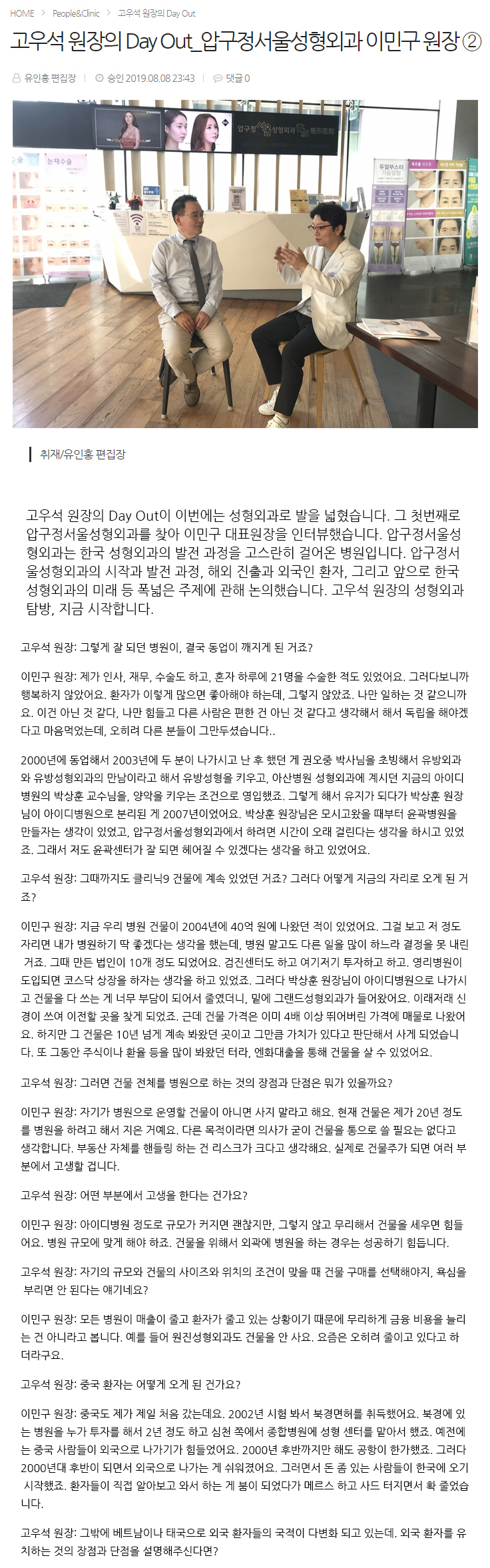
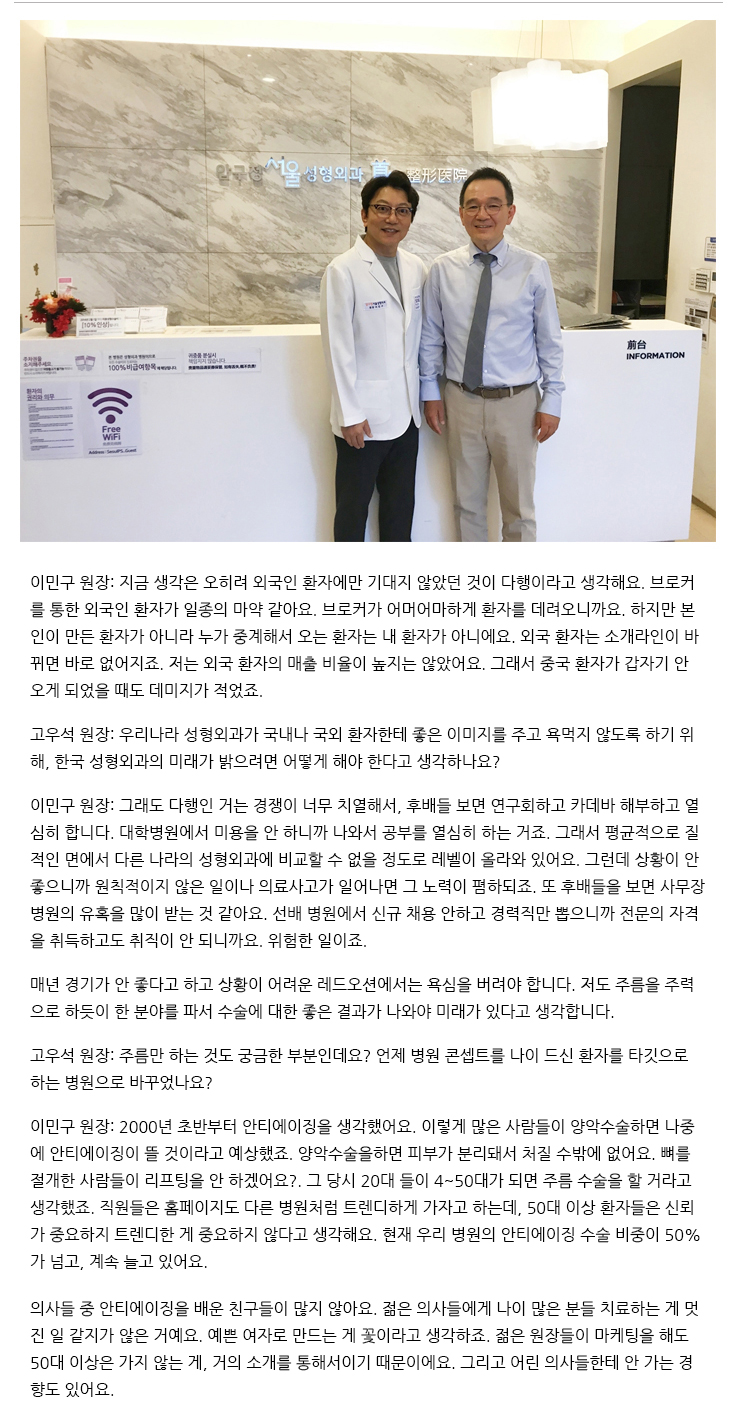
Dr. Goh Woo-seok’s Day Out has now expanded into plastic surgery. As the first stop, he visited Apgujeong Seoul Plastic Surgery and interviewed CEO Director Dr. Lee Min-gu. Apgujeong Seoul Plastic Surgery is a hospital that has walked through the development process of Korean plastic surgery as it happened. We discussed a wide range of topics, including the beginnings and growth of Apgujeong Seoul Plastic Surgery, overseas expansion and foreign patients, and the future of Korean plastic surgery. Dr. Goh Woo-seok’s tour of plastic surgery starts now.
Dr. Goh Woo-seok: So the hospital that was doing so well eventually had its partnership break down?
Dr. Lee Min-gu: I handled human resources, finance, and surgery too, and there was a time when I performed surgery on 21 patients in a single day by myself. Because of that, I wasn’t happy. When there are that many patients, you should be happy, but I wasn’t. It felt like I was the only one working. I thought this wasn’t right, that it didn’t seem fair for only me to struggle while others were comfortable, so I decided I needed to become independent—but instead, the other partners quit.
We formed the partnership in 2000, and after the two left in 2003, what we did was invite Dr. Kwon Oh-joong and, under the idea of bringing together breast surgery and breast plastic surgery, grow the breast plastic surgery field. We also brought in Professor Park Sang-hoon, who was then at Asan Medical Center’s plastic surgery department and is now with ID Hospital, on the condition that he would develop orthognathic surgery. That is how we continued, and Dr. Park Sang-hoon separated and moved to ID Hospital in 2007. From the time we brought Dr. Park Sang-hoon in, he had the idea of building a contouring hospital, and he was already thinking that doing it at Apgujeong Seoul Plastic Surgery would take a long time. So I also thought that if the contour center did well, we could part ways.
Dr. Goh Woo-seok: You were still in the Clinic9 building back then, right? How did you end up at your current location?
Dr. Lee Min-gu: The building where our hospital is now was once listed for 4 billion won in 2004. When I saw that, I thought a place like that would be perfect for my hospital, but because I was also doing many other things besides the hospital, I couldn’t make a decision. By then, the corporation we had created had about 10 entities. We were also running a screening center and investing in various places. We were thinking that if for-profit hospitals were introduced, we would list on KOSDAQ. Then Dr. Park Sang-hoon left for ID Hospital, and using the whole building became too much of a burden, so we downsized—and Grand Plastic Surgery moved into the space below. All of that made me think about relocating. But the building had already been listed at more than four times the original price. Still, I had watched that building for more than 10 years, and I judged that it was worth that much, so I bought it. Also, because I had been watching stocks and exchange rates a lot, I was able to buy the building through a yen-denominated loan.
Dr. Goh Woo-seok: Then what are the advantages and disadvantages of using an entire building as a hospital?
Dr. Lee Min-gu: I say not to buy a building unless it is one you will operate as a hospital yourself. The current building was built because I intended to run the hospital there for about 20 years. If there is another purpose, I don’t think a doctor necessarily needs to use an entire building. I think handling real estate itself carries a big risk. In reality, if you become a building owner, you will have a hard time in many ways.
Dr. Goh Woo-seok: What kind of things make it hard?
Dr. Lee Min-gu: If the scale is as large as ID Hospital, it is fine, but if not and you force yourself to build a building, it becomes difficult. You have to do it in a way that matches the hospital’s size. It is hard to succeed if you run a hospital in an outlying area just for the sake of the building.
Dr. Goh Woo-seok: So you should choose to buy a building only when your scale, the building size, and the location conditions match, and not get greedy?
Dr. Lee Min-gu: Since sales are falling and the number of patients is decreasing at every hospital, I don’t think it is right to increase financial costs recklessly. For example, even Wonjin Plastic Surgery does not buy buildings. I heard they are actually reducing things these days.
Dr. Goh Woo-seok: How did Chinese patients start coming?
Dr. Lee Min-gu: I was the first one to go to China too. I took the exam in 2002 and obtained a Beijing license. Someone invested in a hospital in Beijing, and I ran it for about two years, then took charge of the plastic surgery center at a general hospital in Shenzhen. In the past, it was hard for Chinese people to go abroad. Even until the late 2000s, airports were quiet. Then in the late 2000s, it became easier to go overseas. As a result, people with some money started coming to Korea. There was a boom in patients who researched on their own and came directly, but that dropped sharply after MERS and THAAD.
Dr. Goh Woo-seok: In addition, foreign patients are becoming more diverse in nationality, with more coming from Vietnam and Thailand. If you were to explain the pros and cons of attracting foreign patients?
Dr. Lee Min-gu: Looking back now, I think it was fortunate that we did not rely only on foreign patients. Foreign patients brought in through brokers are like a kind of drug. Brokers bring in an enormous number of patients. But patients who come through someone else’s referral, not ones I created myself, are not truly my patients. Foreign patients disappear immediately if the referral line changes. The share of my revenue from foreign patients was not high, so when Chinese patients suddenly stopped coming, the damage was small.
Dr. Goh Woo-seok: What do you think should be done for Korean plastic surgery to have a bright future, so it can give a good image to domestic and overseas patients and avoid criticism?
Dr. Lee Min-gu: The fortunate thing is that competition is so intense that when I look at younger doctors, they study hard through study groups and cadaver dissection. Since university hospitals do not do much aesthetic surgery, they come out and study hard. So, on average, the quality level has risen to a point where it is incomparable to plastic surgery in other countries. But because the situation is not good, if something non-principled happens or a medical accident occurs, all that effort gets diminished. Also, when I look at younger doctors, it seems they are heavily tempted by clinic-run hospitals. Since senior hospitals do not hire new staff and only recruit experienced doctors, even after obtaining board certification they cannot get jobs. It is dangerous.
In a red ocean where people say the economy is bad every year and conditions are difficult, you have to let go of greed. I also think that, just as I focus on wrinkles as my main field, there is a future only when you dig deeply into one area and get good surgical results.
Dr. Goh Woo-seok: I’m curious about doing only wrinkles as well. When did you change the hospital concept to one targeting older patients?
Dr. Lee Min-gu: Since the early 2000s, I had been thinking about anti-aging. I predicted that with so many people getting orthognathic surgery, anti-aging would become popular later on. If you get orthognathic surgery, the skin separates and inevitably sags. Would people who have had bone surgery not get lifting procedures? At that time, I thought that when people in their 20s became 40s and 50s, they would seek wrinkle surgery. The staff say the website should be trendy like other hospitals, but I think that for patients over 50, trust is important, not trendiness. At present, anti-aging surgery makes up more than 50% of our hospital’s procedures, and it keeps increasing.
There are not many doctors who have learned anti-aging among doctors. Younger doctors don’t think treating older patients is cool. They think making people into beautiful women is the highlight. Even when younger directors do marketing, people over 50 do not come because it is mostly through referrals. And there is also a tendency not to go to younger doctors.