Hello, this is Director Choi Junghyuk of Apgujeong Seoul Plastic Surgery.
Nose surgery is one of the important procedures many people consider to improve their appearance and boost their confidence.
Because it can bring major changes to your appearance,
it is very important to understand the post-operative precautions accurately
and manage recovery thoroughly.
If nose surgery is not properly managed after the operation, unexpected
side effects or delayed recovery may occur,
so consistent care and caution are needed after surgery.
Today, for those who are considering nose surgery or
have already had nose surgery, I would like to share some precautions.
Post-Operative Care After Nose Surgery
After nose surgery, care is needed to protect the surgical area
and support recovery.
Right after surgery, tape or a splint will be applied,
which helps maintain the shape of the nose stably.
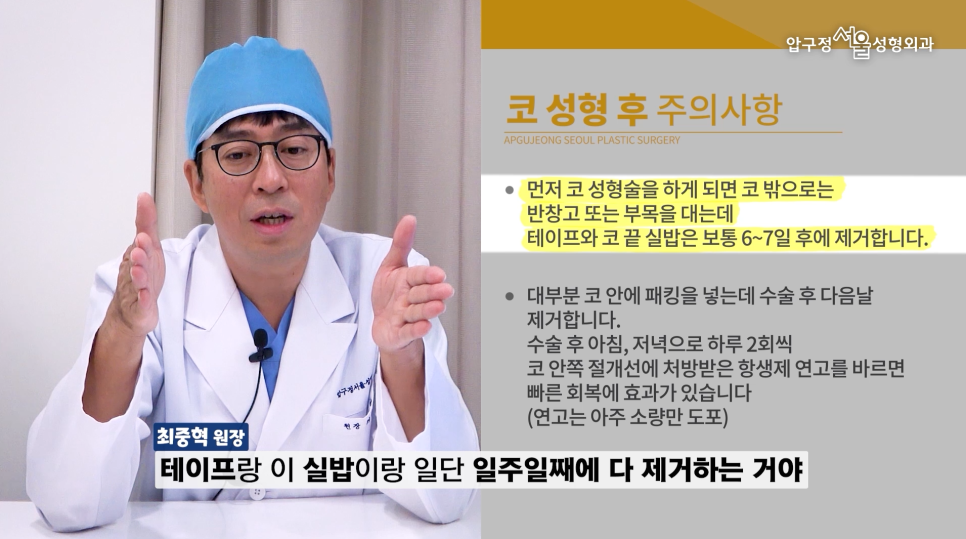
The tape or splint should be removed 6–7 days after surgery,
and it must be removed at the hospital.
If the tape or splint is removed incorrectly, the shape of the nose may
deform,
so it is important to be treated by a specialist.
In addition, packing is placed inside the nose, and the day after surgery,
the packing is removed.
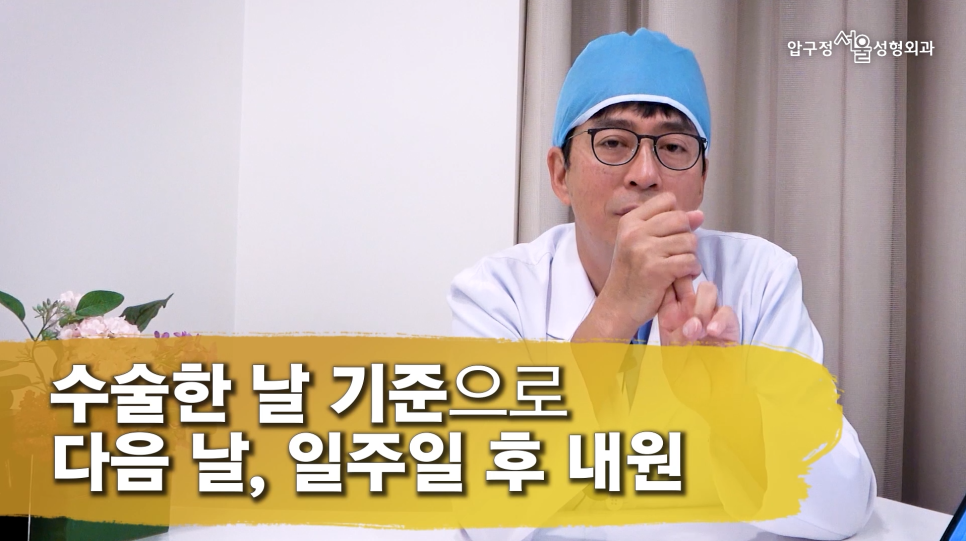
Even after the packing is removed, you will visit the hospital
for treatment twice at one-week intervals,
and this process plays an important role in supporting recovery and reducing swelling.
After surgery, apply ointment to the incision inside the nose twice a day,
in the morning and evening, to promote recovery,
which is effective because it helps wounds heal quickly.
Tape, Splint, and UV Precautions
The tape or splint should not be removed on your own,
as there is a concern that the shape of the nose may change;
it must be removed at the hospital! Until the tape or splint is removed,
you should protect the nose from external irritation.
Bruising may occur after surgery,
and it usually disappears after about 2–3 weeks.
If you are bruised, exposure to direct sunlight may cause pigmentation on the face,
leading to freckles or dark spots, so until the bruising disappears completely,
you should avoid direct sunlight by using a hat or cosmetics containing sunscreen.
Exercise and Smoking Precautions
After surgery, exercise, drinking, and smoking can all interfere with recovery,
so caution is necessary.
Alcohol and smoking interfere with blood circulation
and can delay wound healing,
which may cause swelling at the surgical site to last longer.
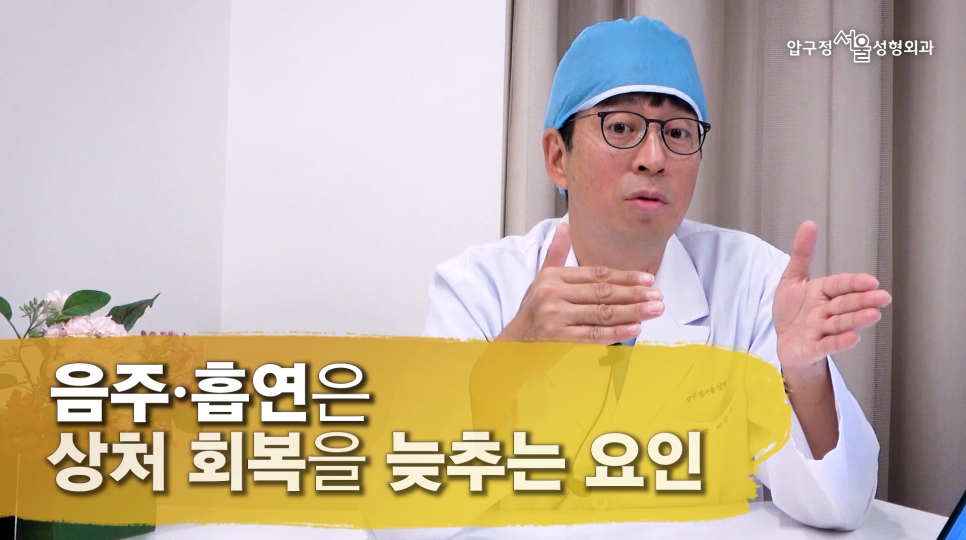
In particular, smoking has a negative effect on skin regeneration
and may slow wound healing.
Therefore, it is best to avoid alcohol and smoking
for at least 4 weeks after surgery.
Also, intense exercise can raise blood pressure
and worsen swelling,
so strenuous exercise should be avoided during the first 4 weeks after surgery.
During this period, it is better to keep exercise limited to light walking.
Ice Packs and Posture Management
Ice packs are effective in relieving swelling and inflammation,
and they should be used consistently from immediately after surgery
through the first and second day after surgery.
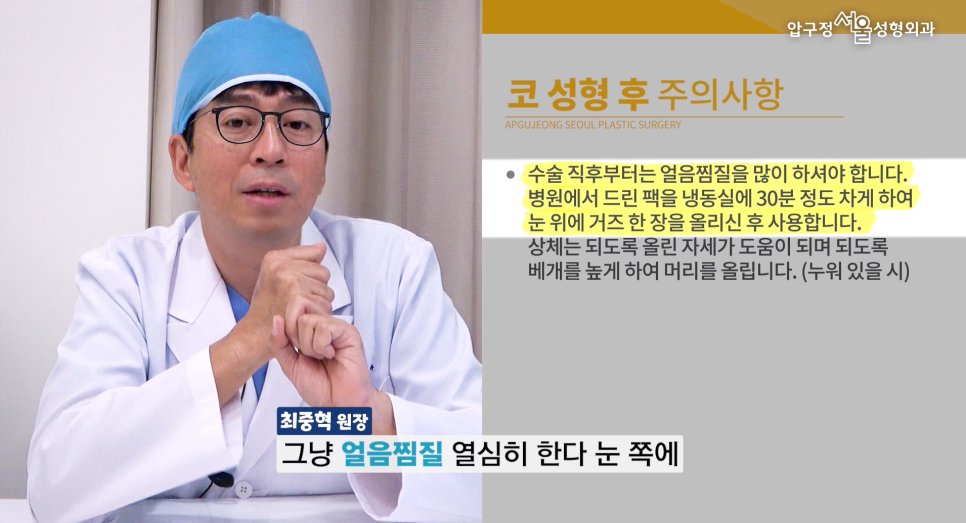
Put the ice pack provided by the hospital into the freezer
and chill it for about 30 minutes,
then place gauze over the eyes and begin cooling.
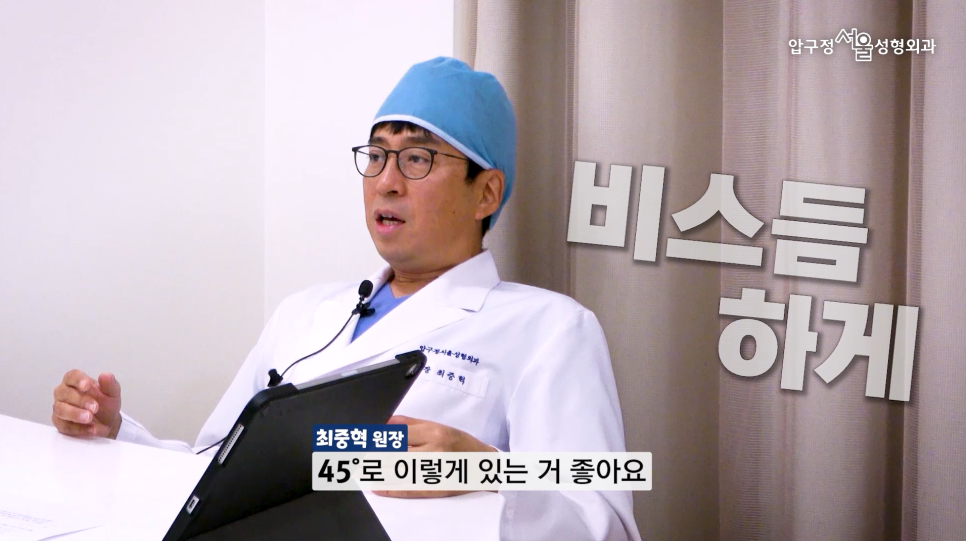
For the first few days after surgery, it is good to keep your upper body raised
at a 45-degree angle while sitting,
or to use a higher pillow to keep your head elevated.
This helps the swelling go down more quickly,
and speeds up recovery.
Of course, it is also possible to rest or sleep comfortably lying down, but it is better to rest with your head elevated as much as possible.
Washing Your Face and Bathing Precautions
Right after surgery, you may gently wash only the rest of your face,
excluding the nose area.
Immediately after surgery, care should be taken to prevent water from touching the nose,
and when washing your face, the area around the nose should be wiped carefully.
During the first week, you must carefully manage the nose so that water does not touch it,
and after the stitches are removed,
you can gradually begin washing the nose area as well.
Bathing and washing your hair are possible even after surgery,
but special care must be taken to prevent water from touching the nose.
On the first day after stitch removal, gently wash only the area where the stitches were,
and the rest of the face can be washed normally.
Progress and Hospital Visits
After surgery, it is important to regularly check the progress
and make sure recovery is proceeding without problems.
On the seventh day after surgery, you should visit the hospital
to remove the dressing and stitches,
and after that, it is good to return to the hospital again after 3–4 weeks
to check the progress.
Of course, if recovery is going well,
you may not need to visit the hospital,
but checking your condition after surgery and receiving advice from a specialist
is a good way to ensure faster and safer recovery.
Nose surgery is not simply a procedure aimed at changing appearance.
It is a very delicate and precise operation,
and its results can greatly affect a patient’s appearance and confidence.
Therefore, post-operative care is important,
but most importantly, the key is choosing a medical team that performs the surgery well.
This is because only when the surgery is performed well can recovery be fast,
and a natural result be achieved without side effects.