Hello, this is Director Choi Junghyeok of Apgujeong Seoul Plastic Surgery.
In these busy times, many people look into #chin #implant surgery because it can offer a significant effect in return for the cost and time involved.
Let’s take a look at some of the questions that are often asked during consultations about #chinimplant surgery.
Q. If you have a weak chin,
is a double chin inevitable?

When the chin tip is small or set back, the skin and fat may not be pulled taut enough,
so excess tissue can remain.
As this residual fat builds up over time,
there is a high chance that the double chin will become more noticeable.
In many cases, chin correction surgery alone can refine the jawline and naturally improve the double chin.
However, if there is a large amount of fat or poor skin elasticity,
the improvement may be limited.
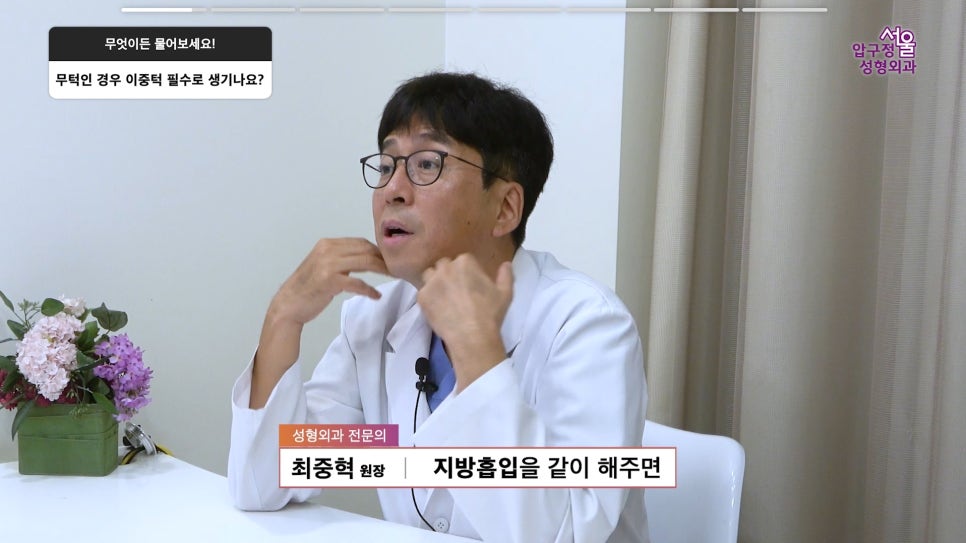
In such cases, combining liposuction with chin surgery can more effectively address the double chin
and create a sharper, more balanced facial contour.
Q. After chin implant surgery,
is there a risk of bone erosion?
When a silicone implant is inserted into the chin tip,
over a long period of time the implant may press lightly against the bone.
This may cause the bone to erode very slightly,
but it is not something to worry about seriously.

Even if erosion does occur,
it is usually very mild, around 1 mm,

and does not cause any special cosmetic or functional problems.
Accordingly, there is no weakening of chewing or speaking functions,
and the shape of the face does not become distorted,
so there is no need to be anxious.
In conclusion, while a silicone implant may cause some thinning of the bone,
it does not create any problems in daily life or aesthetically,
so there is no need to worry.
Q. After chin implant surgery,
will the face look longer?
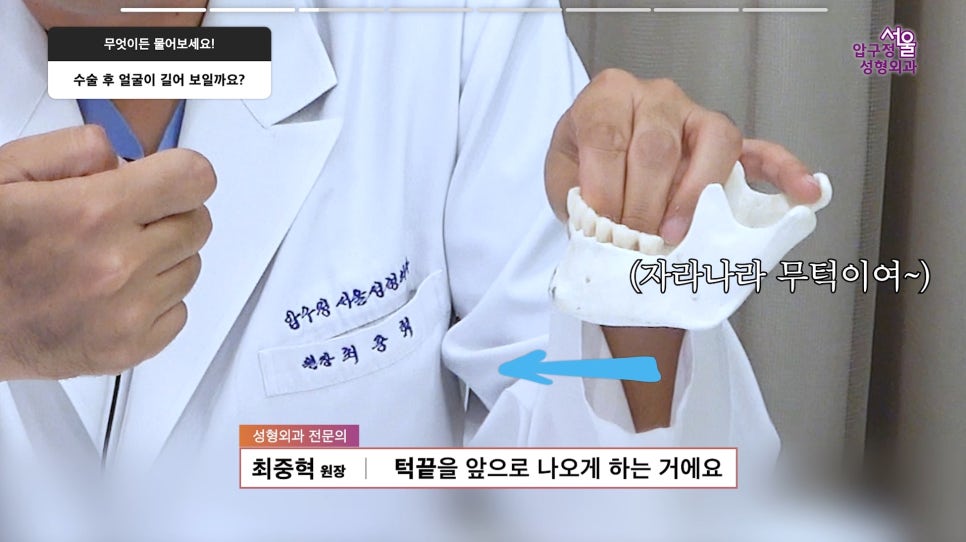
The main purpose of chin surgery is to bring the chin forward and balance the face from the side and front.
Through this, the facial outline becomes clearer,
creating a more three-dimensional impression.
During consultations, some people want not only to move the chin forward but also to make the chin tip slightly longer.
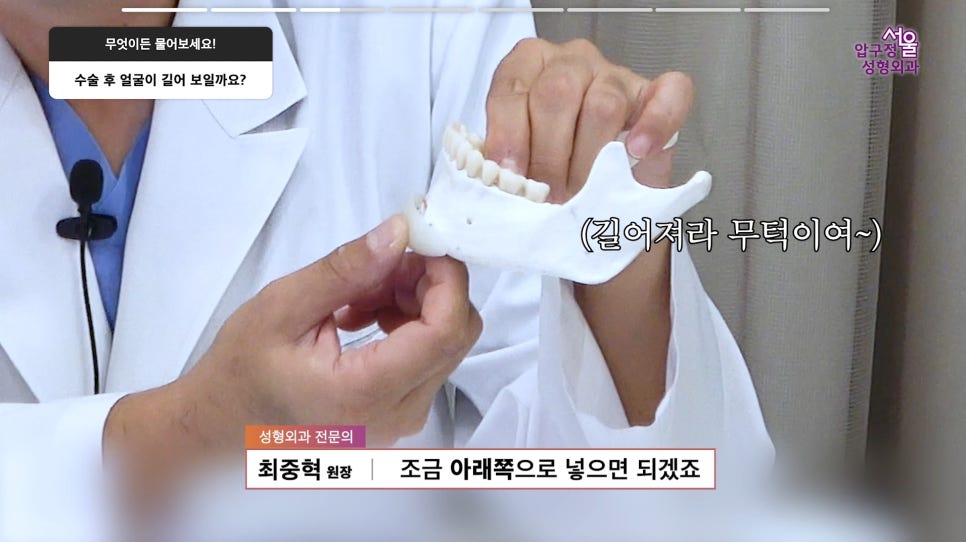
In such cases, if the silicone implant is inserted slightly lower in line with the jawbone,
the length can be adjusted naturally.
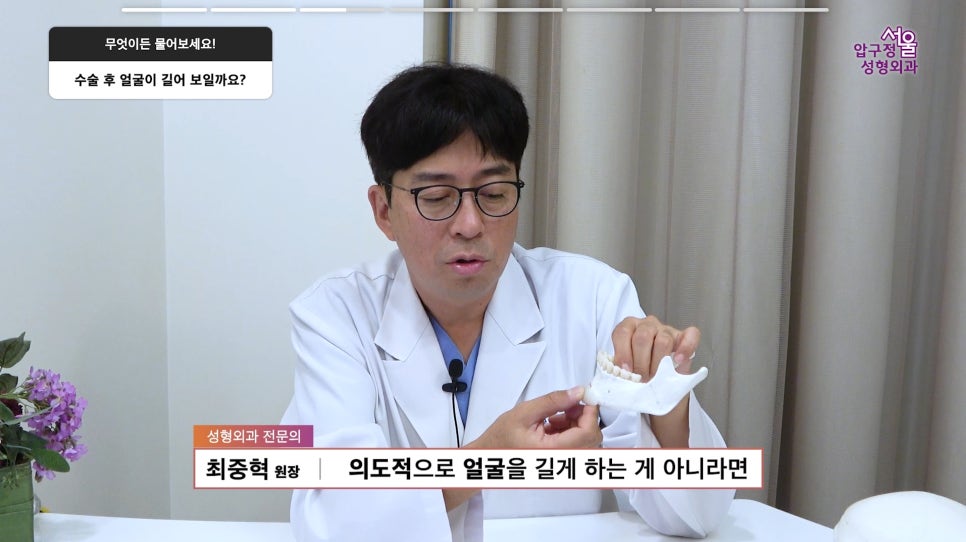
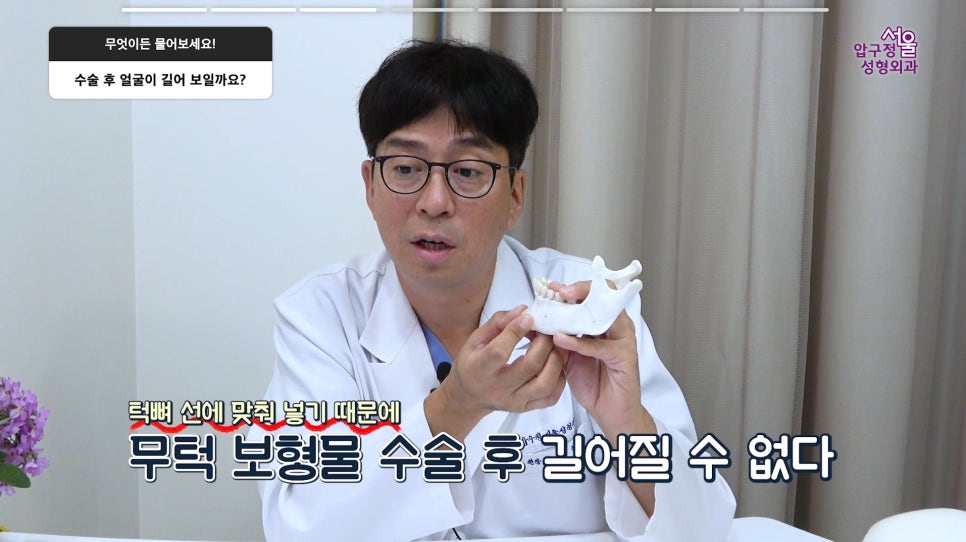
Because silicone implants are positioned to match the structure of the jawbone,
unless the goal is specifically to make the face longer,
the overall face length will not noticeably increase.
So there is no need to worry that chin surgery will make your face look longer.
Q. After surgery, if I press on my chin,
can the shape of the implant change?
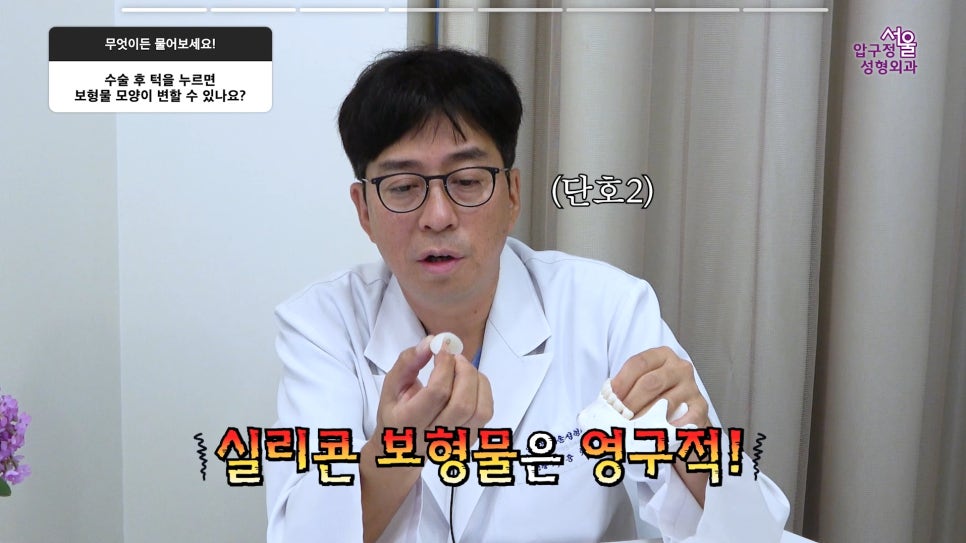
Once a silicone implant is inserted,
it is a permanent material that does not deform or get absorbed,
so there is no need to worry about its shape changing over time.

However, right after surgery,
the implant has not yet fully settled,
so it is important to avoid touching it by hand or resting your chin on your hand, especially during the first week.

After this period, the implant becomes stably fixed,
and from then on you can freely eat, wash your face, and sleep in your usual positions
without any special restrictions in daily life.
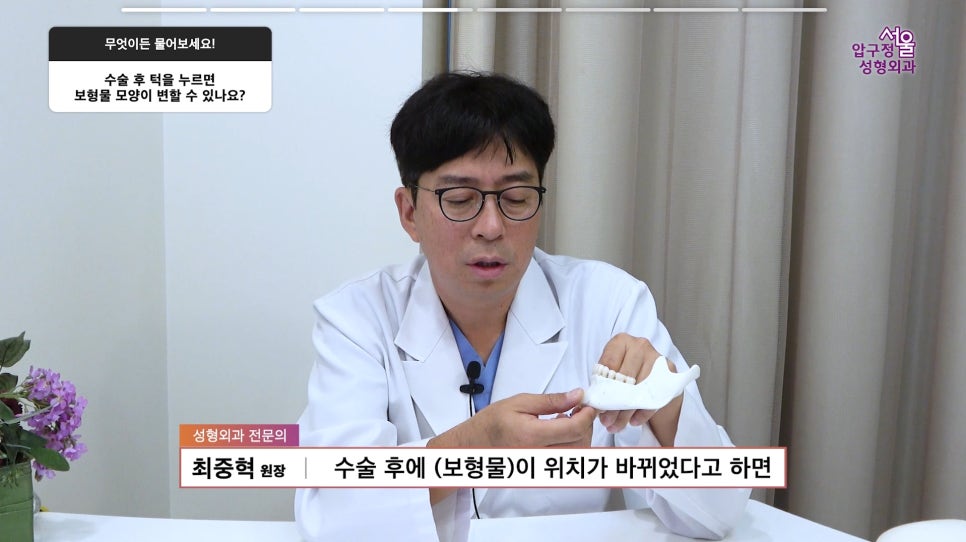

If you feel that the implant’s position has changed after surgery,
it is more likely not because you moved it by touching it,
but because it was not sufficiently fixed during surgery or was not inserted in the correct position.
So rather than worrying about the implant moving,
just be careful during the initial recovery period.
Q. After chin implant surgery, is it okay to sing or yawn widely?
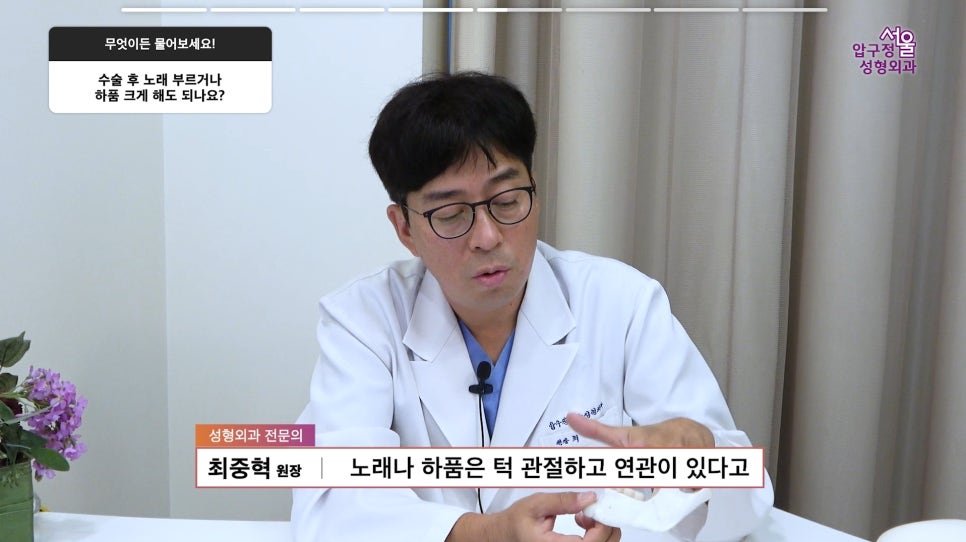

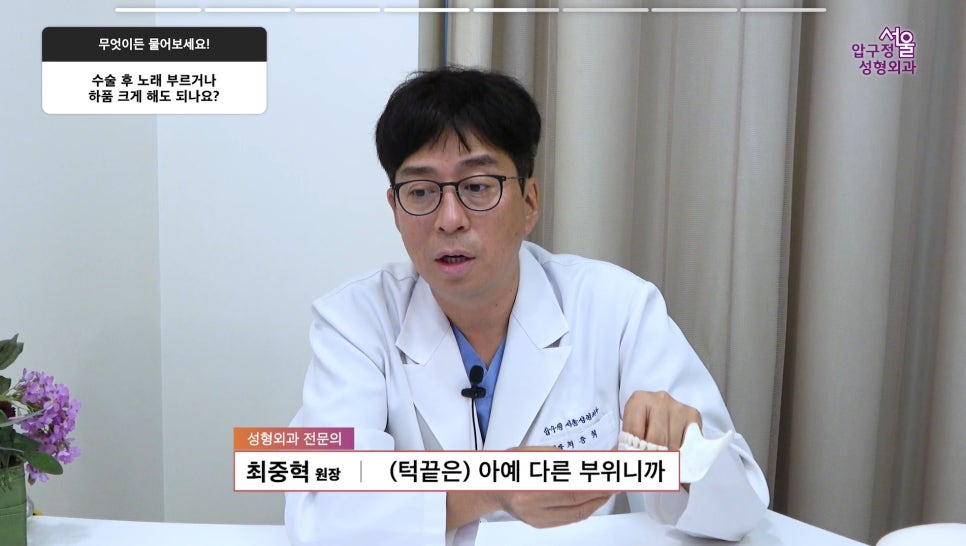
Singing or yawning may be related to the temporomandibular joint,
but since this is a completely different area from the chin tip,
it is not an action that requires special caution after chin surgery.
So after surgery, you can sing or yawn freely without any problem.
Q. Ten years after chin implant surgery,
do I need to replace the implant?

When a silicone implant is inserted,
some people think that it has an expiration date
and must be replaced at regular intervals.

However, silicone implants are not materials that deform or wear out,
so there is absolutely no need to replace them even after 5 or 10 years.


Of course, in rare cases inflammation may occur
or unexpected problems may arise,
but in such cases, treatment or correction can be performed as needed.

However, simply because time has passed,
there is no need to replace the implant,
so you do not need to worry about this long term either.
Q. After surgery, is there a reason why I need to tape my chin?
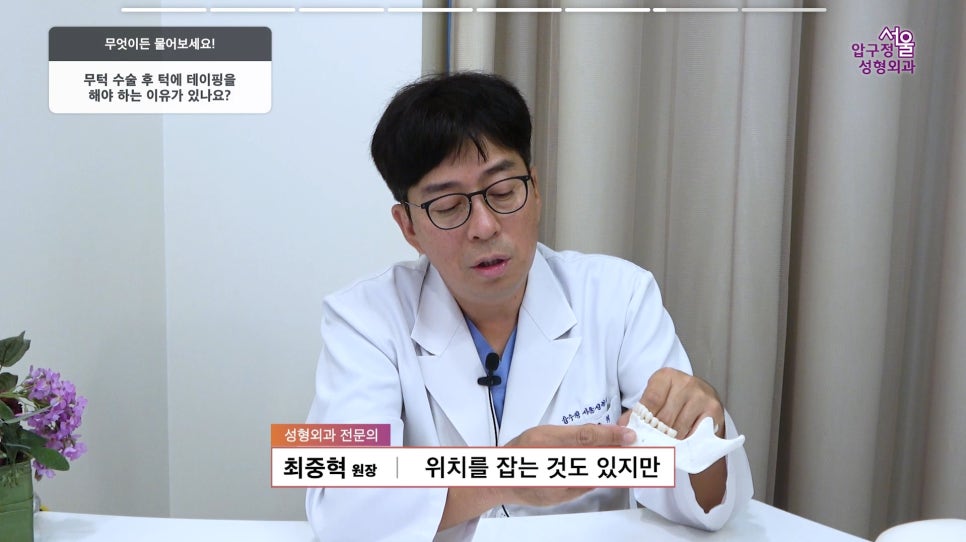
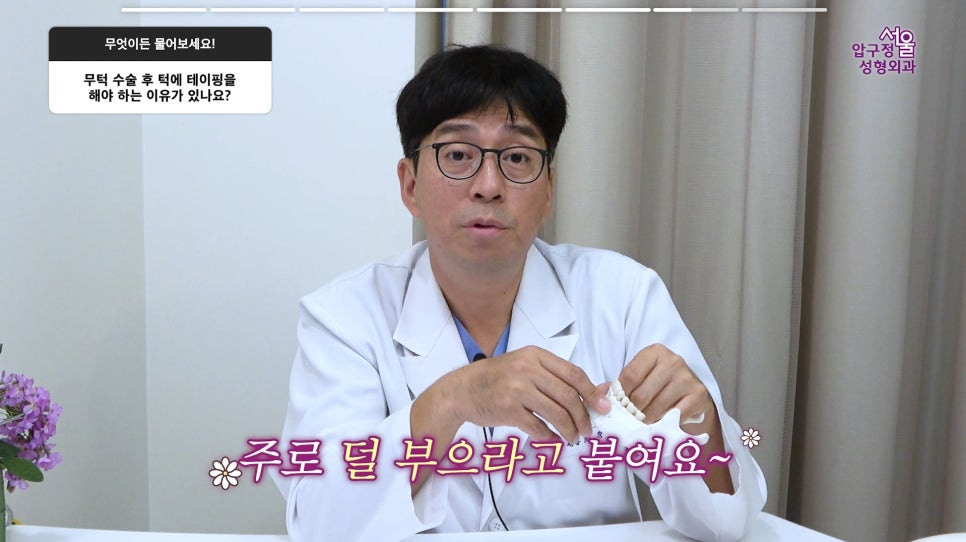
The tape also helps stabilize the implant’s position,
but its main purpose is to reduce swelling.
Therefore, it does not need to be kept on for a long time.
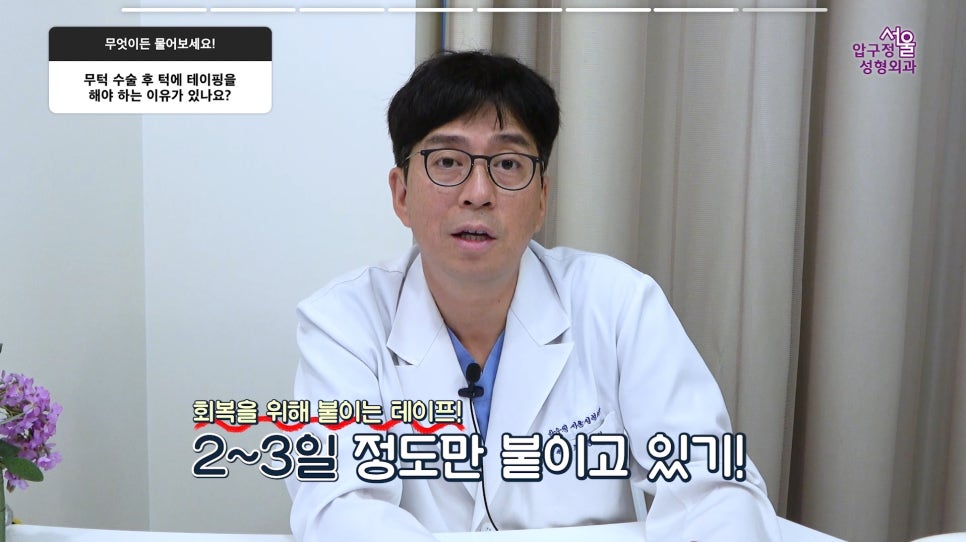
It is an auxiliary tool used to support recovery after surgery,
so usually keeping it on for about 2 to 3 days is sufficient.
After that, the swelling will naturally subside
and the tissue will begin to settle,
so there is no need to keep it on any longer and you can stay comfortable.
Chin implant surgery is a relatively simple procedure,
but it can be very helpful in improving facial contour and balance.
The implant is maintained permanently,
and because it does not deform or need replacement over time,
it is a method that can be chosen without much burden.
After surgery, if you simply take light care during the initial recovery period,
over time it settles naturally without interfering with daily life.
Also, concerns such as changes in face length or implant movement,
which people often worry about, are often misinformation,
so there is no need to be anxious.
By choosing the method that suits you through accurate information and 충분한 consultation,
you can complete a clearer and more balanced facial line.
If you have any further questions about chin implants or would like a consultation,
please contact us through the reservation window below.
This has been Director Choi Junghyeok.
Thank you.