Revision Rhinoplasty Probability
Why does it feel so unsettling?
Hello.
I am Choi Joong-hyuk, a board-certified plastic surgeon at Apgujeong Seoul Plastic Surgery, where I have long performed nose surgery and revision nose surgery in Apgujeong.
One of the questions I hear most often in the consultation room is this.
"Is rhinoplasty a surgery that often needs revision?"
This question mixes vague fear with fragmentary stories heard from others.
But the reality we see in clinical practice is a little different.
Where did the idea that revision is inevitable start?
There is a reason people say, "You end up needing nose surgery again anyway."
Until the early 2000s, it was common to insert only silicone into the bridge of the nose, with little consideration given to the structure of the nasal tip.
As a result, over time, many cases led to revision surgery because the tip drooped, only the bridge looked overly prominent, or the shape did not suit the face. In other words, the limitations of older surgical methods created the perception that the probability of revision rhinoplasty is high.
The biggest cause is not inflammation
Many people think silicone side effects or inflammation are the biggest causes.
But in reality, most reasons that lead people to decide on revision are dissatisfaction with the shape.
Feeling awkward from the front, insufficient support at the nasal tip, asymmetry that appears over time
These issues lead to the conclusion that they want it done again.
In other words, the probability of revision rhinoplasty is more deeply connected to design issues than to material issues.
The key factor that determines whether revision is needed
is the nasal tip

From a medical standpoint at Apgujeong Seoul Plastic Surgery,
bridge-related issues are relatively easier to correct.
Height, curvature, line adjustment
But the nasal tip is different. Cartilage strength, damage caused by previous surgery, skin thickness
All of these factors affect the outcome.
The less adequately the nasal tip is designed, the more likely revision becomes over time.
That is why experienced specialists spend the most time on the tip from the very first surgery.
If the skin is thin,
will the probability of revision rhinoplasty increase?
That is not entirely wrong.
Rhinoplasty is not a surgery that changes the skin;
it is a surgery that creates the structure underneath the skin.
The thinner the skin, the more likely cartilage contours, implant edges, and subtle asymmetry
are to show through.
In such cases, if height is increased too aggressively out of excessive desire, the likelihood of eventually needing revision increases.
So rather than asking, "How high can it be raised?"
The more important question is, "What is the stable height for my face?"
Facts you need to know to reduce the probability of revision rhinoplasty
Many people ask.
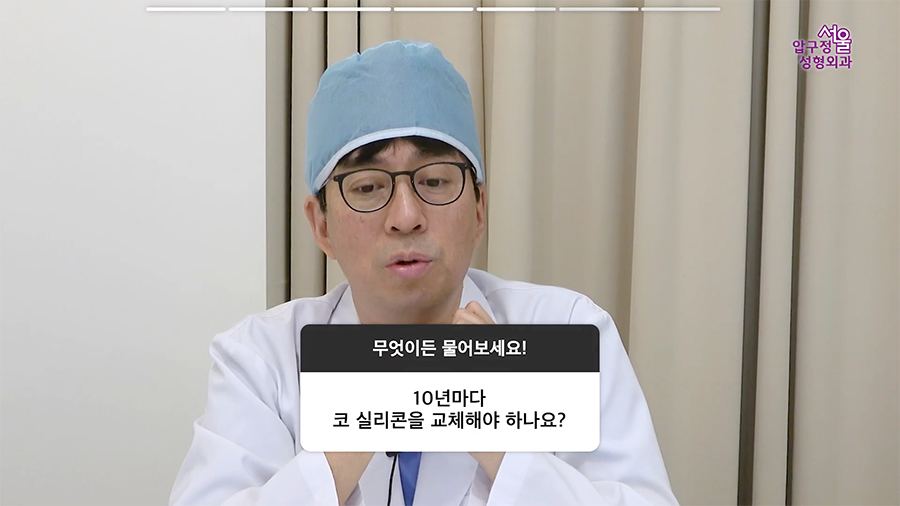
"Should silicone be replaced every 10 years?"
The answer is no. If there is no problem, silicone can be maintained for life.
Revision is needed when there is a clear reason, such as changes in shape, contracture, calcification, or inflammation.
Also, swelling from revision surgery may be less than after the initial surgery if it is a simple correction,
or it may be greater if it is a full revision.
There is no need to assume that revision surgery is always difficult.
Closing remarks from Apgujeong Seoul Plastic Surgery
The standards of people considering rhinoplasty have become much higher than before.
Natural results, stability, and results that last a long time
It is only natural to want all of these.
The second surgery in rhinoplasty is
not the problem of the surgery itself, but the result of choices and design.
What is possible with the current condition of your nose,
what should be avoided—an accurate consultation that clarifies these points
is the most realistic way to avoid revision surgery.
As a board-certified plastic surgeon at Apgujeong Seoul Plastic Surgery,
I hope this article has eased your concerns, even a little.