Can you really not make a “pig nose” after rhinoplasty?
Rhinoplasty consultation at Apgujeong Seoul Plastic Surgery

Hello.
I am Dr. Choi Jung-hyuk, a board-certified plastic surgeon at Apgujeong Seoul Plastic Surgery.
When conducting rhinoplasty consultations,
there is one question I hear particularly often.
“Doctor, if I undergo rhinoplasty, will I never be able to make a ‘pig nose’ for the rest of my life?”
On social media, people sometimes say that being able to make a “pig nose” means you have a natural nose,
while not being able to do so means you have a surgically altered nose.
As a result, people who are considering surgery often worry
that their nose might look too obviously altered.
However, it is not accurate to judge whether someone has had surgery solely by whether they can make a “pig nose.”
Today, I will explain what I most often discuss during consultations at Apgujeong Seoul Plastic Surgery regarding the “pig nose” after rhinoplasty.
Why a “pig nose” may not be possible
It is not simply because of an implant.
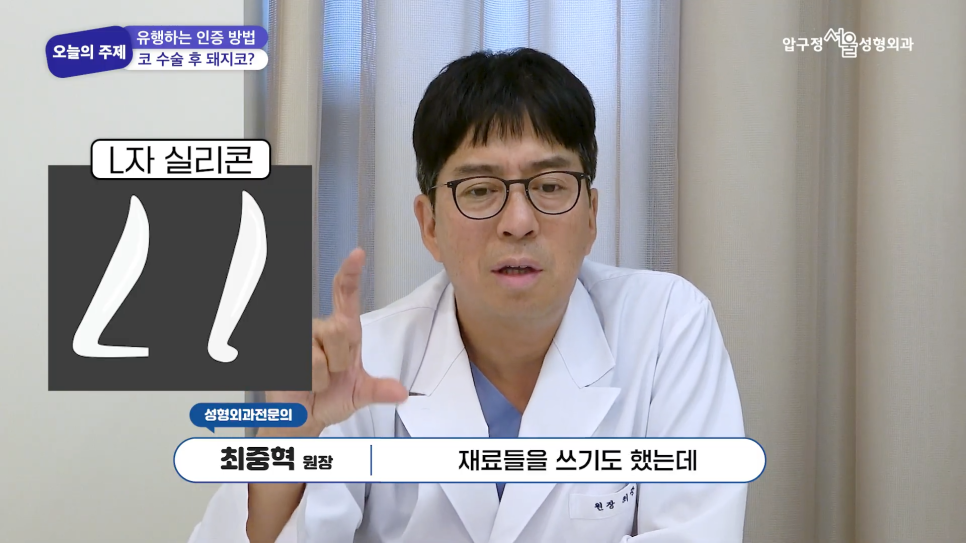
In the past, long silicone implants were often used.
With this approach, movement at the tip of the nose was restricted, making it almost impossible to create a “pig nose.”
However, in modern rhinoplasty, it is important not simply to raise the tip of the nose,
but to create a structure that supports it securely.
The tip of the nose is naturally a soft, mobile area.
However, raising the tip requires a certain degree of support to maintain its shape.
Therefore, after surgery, the tip of the nose may naturally feel somewhat firmer than it did before surgery.

In other words, the reason a “pig nose” may not be possible is related not simply to the implant,
but also to structural changes made to maintain the tip of the nose securely.
During rhinoplasty consultations, I am also often asked whether a slightly firmer nasal tip is normal
and whether it might look too unnatural.
Creating the amount of support that is needed and making the tip excessively hard are clearly different matters.
The movement of the nose may vary depending on the material used for the nasal tip.

Ear cartilage, septal cartilage, and rib cartilage are primarily used in rhinoplasty.
Because each material has a different level of firmness, the movement of the nasal tip can also differ.
Ear cartilage is the most flexible, so movement tends to feel relatively natural.
Septal cartilage offers a balance between appropriate support and movement.
Rib cartilage is the firmest material. While it provides strong support for the nasal tip,
movement may be relatively restricted.
The important point here is that no material is unconditionally good or bad.
The appropriate material depends on how much the nose needs to be raised, the thickness of the skin,
and the structure of the existing nose.
That is why the process of finding the method suited to you through an in-person rhinoplasty consultation is more important than relying on reviews posted on social media.
When can you make a “pig nose” after rhinoplasty?
Immediately after surgery, the tissues and supporting structures inside the nose are settling into place.
During this period, it is best to avoid touching or twisting the nose forcefully.

In general, after about one month, the internal tissues have stabilized to some extent,
and many people have no difficulty with everyday activities afterward.
Of course, recovery speed varies from person to person, so it is most important to follow the guidance of your treating medical professional regarding the exact timing.
During rhinoplasty consultations, people also often ask whether the shape of their nose might change while washing their face.
Once sufficient time has passed for recovery, it is uncommon for the shape of the nose to change easily as a result of normal daily activities.
Can you tell whether someone has had rhinoplasty?

“What if it looks obvious that I had surgery?”
This is also a concern I often hear in the consultation room.
Open surgery involves an incision in the columella,
but over time, the incision line is generally difficult to notice.
Closed surgery does not involve an external incision, so it is even more difficult to distinguish.

Ultimately, it is not realistically easy to determine whether someone has had rhinoplasty based solely on whether they can make a “pig nose” or by looking only for an incision scar.
What matters more is a natural proportion that harmonizes with the face as a whole.
In my experience, a nose that suits a person’s image tends to provide greater satisfaction than one that looks obviously surgical.
When considering rhinoplasty, you may find a great deal of conflicting information online.
Rather than making a simple judgment that being able to make a “pig nose” means the surgery was successful and not being able to do so means it was an absolute failure,
it is much more important to understand why these differences occur.
At Apgujeong Seoul Plastic Surgery, we comprehensively analyze the current structure of the nose, skin condition, desired appearance, and the level of support needed,
and explain the surgical method appropriate for each individual.
Rhinoplasty is not simply a procedure to raise the nose;
it is a procedure that must also take into account the balance and function of the entire face.
If you are considering surgery, rather than searching only for reviews,
please consult sufficiently with a board-certified plastic surgeon to determine the method suited to you.
That process is the most important first step toward a satisfactory result.