When considering ingredients related to the skin, there are usually
many different ones that are commonly known, such as collagen, elastin,
and hyaluronic acid.
Today, let’s take a look at the ingredient ‘polylactic acid’
among the ingredients related to skin.
I hope this is helpful for those who were curious^^

What Is Polylactic Acid (PLA)?
‘Polylactic acid (Polylactic Acid, abbreviated as PLA)’ is
a biodegradable polymer that is attracting attention in various fields.
A polymer simply refers to a substance in which molecules repeat and
are linked together in a long chain, and among these, PLA is gaining
significant attention because it is an eco-friendly polymer made from
plant-derived ingredients.
‘Poly’ means ‘many,’ and ‘lactic acid’ is a name derived from lactic acid,
so it is easy to understand it as a molecule with many lactic acid units linked together.

Where Does It Come From? – Raw Materials of PLA
PLA does not come from petroleum-based sources,
but starts from natural, plant-based raw materials.
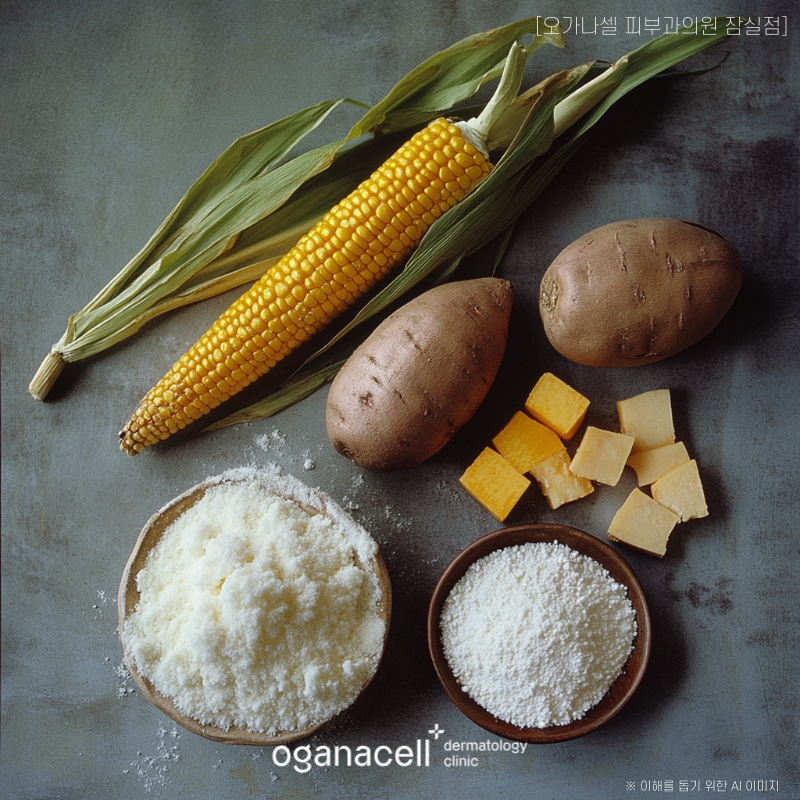
Representative raw materials for PLA include starch-rich plants such as corn starch,
sugarcane, and sweet potatoes.
These plants contain starch that can be converted into glucose,
and when that glucose is fermented,
lactic acid is produced.
This lactic acid becomes the basic material for PLA.

How Is PLA Made? – Manufacturing Process
So how is the polylactic acid ingredient made?
First, starch is extracted from plants.
The starch is converted into glucose, and that glucose is
fermented to produce lactic acid.
Polylactic acid is completed through the process of polymerizing
lactic acid. Here, polymerization means,
simply put, the process of linking together multiple lactic acid molecules
to create a long-chain molecule.
PLA made this way is processed into various forms and used
in industry, medicine, and other fields~!

Where Is Polylactic Acid Used?
– Applications
Polylactic acid is used in a variety of ways because of its biodegradability and biocompatibility. So where is it used?
In general industrial fields, it is used in biodegradable plastics, disposable tableware, packaging materials,
and filaments for 3D printers, among other everyday items.
In the medical and biotechnology fields, it is also used in sutures, meaning threads that break down inside the body after surgery.
In addition, it is used in tissue scaffolds, drug delivery systems,
and as a component in some medical products.

Features of PLA – Why Is It Getting Attention?
Polylactic acid is used as an attractive material in industry because of the following characteristics.
Let’s take a closer look!
It has biodegradable properties, naturally breaking down into water and carbon dioxide over time.
It is also biocompatible, so it is well accepted by the human body.
It is easy to process, allowing it to be made into various forms such as films, fibers, and particles.
It also offers resource renewability and reduced environmental burden!

Examples of Representative Products Containing PLA
Polylactic acid is sometimes included as a component in medical and beauty-related products.
One example is ‘Sculptra,’ a representative product containing PLA.
This is only to show which products PLA is actually used in, so please use it as a reference only.

Above all, when you know the ingredient, you can see it!
As we have seen, polylactic acid is an ingredient attracting attention in various fields such as the environment, biotechnology,
and medicine.
In particular, many people have become interested in PLA because it is derived from natural sources.
In this way, knowing the ingredients of a product allows us to gain a deeper understanding of the everyday items and products we use.
If we continue to take a little more interest in materials and ingredients in the future, we will be able to make wiser decisions when choosing and consuming products, right?
The Jamshil branch of Ogana Cell Dermatology Clinic is located inside the Medical Center on the 11th floor of Lotte World Tower.
Thank you^^
#PolylacticAcid #JamsilSculptra #SculptraIngredients