
“Lala Peel seems to be something people especially say you should keep getting.
Why is that?
Wouldn’t getting it often be hard on the skin?”
In the case of Lala Peel, many people become curious about why it is said to be good to receive it consistently after seeing recommendations or reviews from people around them.
There are so many different types of peeling, so you may wonder why this kind of talk always follows Lala Peel.
So today, let’s look at the principles and effects of Yeongdeungpo Lala Peel, and also explore why so many people recommend receiving it consistently.
Yeongdeungpo Lala Peel
Yeongdeungpo Lala Peel
The principles and effects of Lala Peel
Lala Peel is a peeling method that can gently clear dead skin cells by combining LHA ingredients with alkaline ingredients.
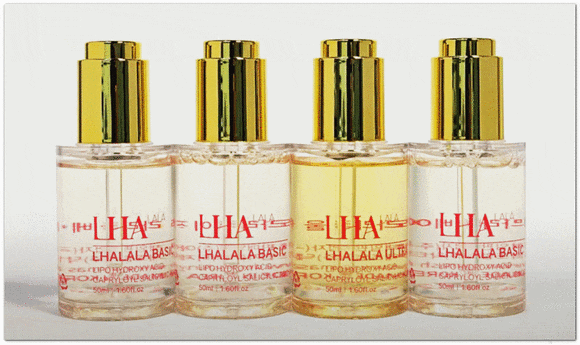
It does not physically scrape or break off dead skin cells; instead, it slowly dissolves proteins while delivering active ingredients into the skin.
Because it has both water-soluble and oil-soluble properties, it is slowly and deeply absorbed into the skin, gently dissolving dead skin cells.
It is close to neutral at about pH 5.5, so skin irritation is relatively low. That is why one of its features is that there is almost no sensitive irritation such as stinging or a feeling of heat during treatment.
Let’s take a look at the ingredients used in Lala Peel.
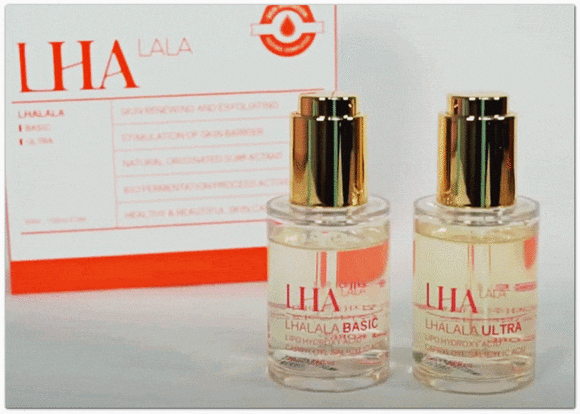
Because the molecular particles are large, it penetrates the skin very slowly. It is a low-irritation ingredient that gently loosens and dissolves dead skin cells.
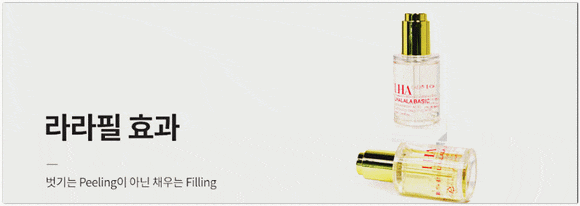
It penetrates deep into the skin, activates fibroblasts, and promotes the remodeling of collagen and elastic fibers.
You can think of it as an ingredient that helps strengthen the skin. Because it helps rebuild the skin barrier, it increases the thickness of the epidermis and helps the skin become firmer.
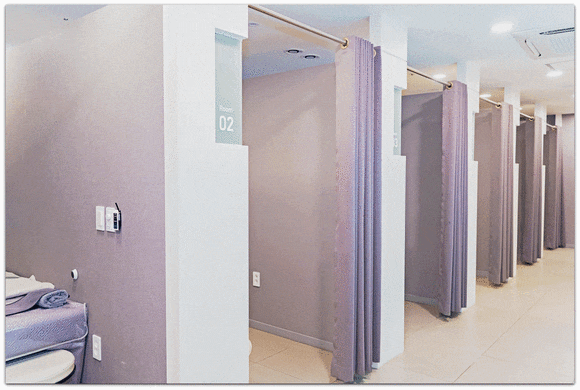
This ingredient has a structure similar to the stratum corneum.
So after treatment, as dead skin cells are cleared away, it helps protect the delicate skin that is revealed. You can think of it as creating a temporary skin-protective barrier on the surface.
Yeongdeungpo Lala Peel
Why is it recommended to keep getting it?
Now let’s look at why people who have tried Lala Peel often recommend receiving it consistently.
First of all, because it is low-irritation, there is less burden on the skin even if you keep receiving it consistently.
It also gently dissolves dead skin cells, and because it contains ingredients that protect the skin after dead skin is cleared, it causes less of the so-called skin flare-up or irritation.

And because Lala Peel uses active ingredients that help skin regeneration, the more consistently you receive it, the less likely your skin is to become thin; instead, it helps fill and strengthen the skin from within.
Another point is that there is almost no downtime.
Since daily life is possible for most people after the procedure, there is no need to cover your face or have restrictions on going out.

Today, while looking at the principles and effects of Yeongdeungpo Lala Peel, we also looked at why there are so many recommendations and reviews saying that you should keep getting it.
To sum up, Lala Peel is a peeling method that “fills rather than scrapes away,” so its effects can become greater when it is received consistently.
Rather than temporarily making the skin look better by irritating it, it helps the skin itself build strength, which is why there are so many comments recommending continued treatment.
However, to achieve better results, the treatment interval should be adjusted appropriately by considering several factors such as skin type and condition, skin reaction, and the skin’s exfoliation cycle. Please receive treatment at a place that carefully takes these points into account.
Thank you. This was Yeongdeungpo UNI^^
< What are the criteria for choosing a dermatology clinic in Yeongdeungpo? >
< Yeongdeungpo UNI clinic hours >
Weekdays: am 10:00 ~ pm 08:30
Weekends: am 10:00 ~ pm 05:00
(No lunch break)
< Directions >
UNI Clinic Yeongdeungpo Branch is located near Exit 5 of Yeongdeungpo Station.