“Ligaments are stretched~~~” — a familiar phrase to many of us,
but today let’s take a look at retaining ligaments, which are actually quite different!

Hello! This is Forena Clinic at Hongik Univ. Station.
It seems many of you have been waiting for this, so let’s get started right away :)
Everyone, hold on tight!
What are retaining ligaments?
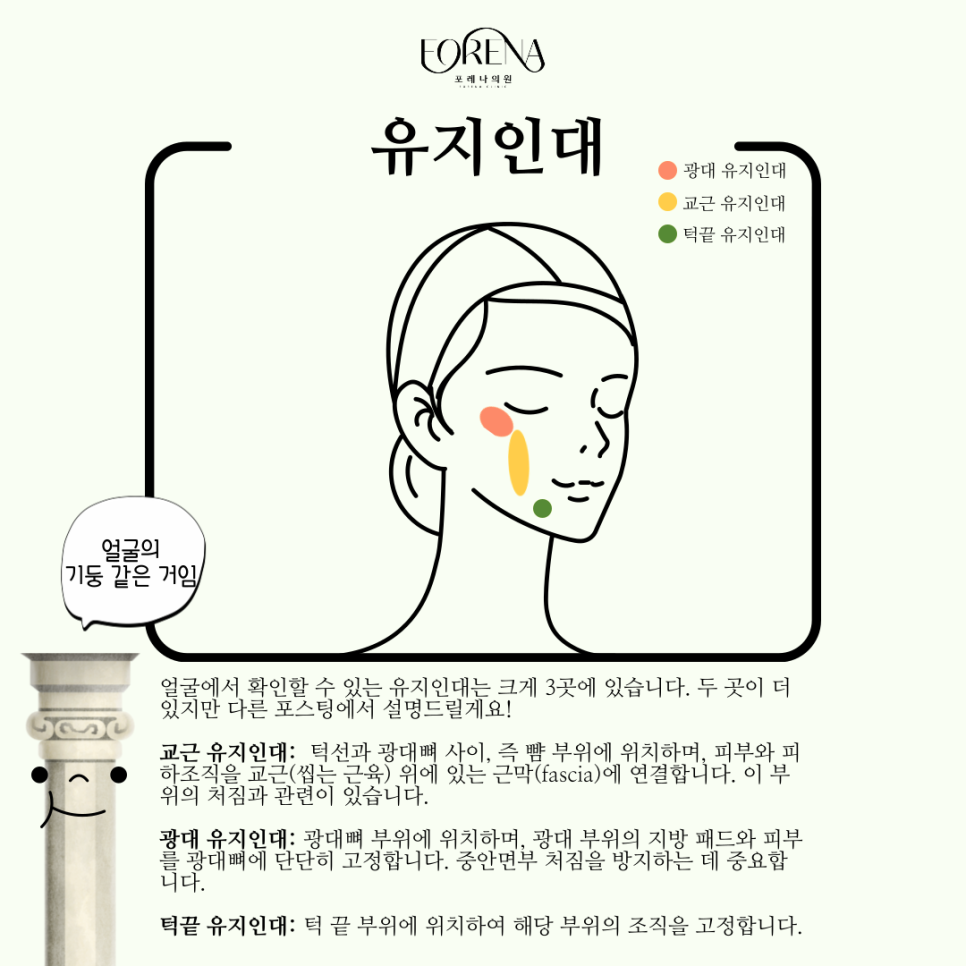
The retaining ligaments visible in the face are mainly found in three areas.
There are two more areas, but I’ll explain those in another post!
Masseter retaining ligament: Located between the jawline and the cheekbone, that is, in the cheek area,
it connects the skin and subcutaneous tissue to the fascia over the masseter (the chewing muscle). It is related to sagging in this area.
Zygomatic retaining ligament: Located in the cheekbone area, it firmly anchors the fat pad and skin of the cheek area to the zygomatic bone.
It is important in preventing midface sagging.
Chin retaining ligament: Located in the chin area, it secures the tissues in that area.
What happens with aging
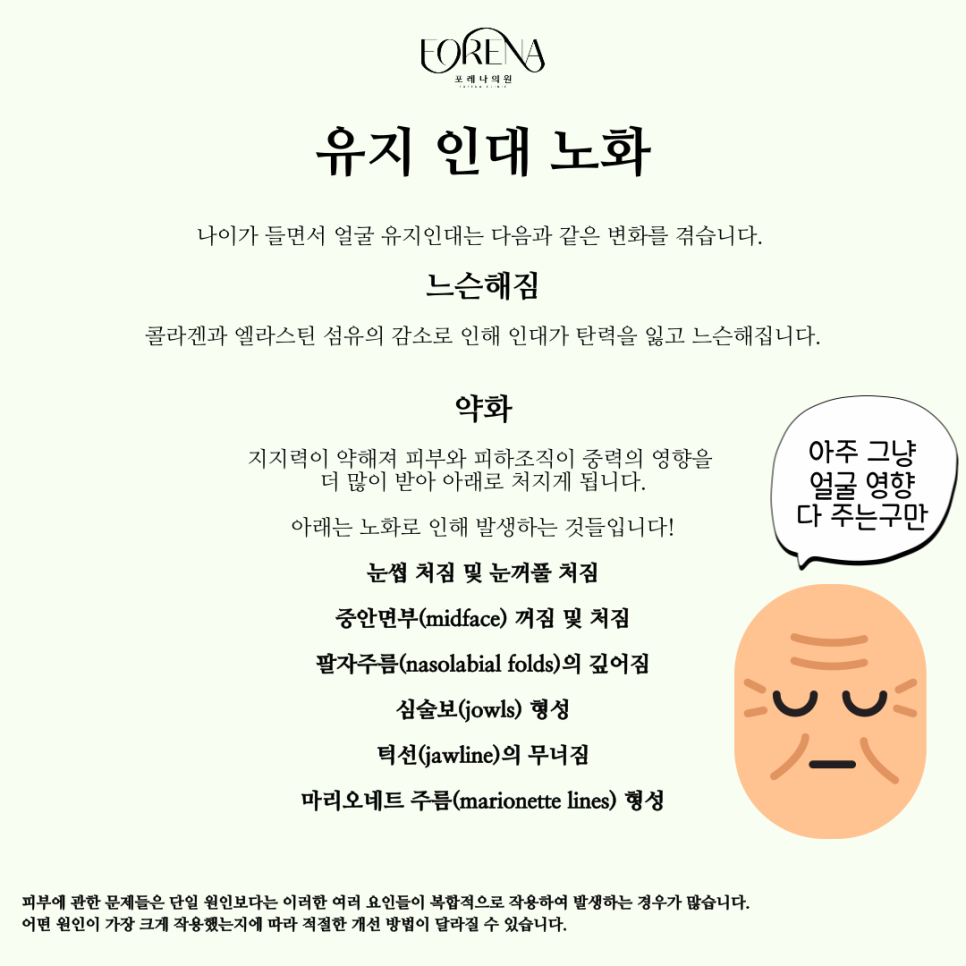
As we age, the facial retaining ligaments undergo the following changes.
Loosening
Due to a decrease in collagen and elastin fibers, the ligaments lose elasticity and become loose.
Weakening
Their support weakens, so the skin and subcutaneous tissue are affected more by gravity
and begin to sag downward.
Below are some changes that occur with aging!
Drooping eyebrows and eyelids
Midface hollowness and sagging
Deepening of nasolabial folds
Formation of jowls
Collapse of the jawline
Formation of marionette lines
Skin-related issues are often caused not by a single factor, but by a combination of these various factors.
Depending on which factor has the greatest influence, the appropriate improvement method may differ.
Are there procedures specifically for retaining ligaments too?
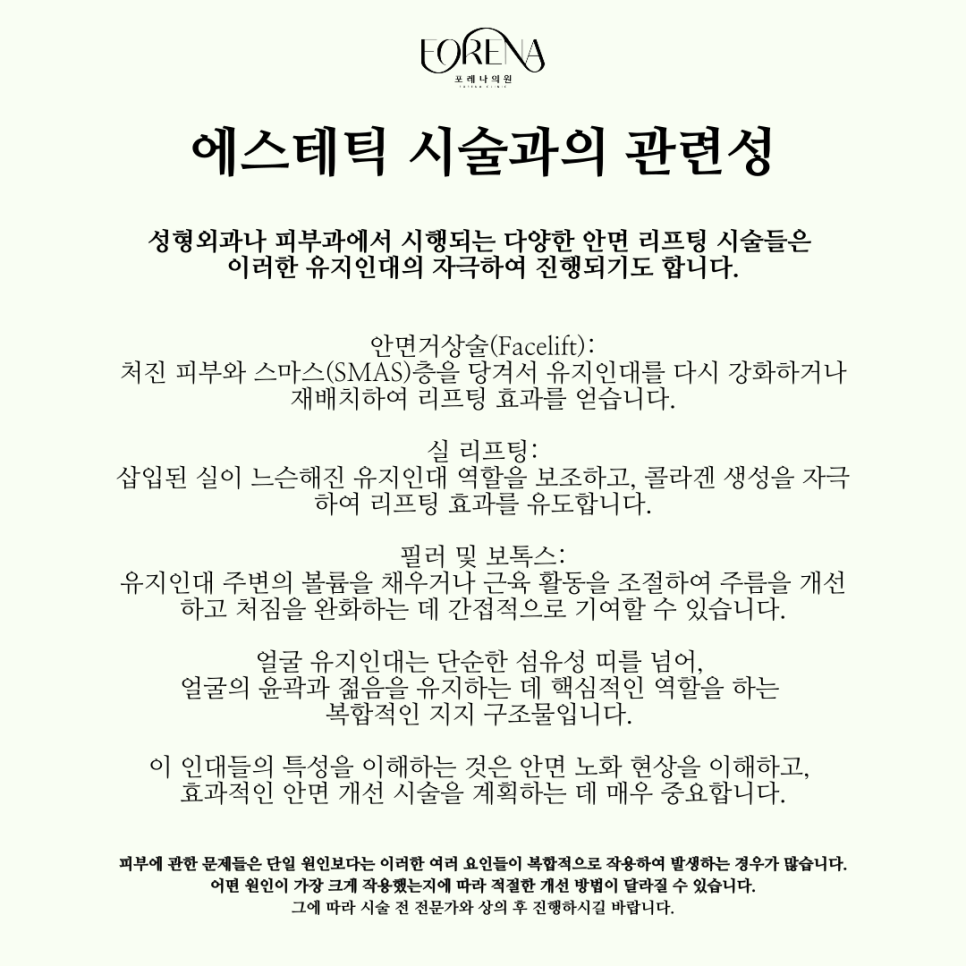
Various facial lifting procedures performed in plastic surgery or dermatology clinics
are sometimes carried out by stimulating these retaining ligaments.
Facelift:
By pulling up sagging skin and the SMAS layer, the retaining ligaments are reinforced or repositioned to achieve a lifting effect.
Thread lifting:
Inserted threads assist the role of loosened retaining ligaments and induce a lifting effect by stimulating collagen production.
Fillers and Botox:
They may indirectly help improve wrinkles and reduce sagging by restoring volume around the retaining ligaments or controlling muscle activity.
Facial retaining ligaments are more than just simple fibrous bands.
They are complex support structures that play a key role in maintaining facial contour and youthfulness.
Understanding the characteristics of these ligaments is very important for understanding facial aging
and planning effective facial improvement procedures.
So expert help is definitely needed!

Q&A
Q:
Is the retaining ligament the same as the joint ligament we usually know?
A:
No, facial retaining ligaments and the ligaments we commonly know
[joint ligaments that connect bone to bone] use the same word, but their anatomical structure, function, and meaning are slightly different.
Joint ligaments: Strong, fibrous bands.
They connect bone to bone.
Examples) cruciate ligaments, anterior talofibular ligament, rotator cuff ligaments, etc.
Facial retaining ligaments: Ligaments focused on the function of support.
They connect soft tissue to bone.
Examples) zygomatic retaining ligament, masseter retaining ligament, mandibular retaining ligament, etc.
Spoiler for the next topic
Did you know that acne also comes in many types?
Of course, even the skin conditions that cause the most stress come in various types!
Next time, we’ll look into this~ If you know the answer, please leave it in the comments1
I worked hard today as well to bring you useful information!
If this information was helpful
then Forena Clinic will continue to cheer on your healthy skin life today as well!
If you have any questions about Forena Clinic in Hongdae, please feel free to let us know as always!
👇Curious about the corrugator muscle?👇
👇Things affected by retaining ligaments👇
👇Why Koreans like white skin👇
👇Go directly to Forena Clinic consultation👇
👇Go directly to Naver Map👇
✅ This post was written directly by Forena Clinic for the purpose of providing medical information, in compliance with Article 56, Paragraph 1 of the Medical Advertising Act.
✅ Because the patient’s skin condition and the medical staff’s clinical experience can vary greatly, please make your decision after 충분한 consultation with a doctor.
✅ The treatment photos in this post were taken with the patients’ consent. The before/after photos were not altered, and were taken under the same conditions.
✅ Please use this post for reference only. For detailed information, we recommend visiting a medical institution directly for examination and treatment.
✅ All procedures performed after visiting the clinic may cause minor or major side effects depending on the individual. Please consult with a medical professional and fully understand the possible side effects and precautions before proceeding.