I thought about this a lot..
I haven’t been very kind to beginners until now..
Always using terms like Ulthera~ Thermage~ that are hard for ordinary people to understand~
This time, it’s a terminology roundup post that’s good for beginners to read!

I’ve organized as many basic terms used in dermatology and skin aesthetics as possible.
If there’s any information you’d like me to add, feel free to let me know!
This post will be updated!


Explanation of dermatology units / dosage terms
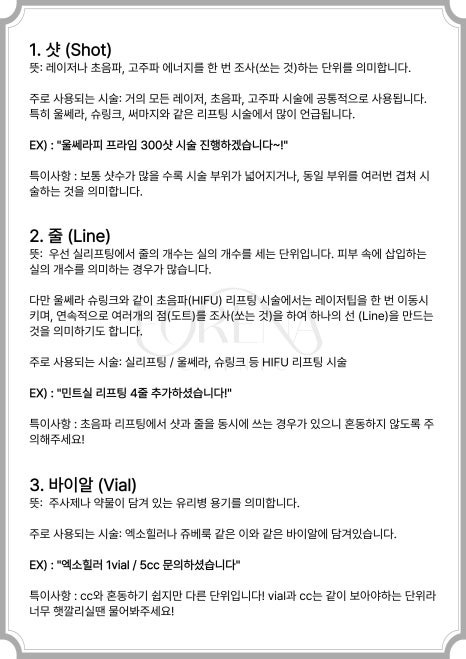
- Shot
Meaning: A unit meaning one application (one firing) of laser, ultrasound, or radiofrequency energy.
Commonly used procedures: Commonly used across almost all laser, ultrasound, and radiofrequency procedures.
It is mentioned especially often in lifting procedures such as Ulthera, Shurink, and Thermage.
EX) : "We’ll proceed with 300 shots of Ulthera Prime~!"
Note: In general, the more shots there are, the wider the treatment area becomes, or it means treating the same area multiple times in overlapping passes.
- Line
Meaning: In thread lifting, the number of lines refers to the number of threads. It often means the number of threads inserted under the skin.
However, in ultrasound (HIFU) lifting procedures such as Ulthera and Shurink, it can also mean moving the laser tip once and firing multiple points (dots) continuously to create one line.
Commonly used procedures: Thread lifting / HIFU lifting procedures such as Ulthera and Shurink
EX) : "You added 4 lines of Mint thread lifting!"
Note: In ultrasound lifting, shots and lines may sometimes be used at the same time, so please be careful not to confuse them!
- Vial
Meaning: A glass container holding an injectable solution or medicine.
Commonly used procedures: ExoHealer and Juvelook come in vials like this.
EX) : "You inquired about ExoHealer 1 vial / 5cc"
Note: It can be easy to confuse with cc, but they are different units! Vial and cc are units that should be considered together, so if you’re ever confused, please ask!
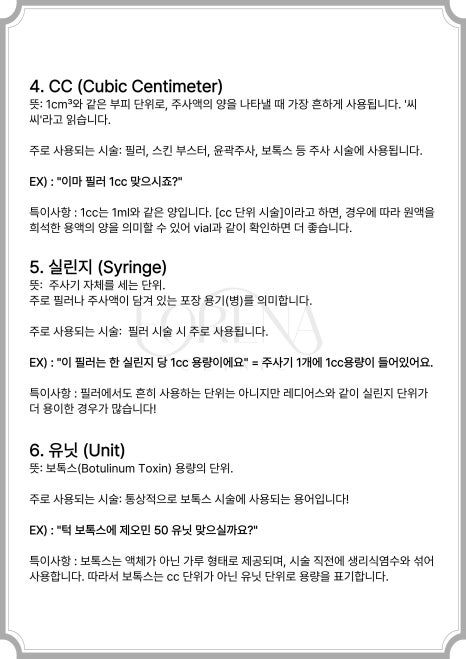
- CC (Cubic Centimeter)
Meaning: A volume unit equal to 1 cm³, and it is the most commonly used way to indicate the amount of injectable solution. It is read as "cc."
Commonly used procedures: Used in injectable procedures such as fillers, skin boosters, contouring injections, and Botox.
EX) : "You’re getting 1 cc of forehead filler, right?"
Note: 1 cc is the same amount as 1 ml. If a procedure is described in "cc units," depending on the case, it may refer to the amount of diluted solution rather than the original concentrate, so it’s better to check it together with the vial.
- Syringe
Meaning: A unit used to count the syringe itself.
It often refers to the packaging container (vial) holding filler or an injectable solution.
Commonly used procedures: Mainly used in filler procedures.
EX) : "This filler has a volume of 1 cc per syringe" = 1 cc is contained in one syringe.
Note: It is not a very commonly used unit even for fillers, but for products like Radiesse, syringe units are often more convenient!
- Unit
Meaning: The unit used for Botox (Botulinum Toxin) dosage.
Commonly used procedures: This is the term commonly used for Botox procedures!
EX) : "Would you like 50 units of Xeomin for your jaw Botox?"
Note: Botox is provided in powder form, not liquid, and is mixed with saline immediately before the procedure. Therefore, Botox dosage is indicated in units rather than cc.
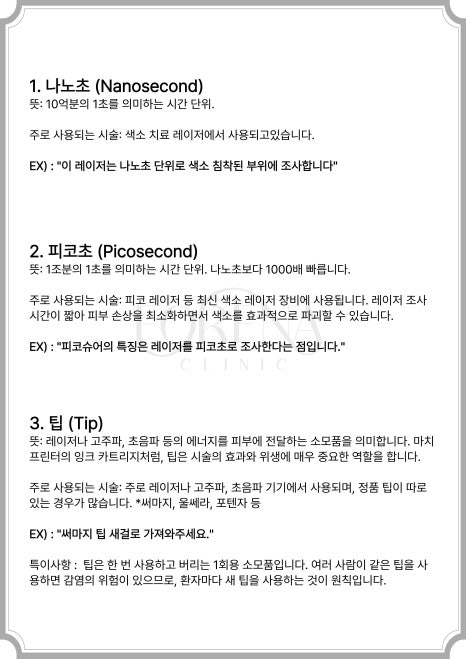
- Nanosecond
Meaning: A unit of time meaning one billionth of a second.
Commonly used procedures: Used in pigment-treatment lasers.
EX) : "This laser is applied to pigmented areas in nanosecond units"
- Picosecond
Meaning: A unit of time meaning one trillionth of a second. It is 1,000 times faster than a nanosecond.
Commonly used procedures: Used in the latest pigment laser devices such as pico lasers. Because the laser pulse duration is short, it can effectively break down pigment while minimizing skin damage.
EX) : "The 특징 of PicoSure is that it delivers laser energy in picoseconds."
- Tip
Meaning: A consumable item that delivers energy such as laser, radiofrequency, or ultrasound to the skin. Like an ink cartridge in a printer, the tip plays a very important role in both treatment effectiveness and hygiene.
Commonly used procedures: Mainly used in laser, radiofrequency, and ultrasound devices, and there are often genuine tips sold separately. *Thermage, Ulthera, Potenza, etc.
EX) : "Please bring me a new Thermage tip."
Note: A tip is a single-use consumable item. If multiple people use the same tip, there is a risk of infection,
so the rule is to use a new tip for each patient.
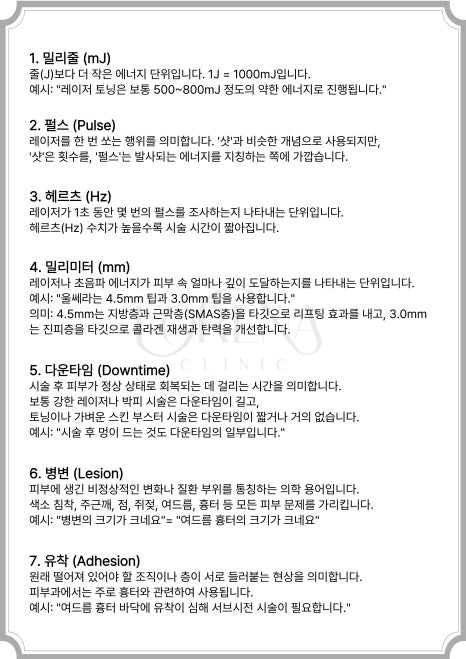
- Millijoule (mJ)
A smaller energy unit than joule (J). 1 J = 1000 mJ.
Example: "Laser toning is usually performed with weak energy of around 500–800 mJ."
- Pulse
Refers to the act of firing the laser once. It is used in a concept similar to "shot,"
but "shot" is closer to the number of times, while "pulse" is closer to the energy being emitted.
- Hertz (Hz)
A unit indicating how many pulses the laser delivers in one second.
The higher the Hertz (Hz) value, the shorter the treatment time.
- Millimeter (mm)
A unit indicating how deep laser or ultrasound energy penetrates into the skin.
Example: "Ulthera uses 4.5 mm tips and 3.0 mm tips."
Meaning: 4.5 mm targets the fat layer and the SMAS layer to create a lifting effect,
and 3.0 mm targets the dermis to improve collagen regeneration and elasticity.
- Downtime
The time it takes for the skin to recover to a normal state after a procedure.
Usually, stronger lasers or resurfacing procedures have longer downtime,
while toning or light skin-booster procedures have short or almost no downtime.
Example: "Bruising after a procedure is also part of downtime."
- Lesion
A medical term that collectively refers to abnormal changes or affected areas on the skin.
It refers to all skin problems such as pigmentation, freckles, moles, skin tags, acne, and scars.
Example: "The lesion is large" = "The acne scar is large"
- Adhesion
Refers to the phenomenon in which tissues or layers that should normally be separated stick together.
In dermatology, it is mainly used in relation to scars.
Example: "There is severe adhesion at the base of the acne scar, so subcision is needed."
Explanation of dermatology procedures / technical terms
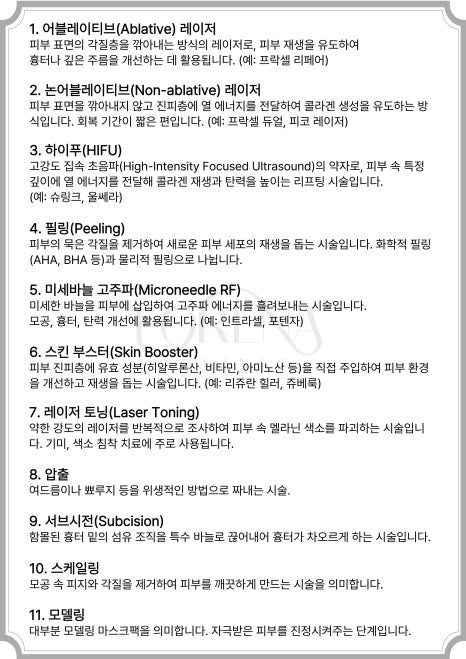
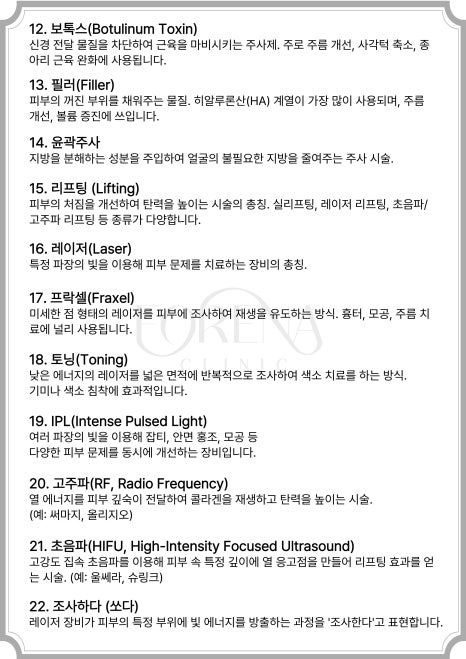
- Ablative laser
A laser that removes the stratum corneum on the skin surface, inducing skin regeneration
and is used to improve scars or deep wrinkles. (Example: Fraxel Repair)
- Non-ablative laser
A method that delivers thermal energy to the dermis without removing the skin surface.
It tends to have a short recovery period. (Example: Fraxel Dual, pico laser)
- HIFU
An abbreviation for High-Intensity Focused Ultrasound,
this is a lifting procedure that delivers thermal energy to a specific depth within the skin to promote collagen regeneration and firmness.
(Example: Shurink, Ulthera)
- Peeling
A procedure that removes old dead skin cells to help new skin cells regenerate. It is divided into chemical peeling (AHA, BHA, etc.) and physical peeling.
- Microneedle RF
A procedure that inserts fine needles into the skin and delivers radiofrequency energy.
It is used to improve pores, scars, and elasticity. (Example: Intracel, Potenza)
- Skin Booster
A procedure that directly injects active ingredients such as hyaluronic acid, vitamins, and amino acids into the dermis to improve the skin environment and aid regeneration.
(Example: Rejuran Healer, Juvelook)
- Laser Toning
A procedure that repeatedly delivers low-intensity laser energy to destroy melanin pigment in the skin. It is mainly used to treat melasma and pigmentation.
- Extraction
A procedure to hygienically squeeze out acne or pimples.
- Subcision
A procedure that cuts the fibrous tissue under a depressed scar with a special needle so the scar can fill in.
- Scaling
Refers to a procedure that cleans the skin by removing sebum and dead skin cells from the pores.
- Modeling
Usually refers to a modeling mask pack. It is a step that soothes irritated skin.
- Dermis
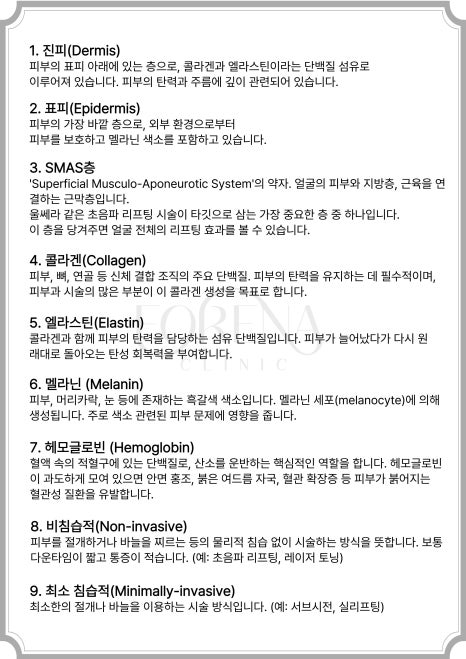
The layer below the epidermis, made up of protein fibers called collagen and elastin.
It is deeply related to the skin’s elasticity and wrinkles.
- Epidermis
The outermost layer of the skin, which protects the skin from the external environment and contains melanin pigment.
- SMAS layer
An abbreviation for "Superficial Musculo-Aponeurotic System." It is a fascial layer connecting the skin, fat layer, and muscles of the face.
It is one of the most important layers targeted by ultrasound lifting procedures such as Ulthera.
Pulling this layer can produce a lifting effect across the entire face.
- Collagen
The main protein in connective tissues of the body such as skin, bones, and cartilage. It is essential for maintaining skin elasticity,
and many dermatology procedures aim to stimulate collagen production.
- Elastin
A fibrous protein that, along with collagen, is responsible for skin elasticity. It gives the skin elastic recoil so it can stretch and then return to its original shape.
- Melanin
A dark brown pigment found in the skin, hair, and eyes. It is produced by melanocytes.
It mainly affects pigment-related skin issues.
- Hemoglobin
A protein in red blood cells that plays a key role in transporting oxygen. When hemoglobin accumulates excessively, it can cause vascular conditions that make the skin red, such as facial flushing, red acne marks, and telangiectasia.
- Non-invasive
Refers to a treatment method performed without physical invasion such as making an incision or inserting a needle. It usually has short downtime and less pain.
(Example: ultrasound lifting, laser toning)
- Minimally invasive
A treatment method using minimal incisions or needles. (Example: subcision, thread lifting)
- Hyaluronic Acid
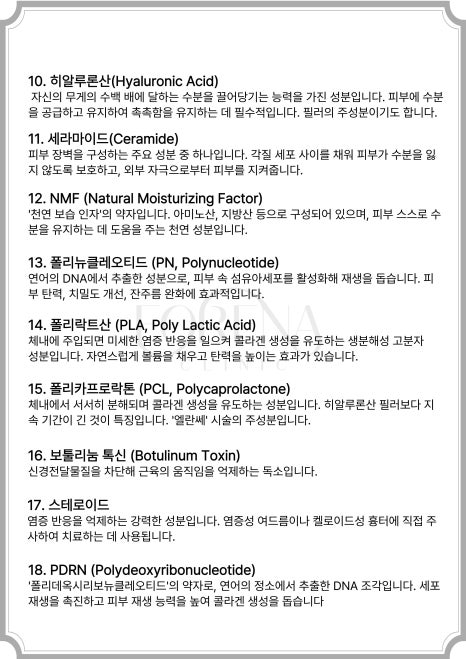
An ingredient with the ability to attract water hundreds of times its own weight. It is essential for hydrating and maintaining moisture in the skin. It is also the main ingredient in fillers.
- Ceramide
One of the main components that make up the skin barrier. It fills the spaces between dead skin cells to help prevent moisture loss,
and protects the skin from external irritants.
- NMF (Natural Moisturizing Factor)
An abbreviation for "Natural Moisturizing Factor." It is made up of amino acids, fatty acids, and other components, and is a natural ingredient that helps the skin retain moisture on its own.
- Polynucleotide (PN)
An ingredient extracted from salmon DNA that helps regeneration by activating fibroblasts in the skin.
It is effective for improving skin elasticity, density, and fine wrinkles.
- Poly Lactic Acid (PLA)
A biodegradable polymer ingredient that induces collagen production by causing a mild inflammatory response when injected into the body.
It has the effect of naturally restoring volume and improving firmness.
- Polycaprolactone (PCL)
An ingredient that gradually breaks down in the body and induces collagen production.
Its characteristic is that it lasts longer than hyaluronic acid fillers. It is the main ingredient of the "Ellansé" treatment.
- Botulinum Toxin
A toxin that inhibits muscle movement by blocking neurotransmitters.
- Steroid
A powerful ingredient that suppresses inflammatory reactions. It is used by direct injection to treat inflammatory acne or keloid scars.
- PDRN (Polydeoxyribonucleotide)
An abbreviation for "Polydeoxyribonucleotide," this is a DNA fragment extracted from salmon testes. It promotes cell regeneration and enhances the skin’s regenerative ability, helping collagen production.

Next time, I’ll definitely cover the topic I promised,, hehe
But,, take care of the dermatology newbies,,
Anyway, next time I’ll definitely look into the types of this!
Please like and comment, and I’ll come back next time with another interesting topic!
👇Take a look at the types of Botox👇
👇Take a look at the types of skin boosters👇
👇Take a look at skin type categories👇
👇Learn everything about milia, xanthelasma, warts, and acne👇
👇Go directly to Forena Clinic consultation👇
👇Go directly to Naver Map👇
✅This post was written directly by Forena Clinic for the purpose of providing medical information, in compliance with Article 56, Paragraph 1 of the Medical Advertising Act.
✅ Because there can be significant differences depending on the patient’s skin condition and the medical staff’s clinical experience,
please make your decision after sufficient consultation with a doctor.
✅ The treatment photos in this post were taken with the patients’ consent.
The before/after photos were not altered, and we state that they were taken under the same conditions.
✅ Please view this post for personal reference only.
We recommend visiting a medical institution directly for a detailed consultation and treatment.
✅ All procedures performed after visiting the clinic may cause minor or major side effects depending on the individual.
Please consult with a professional medical team and fully understand the side effects and precautions before proceeding.