Today, we’ll explain it here at Hongdae Forena Clinic!

Are there really many different types of acne scars?!
There may be many concerns for people who visit a dermatology clinic,
but personally, I think the most common and stressful one is acne.
The reason is that it can happen to anyone, and it often becomes a childhood trauma!
Today, let’s take some time to look at the different types of acne scars!

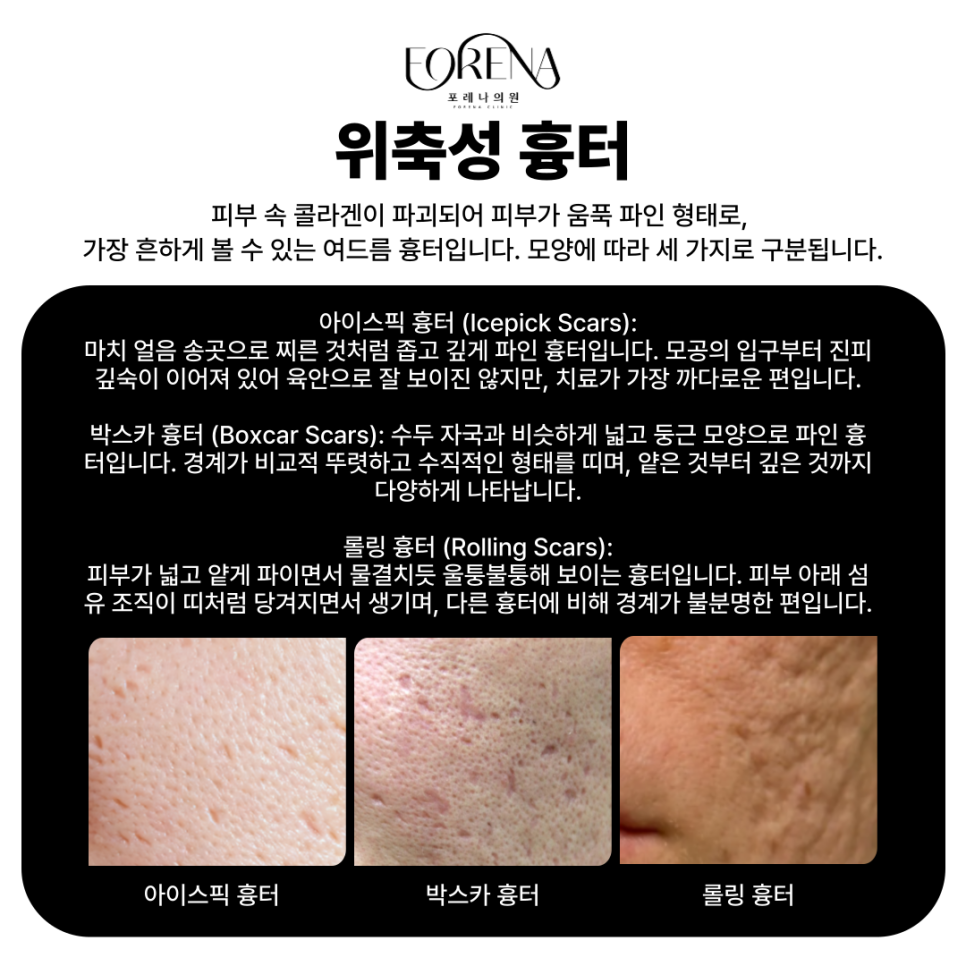
Atrophic scars
These are indented scars formed when collagen in the skin is destroyed,
and they are the most commonly seen type of acne scar. They are divided into three types depending on their shape.
Icepick scars (Icepick Scars):
These are narrow, deep scars that look as if they were punctured by an ice pick. They extend from the pore opening deep into the dermis, so they are not very visible to the naked eye, but they are the most difficult to treat.
Boxcar scars (Boxcar Scars):
These are broad, round indented scars similar to chickenpox marks. They have relatively clear borders and a vertical shape, and can range from shallow to deep.
Rolling scars (Rolling Scars):
These are scars where the skin appears broadly and shallowly indented, giving a wavy, uneven look. They form when fibrous tissue beneath the skin pulls like a band, and their borders are less distinct than other scars.
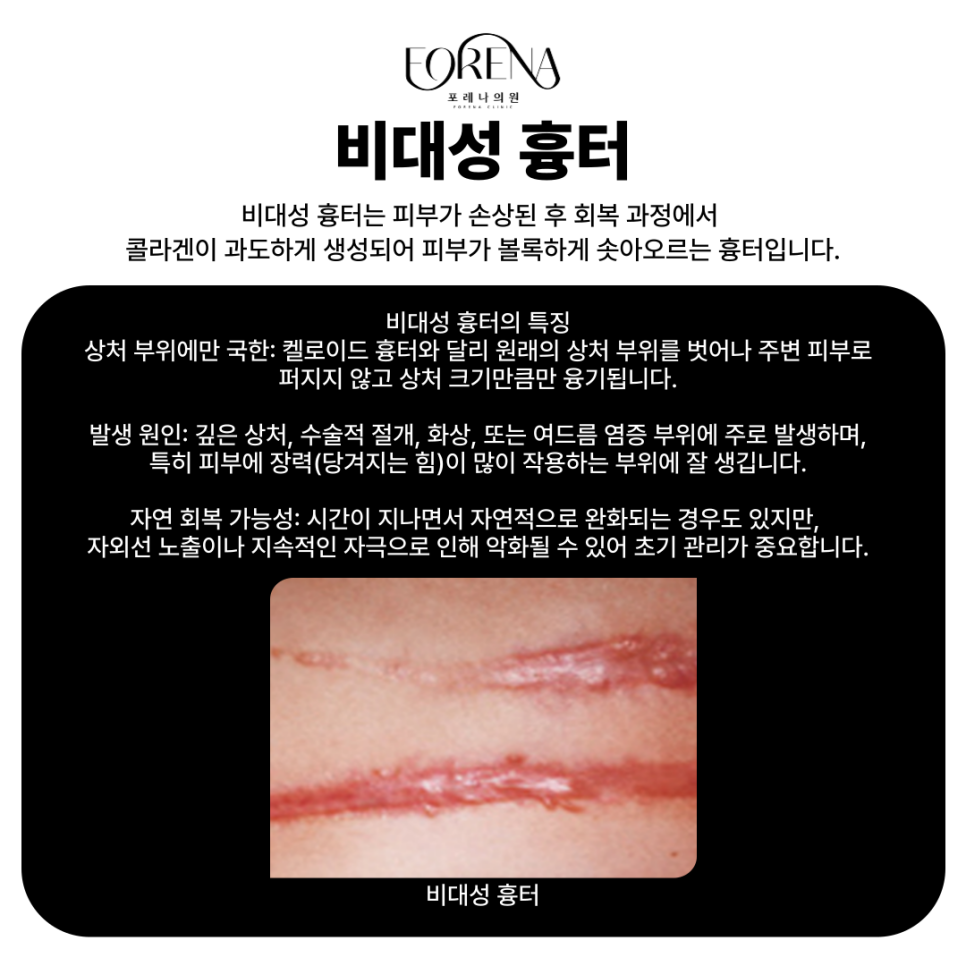
Hypertrophic scars
Hypertrophic scars are scars in which the skin becomes raised during the healing process after damage,
because collagen is produced excessively.
Characteristics of hypertrophic scars
Limited to the wound area: Unlike keloid scars, they do not spread beyond the original wound area into the surrounding skin and only rise to the size of the wound.
Causes: They mainly occur after deep wounds, surgical incisions, burns, or inflamed acne lesions, and they tend to form especially in areas where a lot of tension is applied to the skin.
Possibility of natural recovery: In some cases, they may gradually improve over time,
but they can worsen due to sun exposure or persistent irritation, so early management is important.
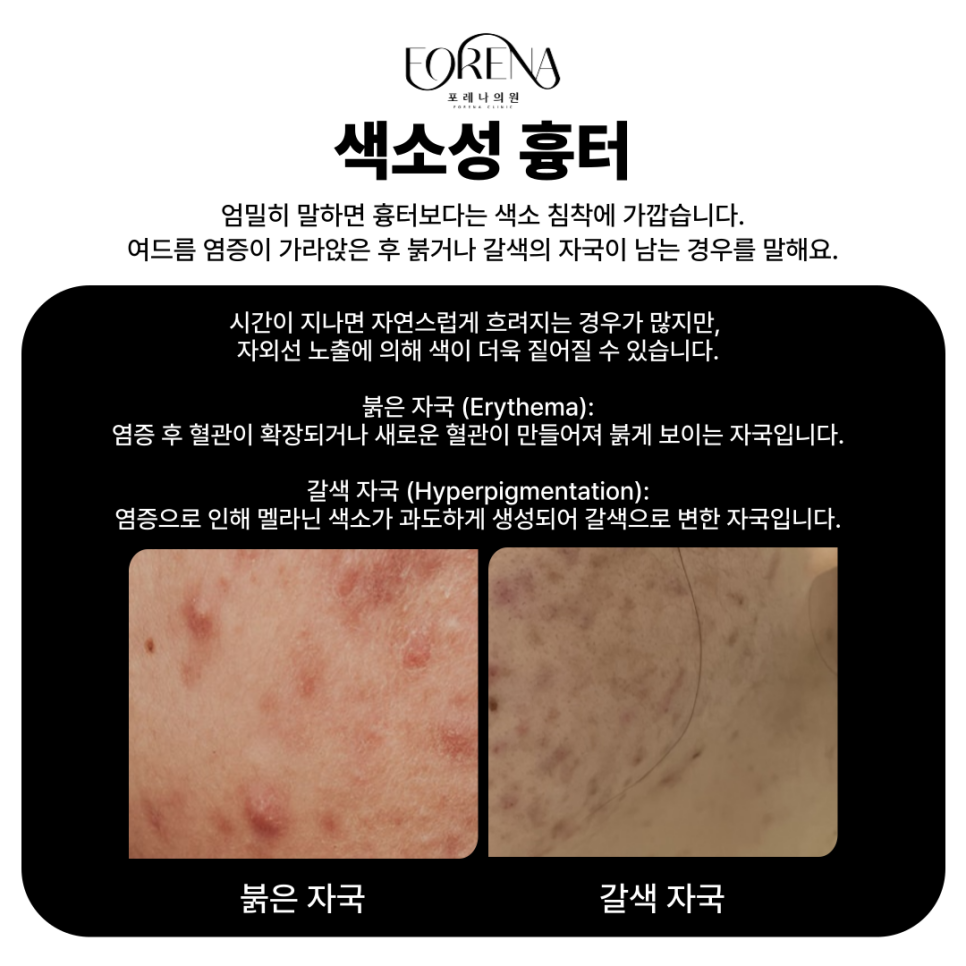
Pigmented scars
Strictly speaking, these are closer to hyperpigmentation than scars.
They refer to red or brown marks left after acne inflammation subsides.
In many cases, they fade naturally over time,
but exposure to ultraviolet light can make the color darker.
Red marks (Erythema):
These are red marks caused by dilated blood vessels or new blood vessel formation after inflammation.
Brown marks (Hyperpigmentation):
These are brown marks caused by excessive melanin production due to inflammation.
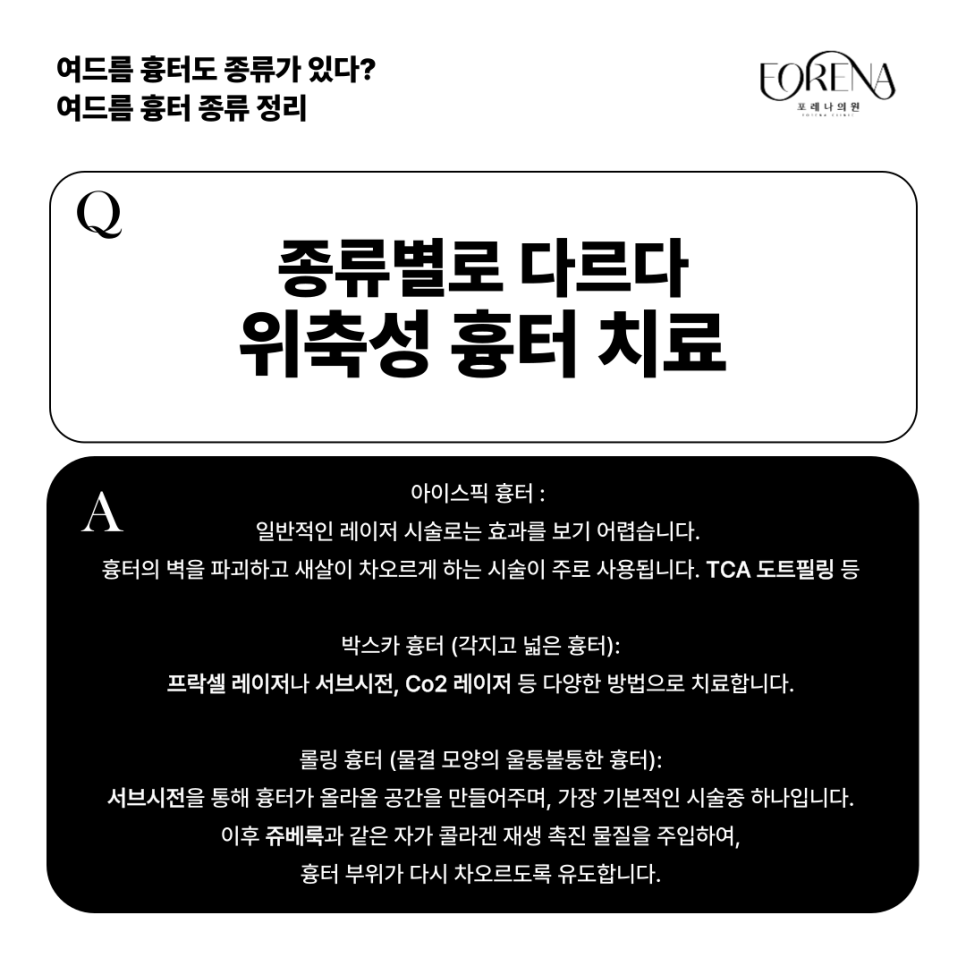
Treatment differs by type! Treating atrophic scars
Icepick scars:
They are difficult to improve with standard laser procedures.
Procedures that destroy the scar walls and help new tissue fill in are mainly used. TCA CROSS, etc.
Boxcar scars (angular and broad scars):
These are treated with various methods such as Fraxel laser, subcision, and CO2 laser.
Rolling scars (wavy, uneven scars):
Subcision is used to create space for the scar to rise, and it is one of the basic procedures.
After that, substances that promote the body’s own collagen regeneration, such as Juvelook, are injected
to encourage the scar area to fill back in.
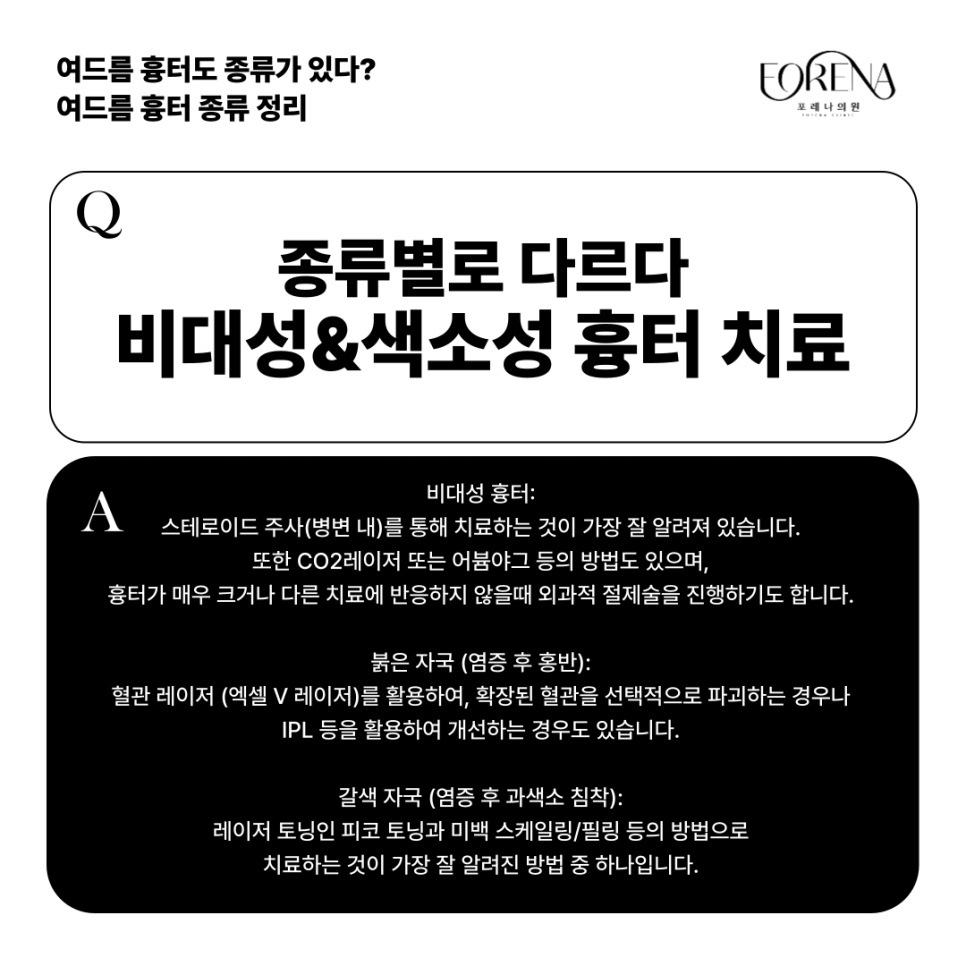
Treating hypertrophic & pigmented scars
Hypertrophic scars:
The best-known treatment is steroid injection (intralesional).
There are also methods such as CO2 laser or Er:YAG laser,
and if the scar is very large or does not respond to other treatments, surgical excision may be performed.
Red marks (post-inflammatory erythema):
A vascular laser (Excel V laser) may be used to selectively destroy dilated blood vessels,
or improvement may be attempted with IPL, etc.
Brown marks (post-inflammatory hyperpigmentation):
Methods such as pico toning, which is a type of laser toning, and whitening scaling/peeling
are among the best-known treatment options.

Next time, I’ll definitely cover the content I promised,, haha
I forgot,,,,,
Please let me off just this once..!!!!!
If today’s information was helpful,
please leave a comment and a like, and I’ll come back next time with another interesting topic!
👇View the treatment/procedure information from today👇
👇Go directly to Forena Clinic consultation👇
👇Go directly to Naver Map👇
✅ This post was written directly by Forena Clinic for the purpose of providing medical information, in compliance with Article 56, Paragraph 1 of the Medical Advertising Act.
✅ Because results vary greatly depending on the patient’s skin condition and the medical staff’s clinical experience,
please make your decision after sufficient consultation with a doctor.
✅ The treatment photos in this post were taken with the patients’ consent.
The before/after photos have not been altered, and we state that they were taken under the same conditions.
✅ Please view this post for reference only.
For detailed information, we recommend visiting the medical institution in person and receiving a consultation.
✅ All procedures performed after a visit may cause minor or major side effects depending on the individual.
Please fully understand the side effects and precautions after consulting with a medical professional before proceeding.