
The eyes are a decisive feature
in forming a first impression,
so even small changes
can greatly alter one’s appearance.
Unlike other areas, the skin around the eyes
has fewer sebaceous glands and is thinner,
making it vulnerable to wrinkles and sagging.
In addition, facial expressions and blinking
more than hundreds of times a day
repeatedly contract and relax the muscles,
so fine lines may appear there first.
In addition, elasticity may decrease due to
external factors such as ultraviolet rays
and everyday habits, often causing the skin to sag.
This article discusses upper and lower eyelid surgery
for those concerned about drooping eyes.
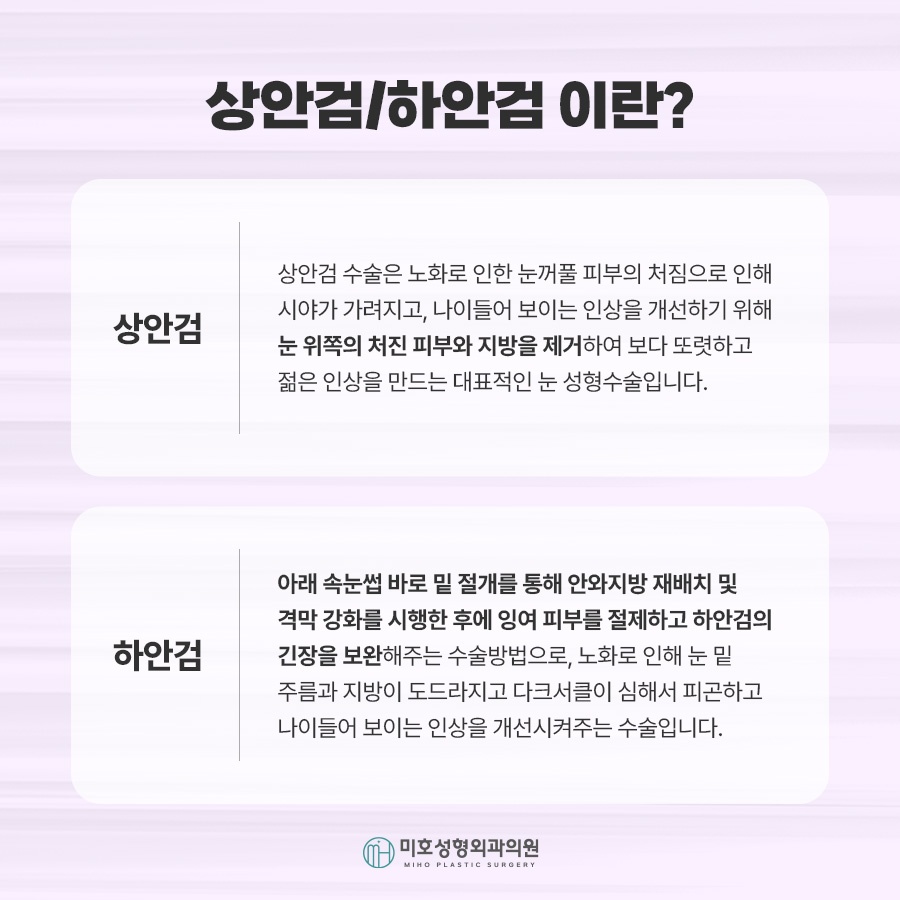
When there is little fat in the upper eyelid,
it may wrinkle and sag easily.
Fat from other areas may also shift forward,
accelerating the sagging.
When the eyelids droop downward,
not only can the eyes look smaller,
but the pupils may become covered, making the expression
look heavy and potentially obstructing the field of vision.
When aging has only just begun,
it may be possible to alleviate these changes
with home care or simple measures.
However, if deep wrinkles and
deformation caused by reduced elasticity
have already developed,
it may be worth considering
upper and lower eyelid surgery.
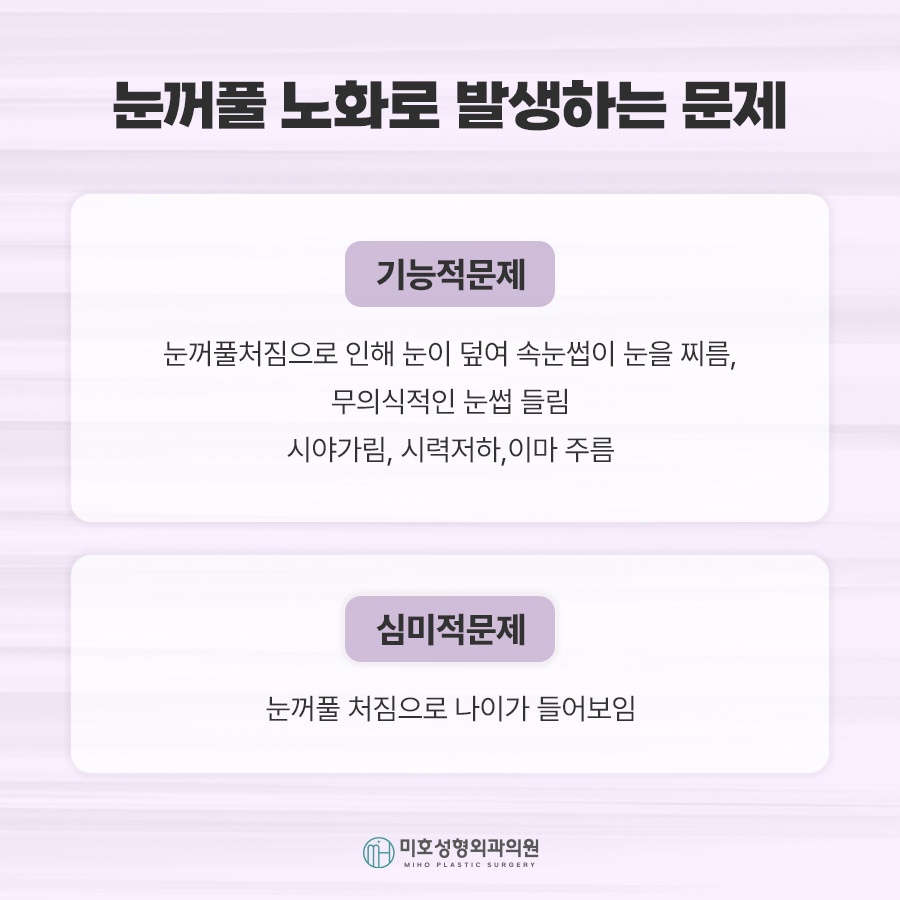
Many people tend to think
that upper and lower eyelid surgery
is performed solely for cosmetic purposes.
Although it can reduce sagging and make the expression
look clearer and brighter,
it may also improve function at the same time.
When the upper eyelid sags downward,
the skin near the outer corner of the eye
can fold over itself.
Tears may collect in this area,
sometimes causing irritation and maceration.
It may also obstruct the field of vision
and pose a safety concern.
By removing some of the excess skin
and unnecessarily accumulated fat
and strengthening weakened muscles,
both cosmetic and functional improvement
may be pursued at the same time.
It may also help reduce or prevent
deep wrinkles in the upper face.
As the skin becomes loose, it can become difficult
to open the eyes using the eyelid muscles alone,
so a person may unconsciously rely on
the muscles of the forehead.
Overusing the muscles in the upper face
can deepen wrinkles on the forehead and between the eyebrows,
making a person look older.
If you have difficulty opening your eyes
and unconsciously furrow your forehead or brow,
or tilt your head backward,
considering this treatment may be worthwhile.
The area beneath the eyes, as well as the upper eyelids,
is vulnerable to age-related changes.
Because the skin layer is very thin
and the area is frequently involved in facial expressions,
fine lines may develop first, followed by hollowness,
bulging, or dark circles.
If you are experiencing these changes,
upper and lower eyelid surgery or
under-eye fat repositioning may be appropriate.
Although both target the skin beneath the eyes,
their indications and principles differ.
It is often mistakenly assumed
that lower eyelid surgery is only for older people,
while under-eye fat repositioning is only for younger people.

The treatment method should not be determined
solely by age.
Instead, an appropriate approach should be selected
based on the pattern of aging changes
and the individual’s anatomical structure.
If the tear trough is deeply indented
and dark circles are prominent at all times,
even when you are not tired,
fat repositioning may be appropriate.
On the other hand, if loose and hollow skin
and protruding orbital fat
have developed together,
lower eyelid surgery may be preferable.
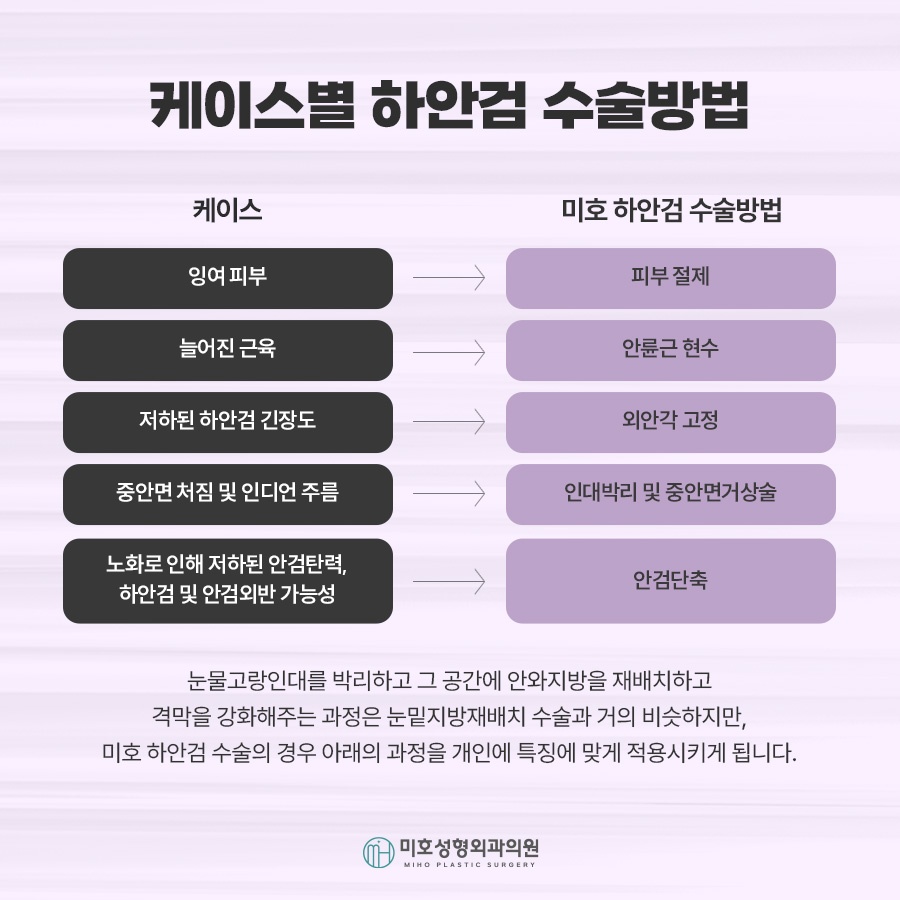
The two methods may look similar at first glance,
but they differ in the extent of tissue removal,
the location where the tissue is fixed,
and the degree to which the muscles are tightened.
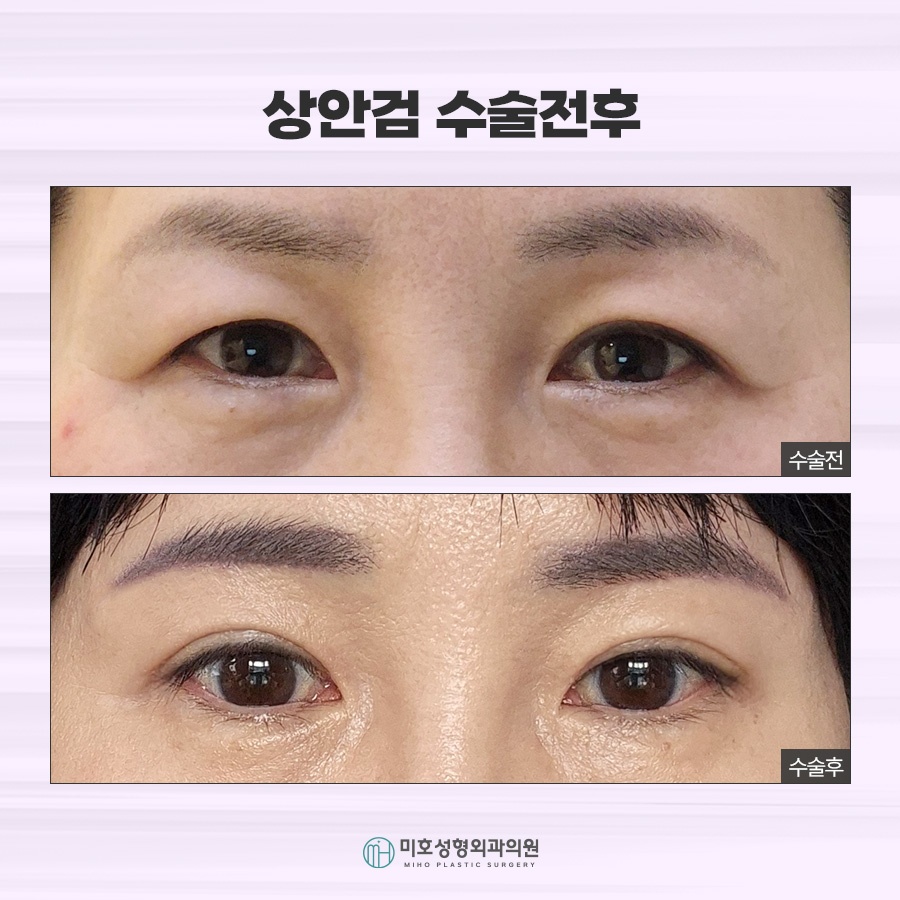
Here is a brief overview
of the upper and lower eyelid surgery methods.
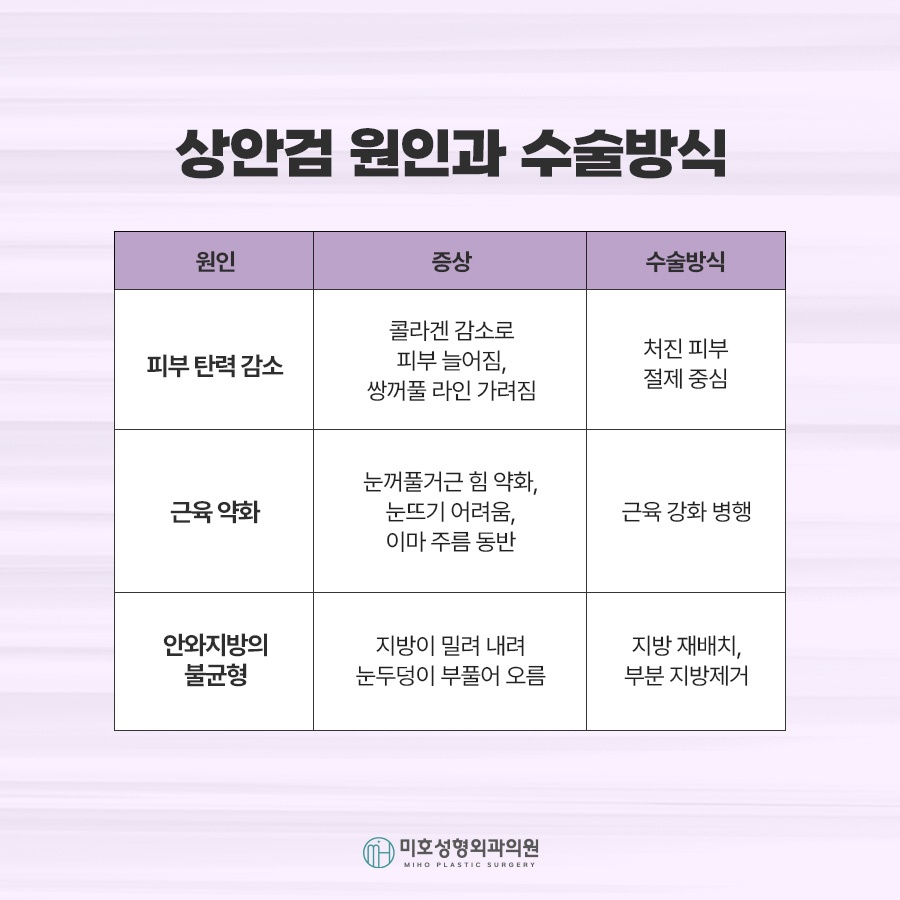
For upper eyelid surgery, loose skin tissue
is incised and partially removed,
then the incision is sutured.
Depending on the individual’s needs,
a double-eyelid crease may be created,
or only the muscle and skin may be removed
without creating a crease.
For lower eyelid surgery, a delicate incision
is made just beneath the eyelashes,
after which excess under-eye fat is removed.
Some fat is left in place to create
the appearance of a youthful lower-eyelid fullness.
The skin tissue is then lifted upward
and finished with fine sutures.
At this point, the septum may also be reinforced
to supplement muscle tension.
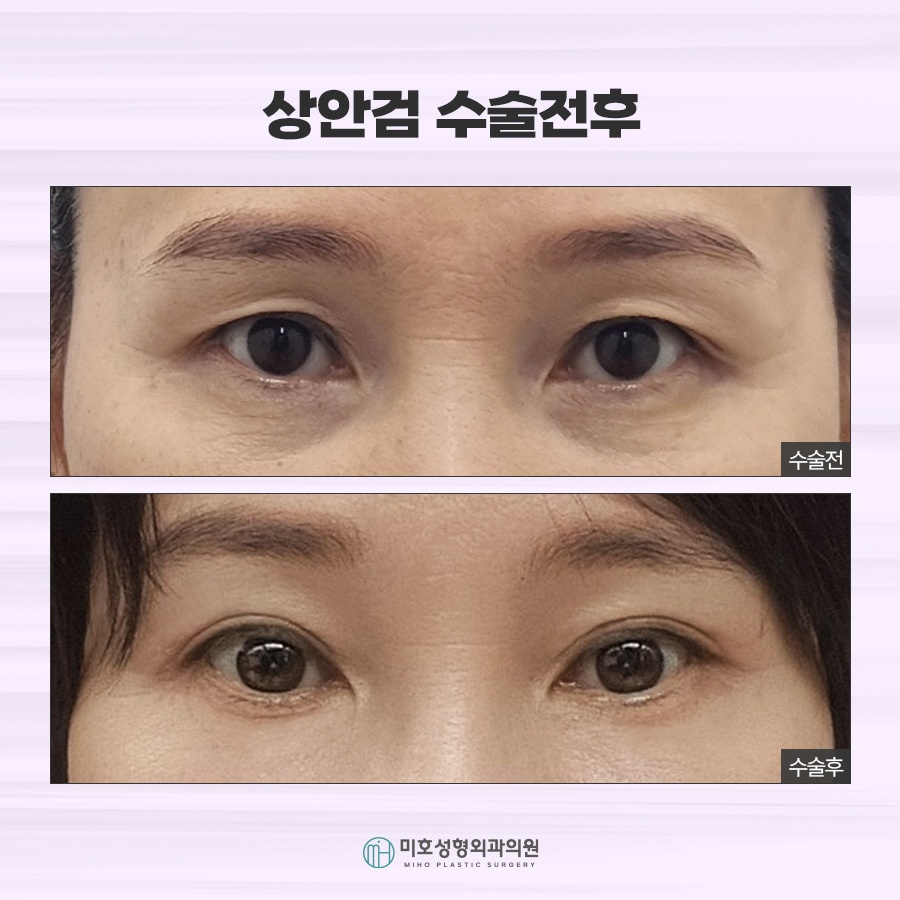
If directly making an incision in the upper eyelid
feels burdensome, a brow lift may be recommended.
This method involves making an incision
along the line beneath the eyebrow
and removing sagging skin.
It can improve sagging without altering
the original shape of the eyes.
If you only have fine lines
or your loss of elasticity is not severe,
you may notice changes with laser treatment,
Botox, or radiofrequency lifting alone.
Because there are various ways
to correct age-related changes,
it is important to consult a medical professional
and select and undergo the treatment
that is appropriate for you.
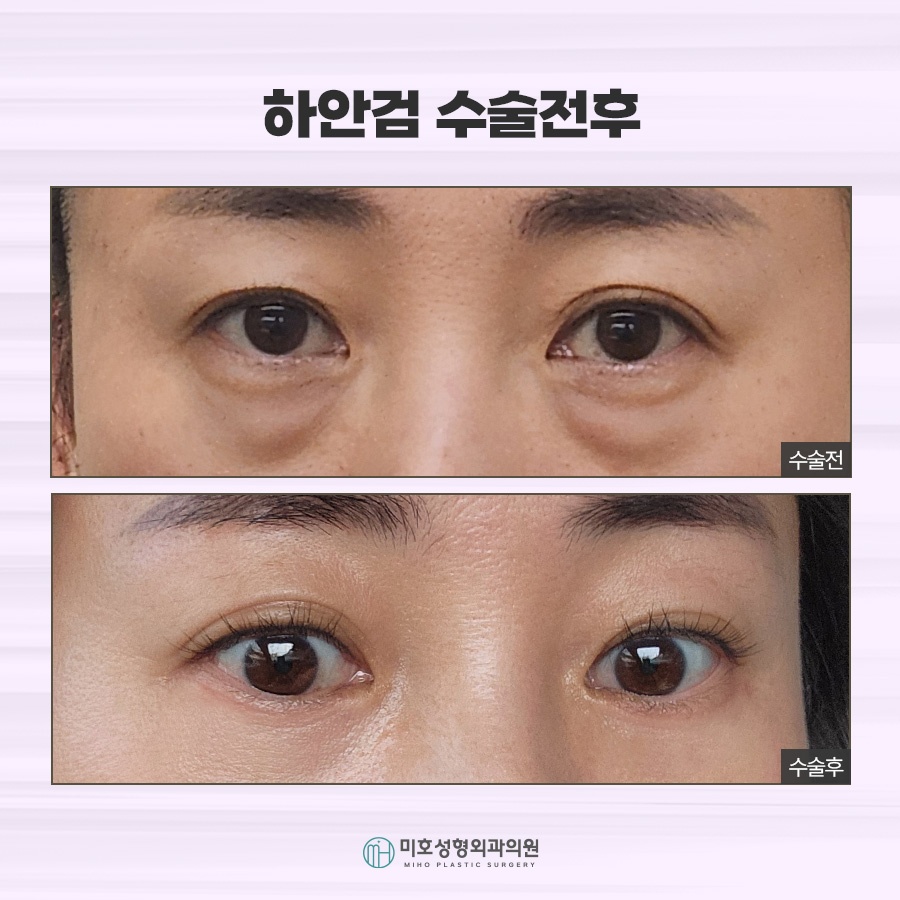
Immediately after the procedure,
the eyes may look more defined
and the expression may appear brighter.
Overuse of the forehead muscles
may also be reduced.
The recovery period varies from person to person,
but on average, it is possible
to return to daily activities in about one to two weeks.
Bruising, swelling, and pain may occur initially,
but these are normal reactions
that generally improve over time.
Do not touch or rub the incision area forcefully.
Alternating cold and warm compresses
may help reduce swelling.
You should avoid smoking and alcohol
for at least four weeks,
and it is also advisable to avoid saunas and swimming pools.
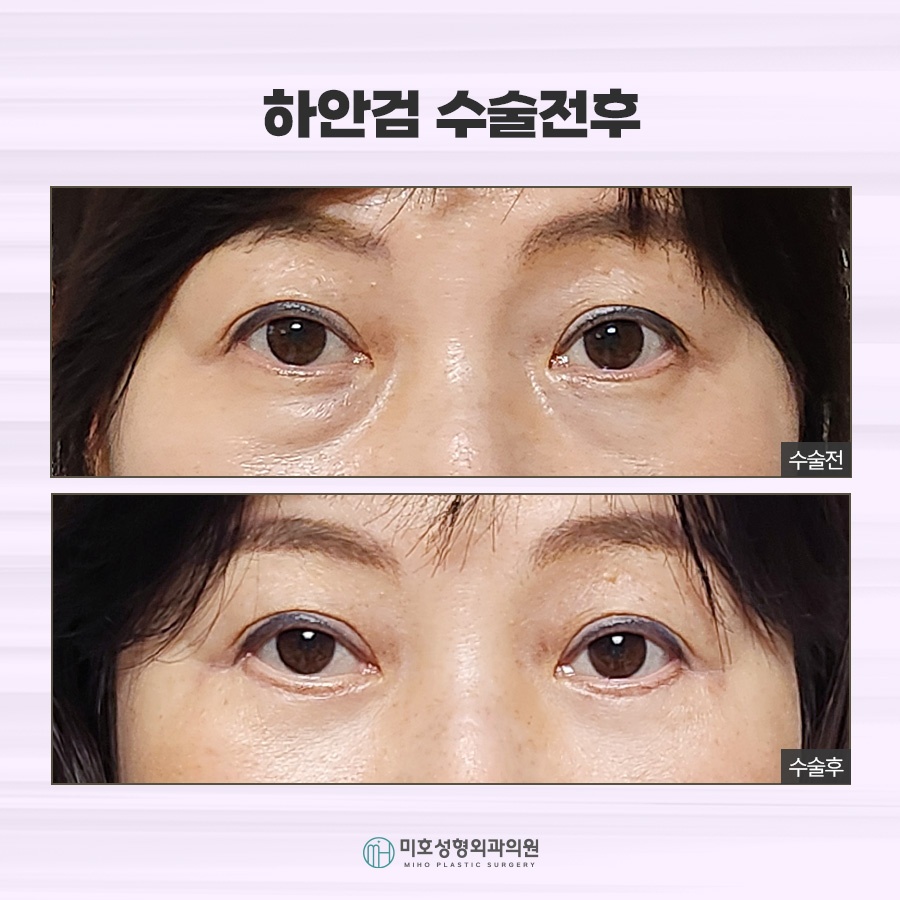
In some cases,
upper and lower eyelid surgery alone
may not be sufficient.
In such cases, a forehead or brow lift
or fat grafting may also be performed.
To achieve a natural and harmonious result,
it is important to assess not only the eye area
but also the surrounding areas
and proceed carefully.
By closely evaluating your current condition
and creating a customized design
based on the medical professional’s experience and technical expertise,
you may achieve a more vibrant and youthful-looking appearance.
Rather than feeling distressed by changes in your appearance,
we hope you will actively seek a solution
by considering the various available approaches.



Previous image
Next image