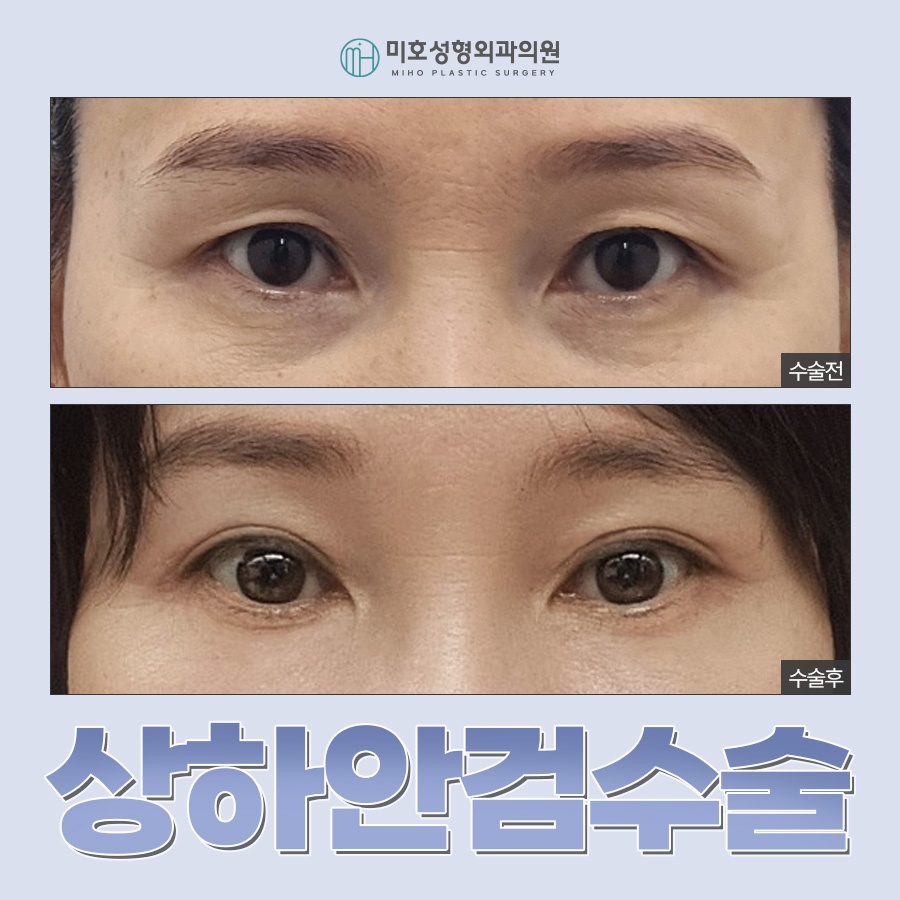
As average life expectancy has increased compared with the past,
more and more people are continuing their economic activities
by finding new careers even after reaching retirement age.
As a result, the importance of self-care has grown
just as much among middle-aged people as it has among younger generations.
Middle-aged cosmetic procedures, which continue to increase every year,
can be very helpful in restoring confidence that has declined
because of aging.
In particular, since the eyes are the area that influences
one's first impression on others,
upper and lower blepharoplasty can bring about significant changes.
Accordingly, not only women but also men
are showing growing interest in the procedure.
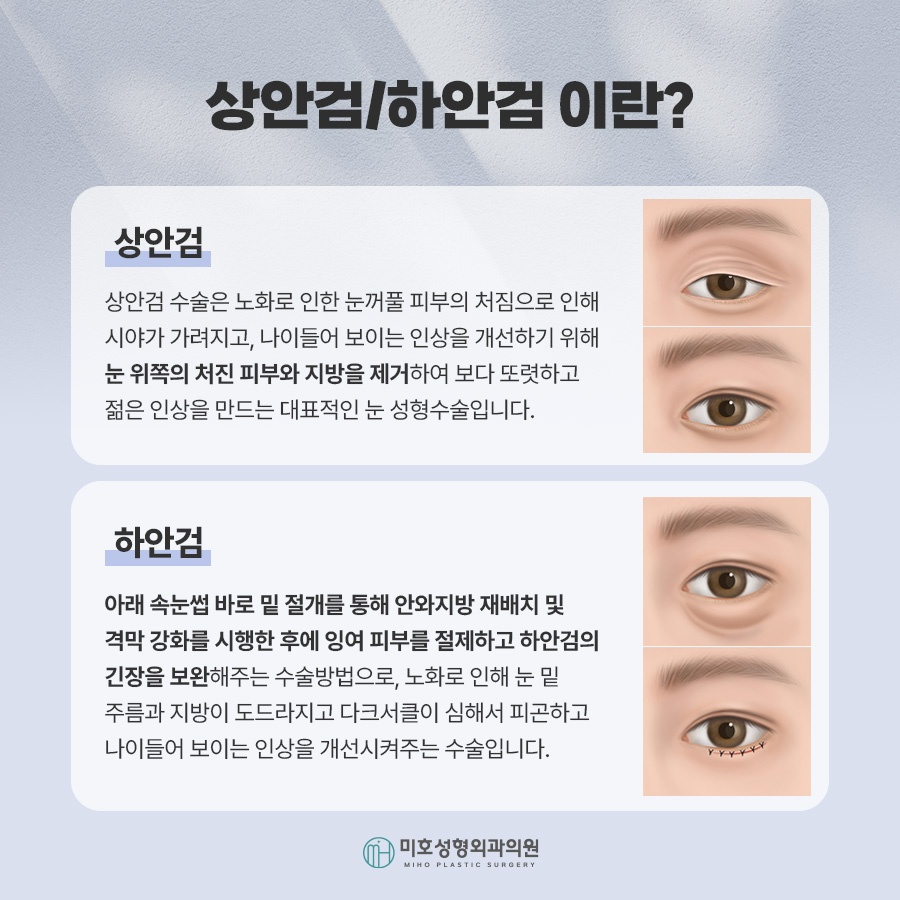
Eye procedures performed for middle-aged individuals
focus less on creating a double-eyelid line
and more on improving both appearance and function
through upper and lower blepharoplasty.
Furthermore, even among people of a similar age,
there can be many differing factors, such as
the degree of drooping eyelids and ptosis,
the thickness of the skin layer and the structure beneath the eyes,
the distance between the eyebrows, and left-right asymmetry.
Therefore, it is important to carefully examine the current condition
and develop a personalized plan.
Since functional aspects must be checked
while also taking the characteristics of aging into consideration,
it is advisable to proceed cautiously
based on an in-depth analysis by a specialist.

In particular,
upper and lower blepharoplasty for middle-aged individuals
can erase signs of aging around the eyes
and help restore a natural appearance.
If the skin layer has become thinner with age,
lost elasticity, and led to drooping eyelids,
upper blepharoplasty may be helpful.
When the eyelids become lax due to aging,
the condition progresses beyond the initial stage,
when the double-eyelid line merely appears smaller,
and can become uncomfortable enough to obstruct the field of vision.
As the drooping gradually becomes more severe,
the eyelashes may repeatedly prick the eyeball,
causing various discomforts.
In addition to frequent tearing,
the surrounding skin may become irritated,
and the eyes may appear red and bloodshot,
among other possible symptoms.

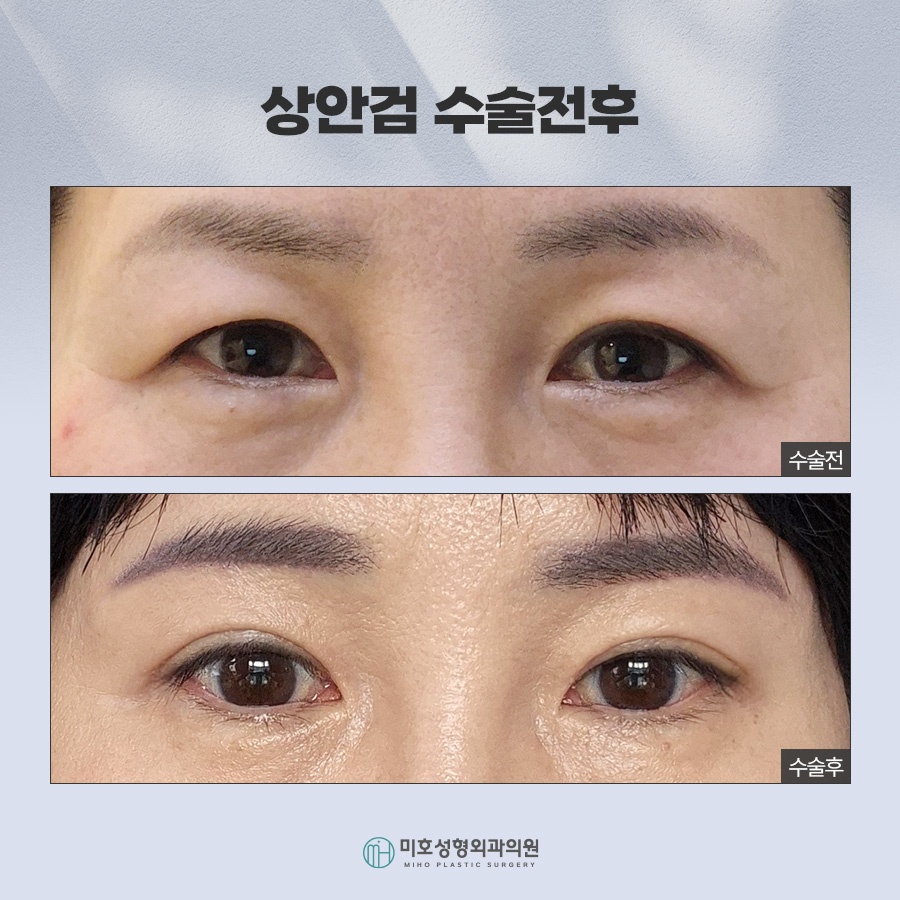
Upper blepharoplasty can improve these issues
by removing unnaturally lax tissue,
eliminating changes in facial expression
and discomfort such as obstructed vision,
and creating a more vibrant, defined,
youthful-looking appearance around the eyes.
The method used for upper blepharoplasty
varies from person to person depending on their condition.
A new double-eyelid line may be created
while removing the muscle from the drooping eyelid,
or the procedure may be completed
by removing only the drooping skin layer and muscle.
The appropriate approach should be determined carefully
through consultation with the physician in charge.
Looking at the process, before the procedure,
the area is first designed and then
carefully and precisely incised.
After the incision, the excess skin layer is
removed and the area is sutured.
This procedure is performed under local anesthesia.
Although the duration varies slightly,
it generally takes about one hour.
Therefore, hospitalization is not required.
After one or two follow-up visits to monitor progress,
the stitches are removed after five to seven days.
Since a recovery period of five to seven days is generally sufficient,
planning the procedure is not difficult,
and a relatively quick return to daily activities is possible.

The most common signs of aging beneath the eyes
that lead people to consider upper and lower blepharoplasty
are sagging and puffiness beneath the eyes.
Lower blepharoplasty can improve awkward-looking areas
and create a smoother appearance.
This approach is distinct from the fat repositioning beneath the eyes
that is often performed in younger individuals
with the aim of improving dark circles.
When necessary, the procedures may be combined.
Lower blepharoplasty may be appropriate
when aging has progressed in the skin layer beneath the eyes,
creating dark shadows and uneven contours.
In such cases, even when a person is feeling well,
their appearance may give others the impression that they are tired
and make them look older than they actually are.
Looking at the causes of dark circles,
the skin layer beneath the eyes becomes thinner
and gradually loses elasticity,
allowing the color of the capillaries to show through.
In addition, when the connections between the tissues beneath the eyes
become loose, they droop under the influence of gravity.
The skin folds around the area where the ligaments are located,
creating uneven contours,
which can further worsen the appearance of dark circles.
The continuous action of the orbicularis oculi muscle
can also create fine, crinkled lines,
making the person appear older.
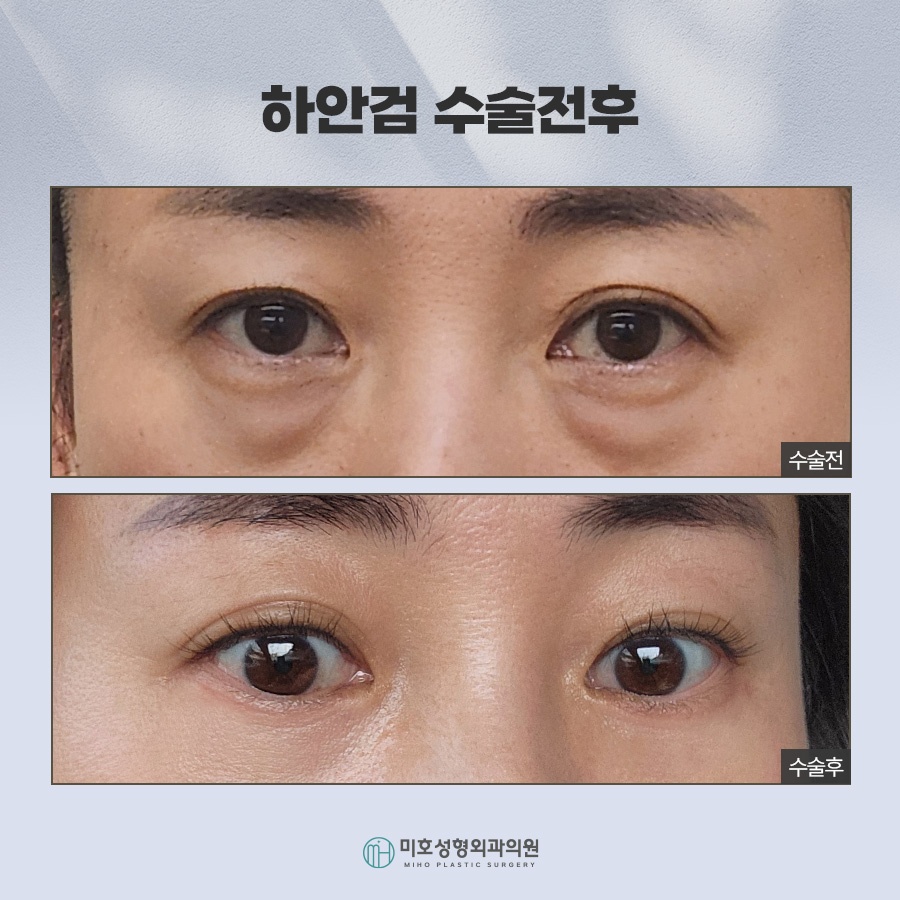
The method of improvement is determined
through an in-depth analysis.
For dark circles that make the complexion appear dull
without protruding fat,
reinforcing the layer beneath the skin
through nano-fat grafting and fat repositioning
may reduce the visibility of the subcutaneous capillaries
and help alleviate the dark circles.
Also,
when determining whether upper and lower blepharoplasty is needed,
if the degree of drooping is not severe,
elasticity may also be expected to improve
through radiofrequency lifting, thread lifting,
or ultrasound lifting.
Separately, if the septum surrounding the orbital fat
is found to have become loose,
tightening and reinforcing the septum
can flatten the protruding area
and improve the shadow beneath the eyes.
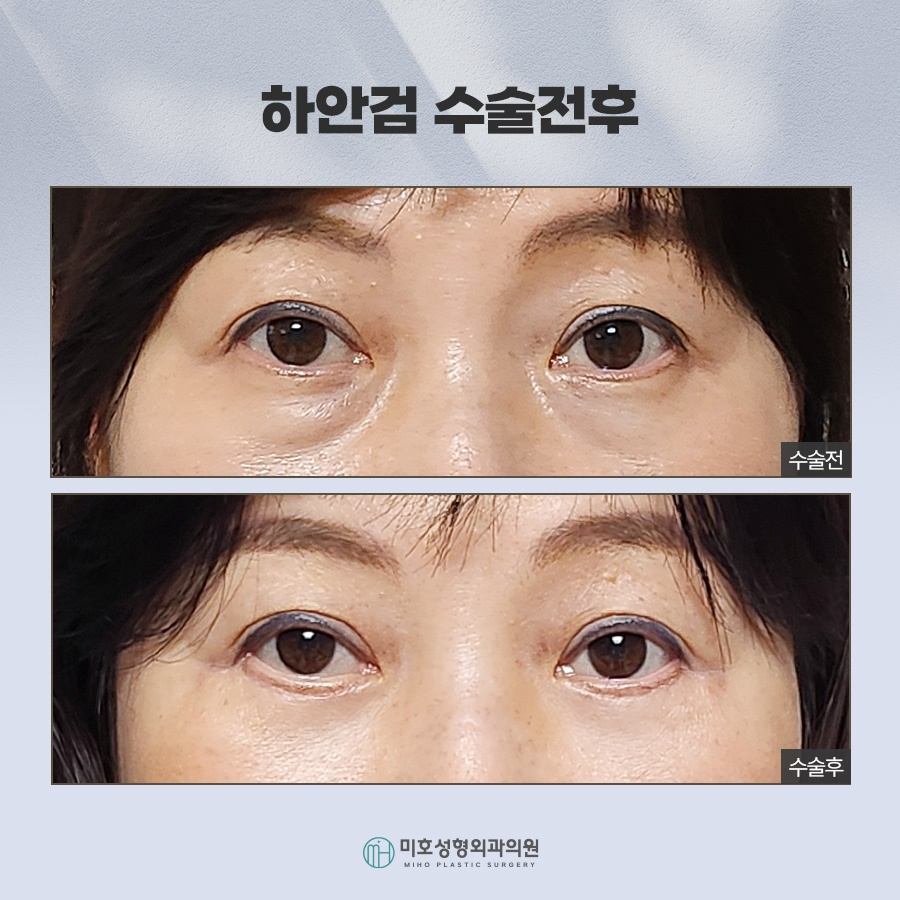
In some cases, a decrease in orbital fat volume
combined with severe sagging can result in puffiness,
which may require fat removal.
If tear trough deformity is also present,
the orbital fat is removed from the septum
and repositioned to fill areas that have become hollow.
If the lower eyelid appears more sunken
than the orbital rim of the maxilla
because of insufficient orbital fat volume,
it can be reinforced with fillers or nano-fat grafting.
In addition, the tear trough ligament,
the maxilla, and the soft tissue of the midface
can make aging beneath the eyes more pronounced.
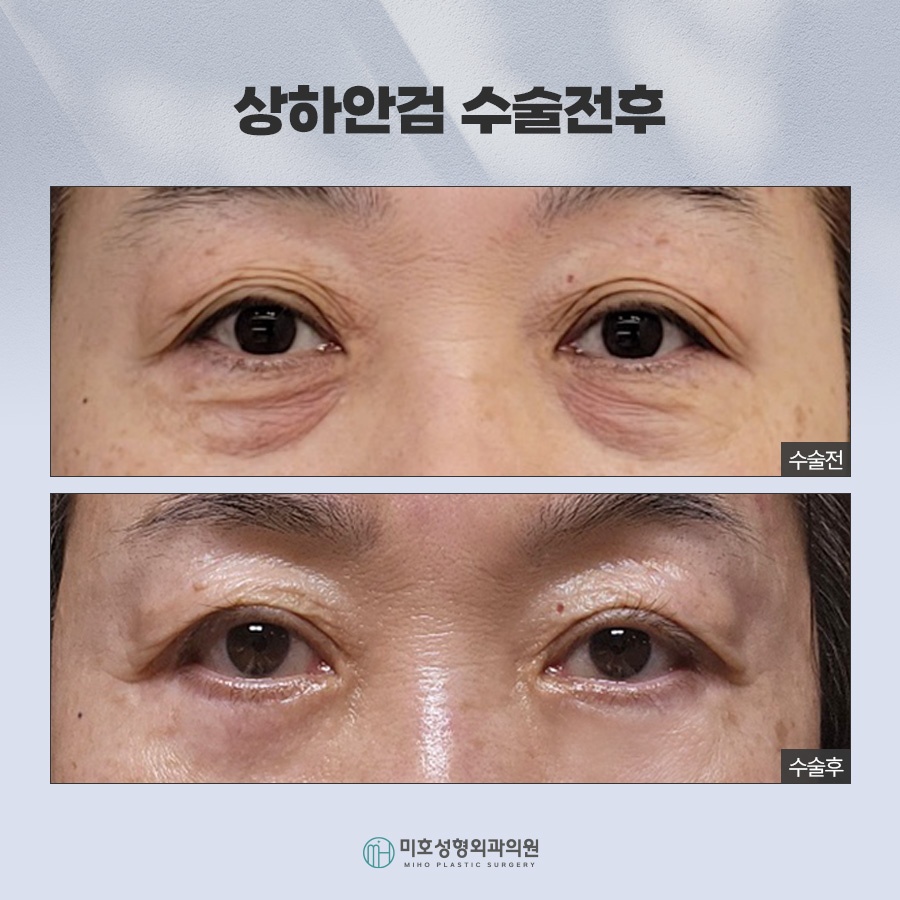
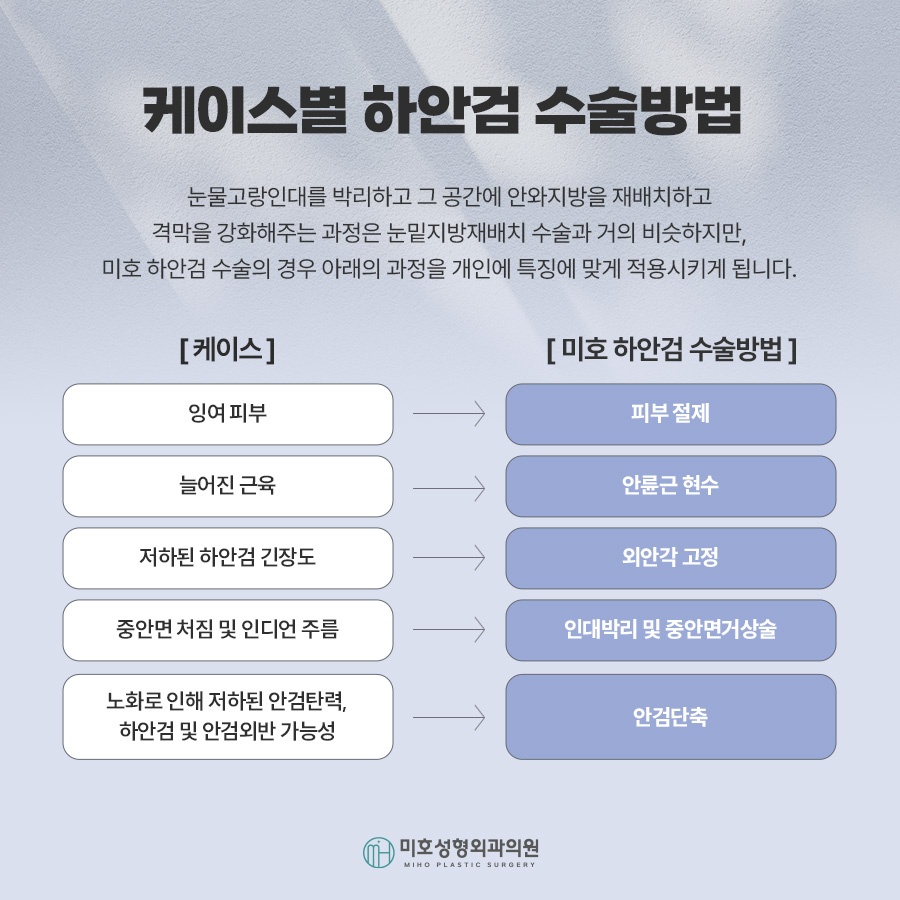
Looking at the lower blepharoplasty process,
it begins by designing the incision area
according to the symptoms.
After making a delicate, minimal incision
just below the eyelashes,
fat beneath the eyes is removed and repositioned.
The skin is then lifted upward with fine sutures
and carefully closed.
As shown, to achieve a high-quality improvement
that corresponds to the progression of aging,
areas affected by changes—including the orbital fat,
septum, and orbicularis oculi muscle—
must be addressed in combination.
In addition,
when undergoing upper and lower blepharoplasty,
please follow the precautions provided to you
so that you can achieve a more natural,
youthful-looking appearance.



Previous image
Next image