
Since the nose is located in the center of the face,
it can be considered one of the most important features
that influences the overall impression.
When the nasal wings droop downward,
the overall shape can appear somewhat heavy,
making it easy to create a stuffy impression.
Even with the same nasal height,
the overall impression can differ considerably
depending on the height of the wings on either side.
The process of lifting the drooping areas upward
and refining the contours is called an alar lift,
or alar elevation in medical terminology.
When the balance with the nasal tip is properly established,
a clearer and more open impression
can be created consistently from every angle,
both front and side.

To understand an alar lift,
it is essential to understand the relationship
between the three elements that make up the nose:
the nasal tip, columella, and nasal alae.
The columella is the column-shaped area
that vertically divides the two nostrils,
and these three elements work together
to create the three-dimensional appearance of the nose.
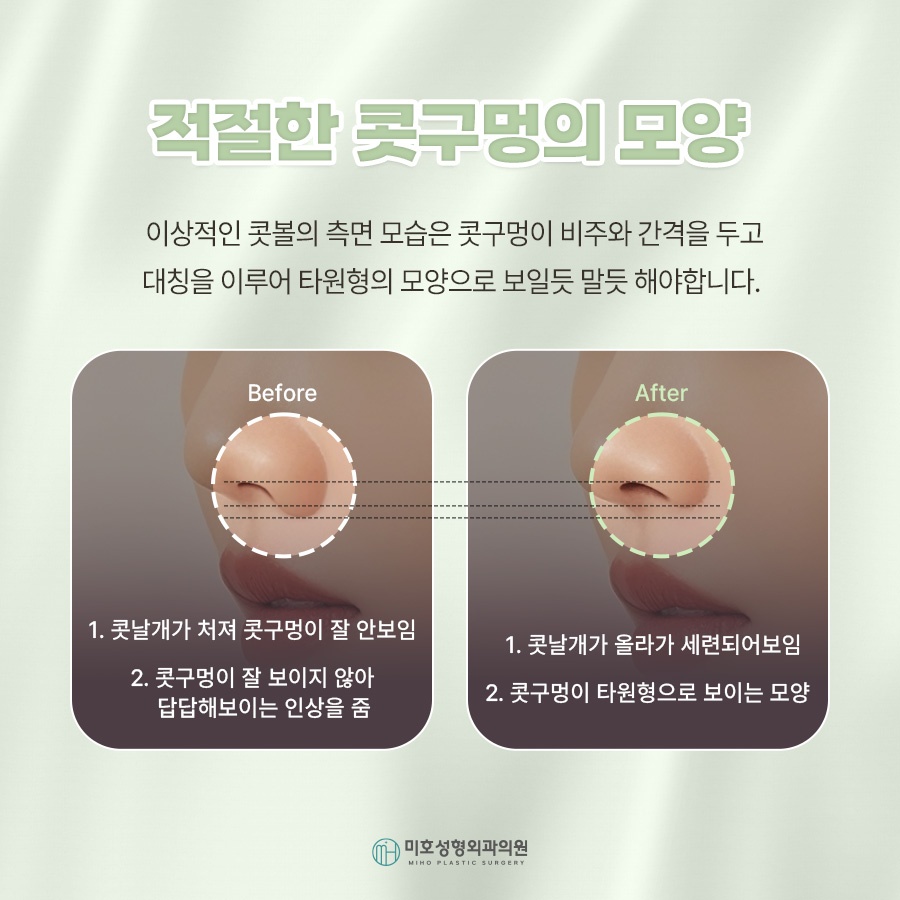
When viewed closely from the side,
the most balanced appearance is achieved
when the lower part of the columella
protrudes approximately 2–3 mm below the lateral alae.
By contrast, when the alar region descends
far too far below the columella,
the entire nose can appear compressed,
while excessive nostril exposure
can create a heavy impression.
This structural imbalance
also affects facial proportions.

From an aesthetic perspective, the ideal shape
is one in which the two lowest points on either side
and the nasal tip are connected by straight lines,
forming a wide, inverted triangle viewed from the side.
The most natural shape is achieved
when the lower edges on both sides
are level with or slightly higher than
the lower part of the columella.
When this structure is maintained properly,
the nasal tip naturally becomes more defined,
while the nostrils are appropriately concealed.
On the other hand, when the lateral edges
descend further,
they form an upside-down inverted triangle,
creating a stuffy impression.
The method used to correct this
is an alar lift.
Several structural factors
can work together to cause the nasal alae to droop.
The main causes include cartilage that is excessively developed downward,
significantly reduced natural elasticity,
or skin in the area that is particularly thick and heavy.
If a person is genetically born with cartilage
that is rotated downward,
the drooping can become more pronounced.
Most of these factors tend to be congenital,
and the condition may worsen
as skin elasticity decreases with age.
This is different from simply having wide nostrils,
and for correction, it is especially important
to carefully assess the degree of drooping.
One representative type in which
the balance between the columella and alae is unnatural
is a shape known as a jug-shaped nose.
The less flexible the tissue and the thicker the skin,
the more severe the downward drooping may become.
As the ends of the alae stretch downward,
the nostrils appear triangular rather than inverted triangular
when viewed from the front.
With this type, the entire nose appears long and heavy,
and the nostrils tend to appear even more exposed,
particularly when smiling.
From the side, the lateral areas are lower than the nasal tip,
which can also make the columella appear relatively short.
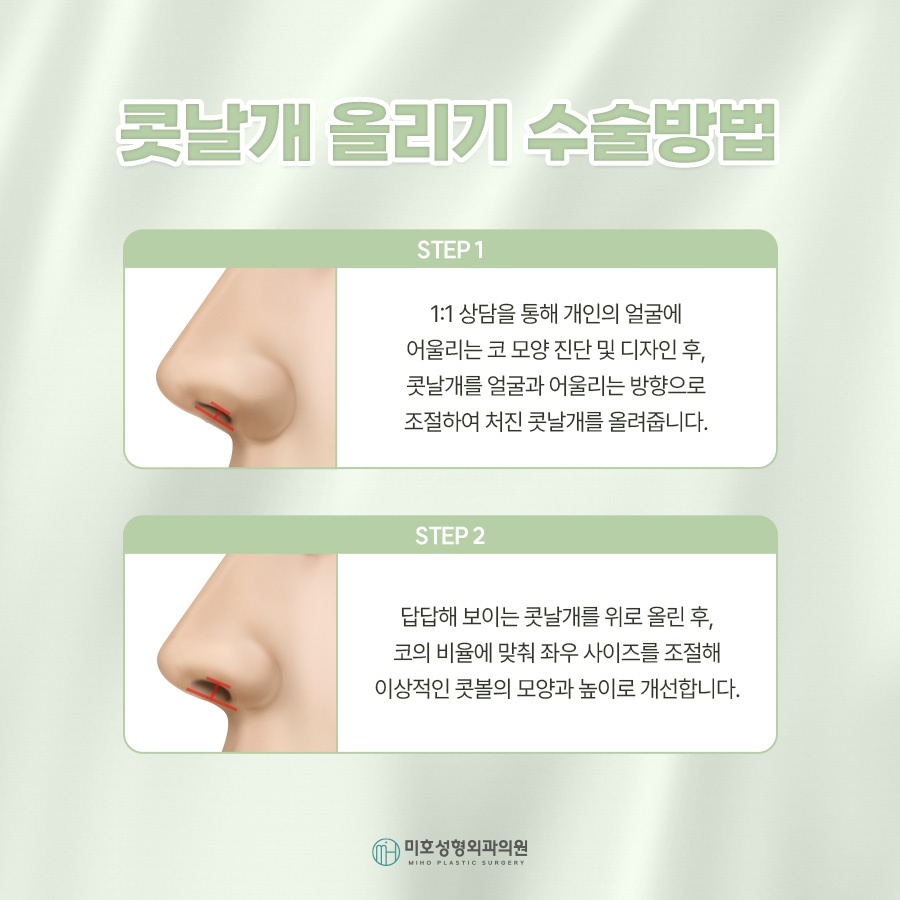
An alar lift is divided into two methods:
non-incisional and incisional.
The two methods may also be applied together
to increase both the scope of correction
and the stability of the results.
A non-incisional procedure lifts both sides
by tying the tissue from inside the nostrils
without affecting the skin,
while an incisional procedure directly manipulates
the skin and cartilage along the boundary line.
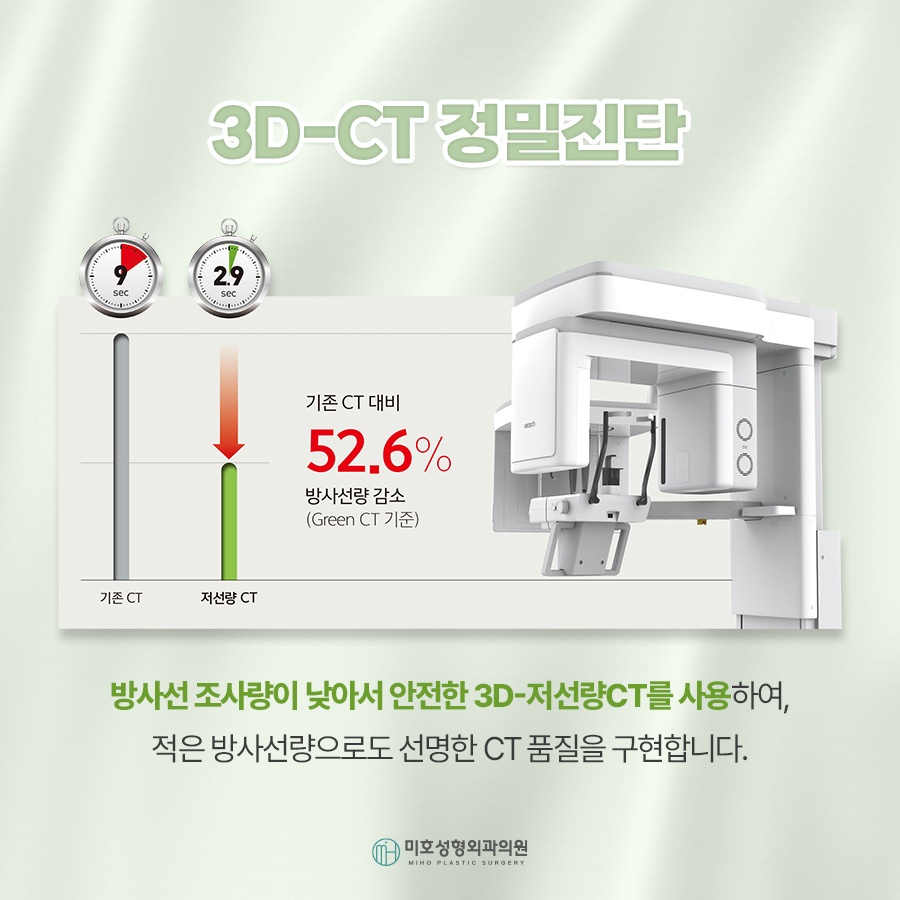
Since the appropriate method varies
according to the degree of drooping and the condition of the soft tissue,
an assessment of the individual's nasal structure
must be conducted first.
A non-incisional procedure is suitable
when the drooping is relatively mild
and the soft-tissue volume is not excessive.
There are two types of sutures used:
absorbable and nonabsorbable.
The duration of maintenance varies
depending on the material.
It has the advantage of placing less burden on the patient
in terms of external scarring,
and the recovery period is generally shorter
than with an incisional procedure.
However, when there is significant structural deformity
or the skin and soft tissue are thick,
the scope of correction may be limited,
and the duration of maintenance may also differ.
A sufficient evaluation is needed
to determine whether the condition of the nose
is suitable for this method.
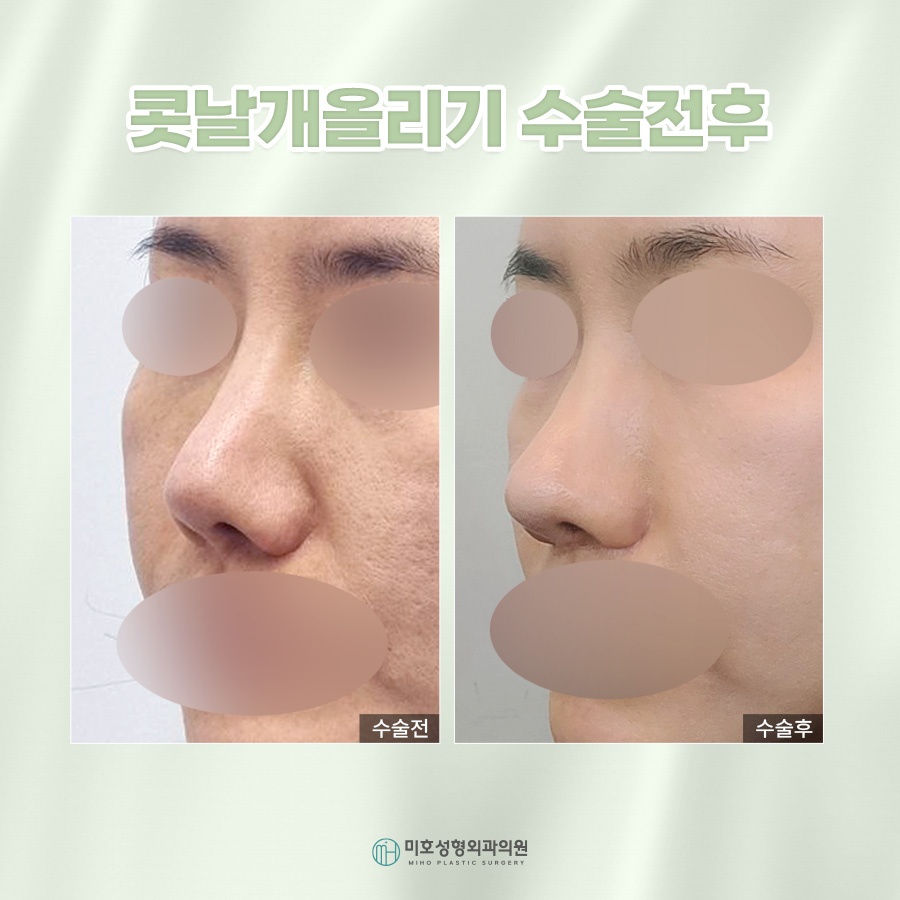
An alar lift accompanied by an incision
directly manipulates the soft tissue,
making it more suitable for structural changes.
Another characteristic of this method
is that the volume and thickness of the tissue in the area
can be adjusted at the same time.
It is mainly used when left-right asymmetry is pronounced
or the degree of laxity is clearly visible,
and the detailed shape of the lines and nasal tip
can also be adjusted together.
Because the design follows the direction of the creases,
the scar is less noticeable.
Since the results are relatively stable
and can be maintained for a comparatively long time,
it is often selected when structural improvement is needed.
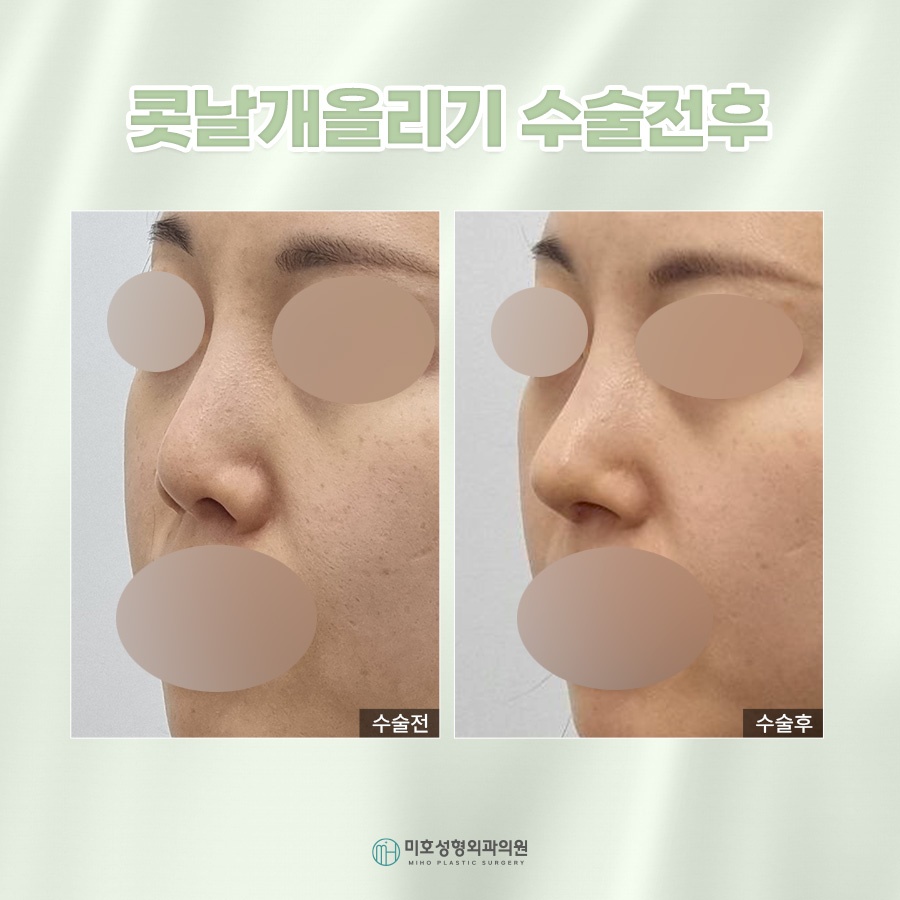
In the early period after refining the shape,
swelling and bruising may occur.
Keeping the head elevated above the heart
and applying cold compresses to the area
can help reduce swelling.
The stitches are usually removed
around seven days after the procedure,
and swelling subsides after one to two weeks.
After the stitches are removed,
it gradually becomes possible to return to daily activities,
while the final appearance settles slowly
over the course of two to three months.
During the recovery period,
avoid pressing on the nose
or blowing it forcefully.
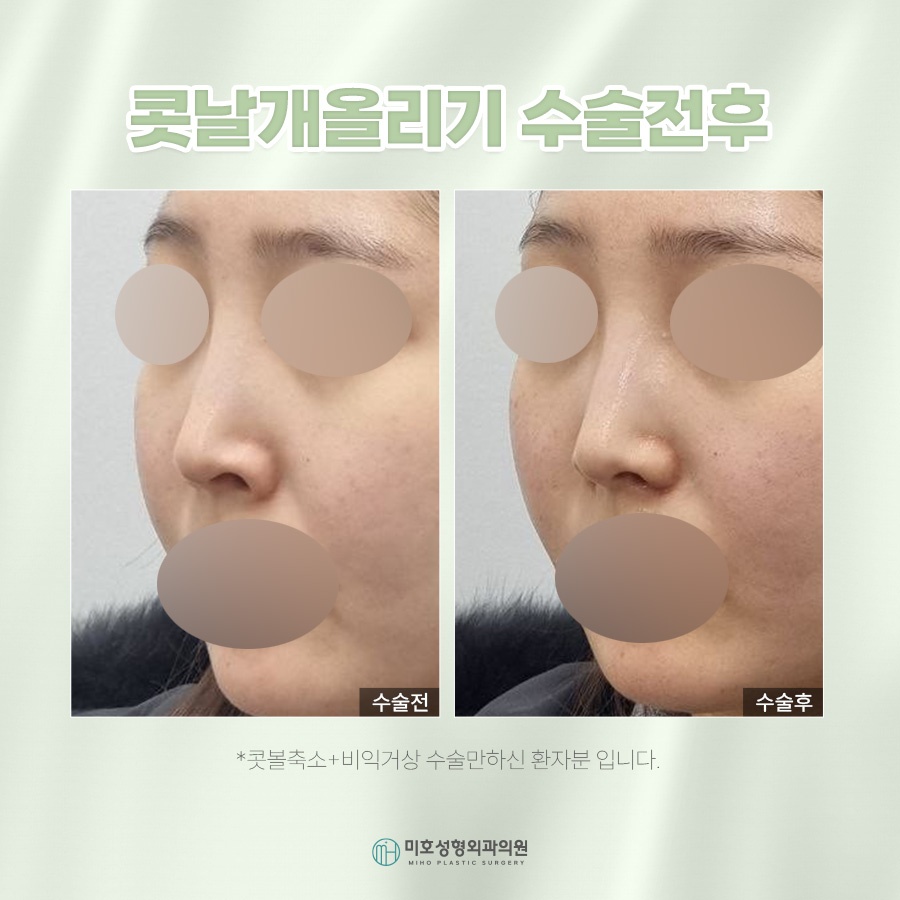
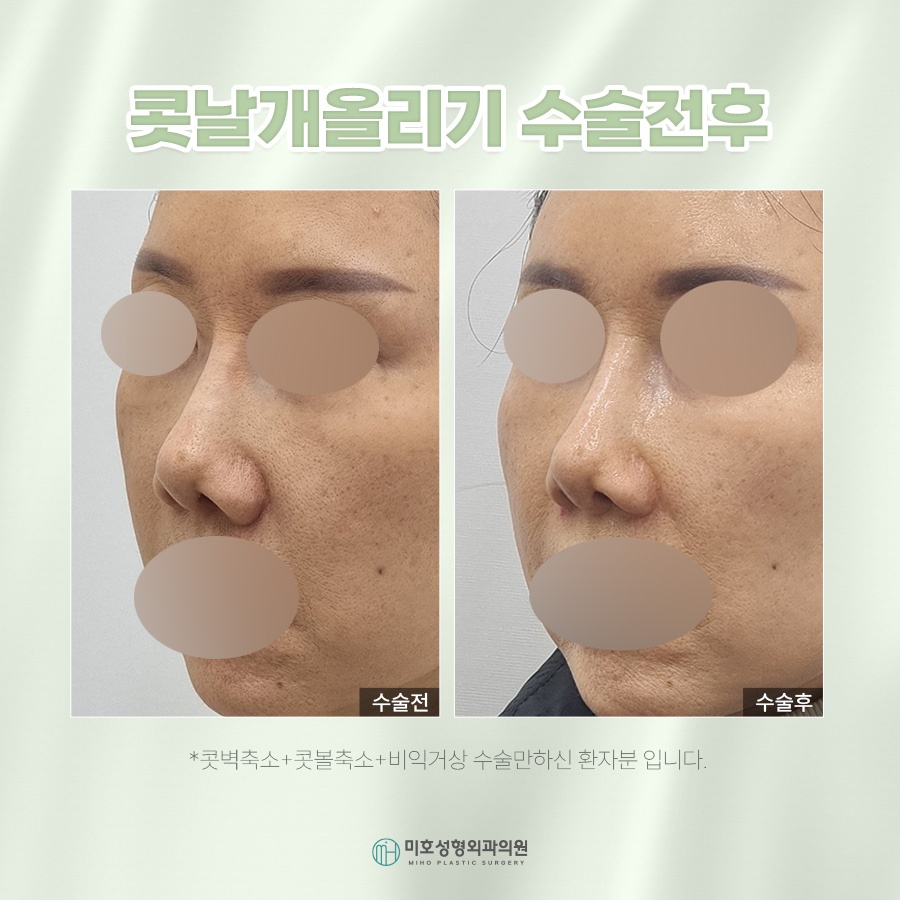
An alar lift restores balance to the nose
and brings a change to the facial impression.
When drooping nasal alae are lifted,
nostril exposure is reduced from the front,
and the nasal tip contour becomes more defined from the side.
The degree of improvement needed,
the condition of the cartilage,
and skin thickness vary from person to person,
so it is advisable to carefully choose a method
suited to one's structural characteristics.
Rather than focusing only on the shape of the nose,
the plan should take into comprehensive consideration
its harmony with the overall facial features
to achieve a natural result.
For this reason, from the planning stage,
it is especially important to have a thorough consultation
with an experienced medical professional
and carefully undergo the simulation process.



Previous image
Next image