
Hello. I’m Kim Hyung-taek, the CEO surgeon at Kowon Plastic Surgery.
In today’s Q&A note, I’d like to talk about whether pus on the nasal bridge after nose surgery can be resolved with autologous cartilage rhinoplasty.
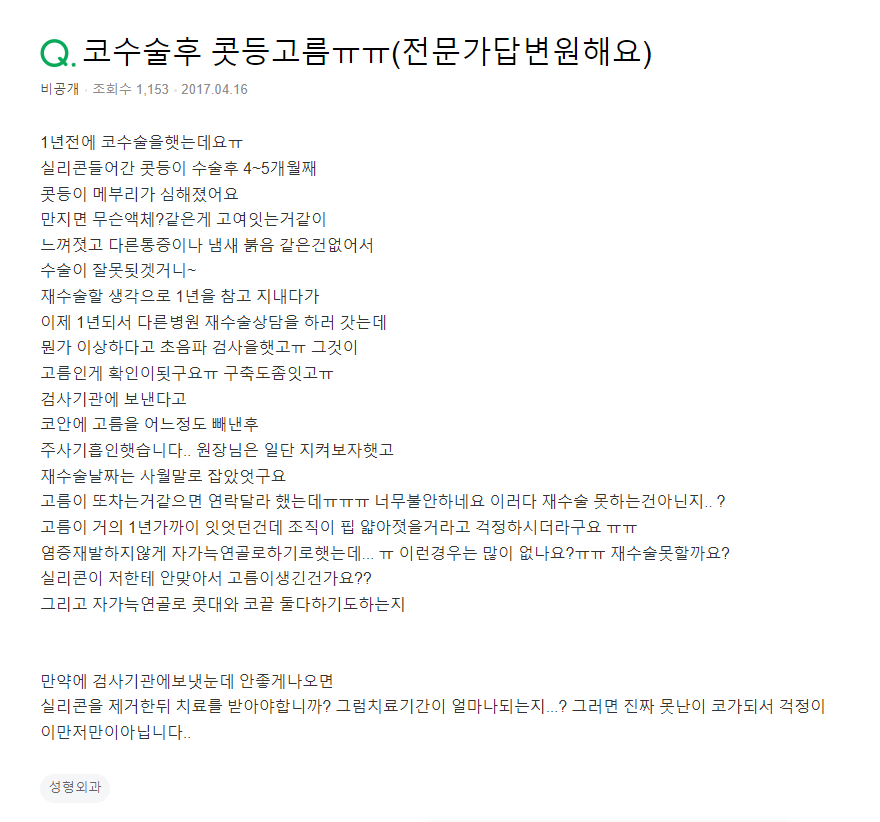
Q. Nasal bridge pus after nose surgery with autologous cartilage rhinoplasty
I had nose surgery a year ago.
Silicone was placed on the bridge of my nose, but 4 to 5 months after the surgery,
a hump on the bridge became more pronounced.
When I touched the bridge of my nose, it felt like some kind of fluid? had collected there.
There was no other pain, strange smell, or redness.
Still, I felt like something had gone wrong with the surgery and thought it was a complication,
so I endured it for a year with the thought of having revision surgery. Now that a year had passed, I went to another hospital for a revision surgery consultation, and they said there were abnormal signs, so I had an ultrasound examination.
It was then confirmed that there was pus on the nasal bridge and that there was also some contracture.
So they also sent it to a testing lab, performed needle aspiration inside the nose, and removed some of the pus.
The director said to observe it for now, and a date for revision nasal surgery was scheduled separately.
I was told to contact them if it seemed like the pus would collect again, but ㅠㅠ
I’m so anxious. I’m worried that I might not even be able to have revision nose surgery at all...
They said that because the pus had been there for nearly a year, the tissue and skin would likely be thinner ㅠㅠ
We decided to use autologous rib cartilage so that the inflammation would not recur.
Is this kind of case uncommon?
Will revision surgery not be possible?
Was the pus caused because silicone was not suitable for me?
And I’m also wondering whether autologous cartilage rhinoplasty can be used to operate on both the nasal bridge and the tip.
If... the test results for the pus on the bridge of my nose that was sent to the testing lab are not good,
should the silicone be removed first and treatment be done before anything else?
Then how long would the treatment period be?
I’m really worried that my nose might end up looking ugly.
From what you’ve described, it sounds like inflammation developed on the nasal bridge after nose surgery.
Since it has continued from around 4 to 5 months after the surgery,
it seems like you may have been living with chronic inflammation for a long time.
It would be better to give an accurate diagnosis after examining you in person. That’s because the surgical plan can change depending on the degree of inflammation, the current degree of contracture, and the shape of the nose.
I understand that you are very worried in your current condition.
First, since the pus from the bridge of your nose has been sent for testing, it would be best to confirm what kind of bacteria is present and then receive antibiotic treatment accordingly to treat the inflammation.
If there is no response to antibiotic treatment, the silicone may be removed, irrigation performed, and revision surgery done after 6 months.
Contracture can develop in the meantime, so it would be good to keep a close watch on the progress.
Also, for a nose that has had inflammation, it is common to perform surgery using autologous cartilage rhinoplasty. You can use autologous rib cartilage for both the nasal bridge and the tip, and if you do not want a feeling that is too firm, you can also use autologous dermis.
Inflammation after nose surgery does sometimes occur.
I hope your revision surgery goes well and that you recover well.
I hope this answer was helpful.
Thank you.
Source: https://kin.naver.com/qna/detail.nhn?d1id=7&dirId=70110&docId=274847664&page=1#answer1
https://blog.naver.com/kowon_note/223330250577