
Hello, I’m Kim Hyung-taek, the lead director of Kowon Plastic Surgery, where we create beautiful lines that become more attractive the more you look at them.
This time, a patient who was uncomfortable with artificial nose implants said they were curious about the surgical method and the recovery period after rhinoplasty when using autologous rib cartilage.
Q. I’m curious about the surgical method for nose implants using autologous rib cartilage and the recovery period after rhinoplasty
While recently researching nose surgery, I learned about something called a custom implant.
But these days, I also learned that instead of fitting silicone, some people shape a nose surgery implant using autologous rib cartilage, which I found fascinating.
To be honest, I had been thinking about whether or not to get nose surgery for a long time, but I was hesitant to make the decision because I was uncomfortable with artificial implants such as Gore-Tex or silicone.
I heard that rib cartilage surgery can involve warping and resorption, and I’m wondering whether those concerns can be ruled out when using a customized autologous rib cartilage implant.
I would also appreciate it if you could explain the surgical method, whether it can achieve the shape I want, and how long I should expect the recovery period after rhinoplasty to be.
#noseimplant #autologousribcartilage #recoveryperiodafternosejob #warping #RibFit #KowonPlasticSurgery
I completely understand the hesitation you may feel when considering nose surgery and being uncomfortable with artificial implants.
Recently, custom autologous rib cartilage implants and autologous tissue implant technology, which can help resolve these concerns, have been drawing attention, and our Kowon Plastic Surgery also performs them, so please keep that in mind.
First, let me explain RibFit, a custom implant made from autologous rib cartilage.
Traditional autologous rib cartilage surgery involved shaving and using the cartilage directly during surgery, and this process came with issues such as warping (the cartilage twisting) and resorption (a reduction in some of the cartilage over time).
Because the shape could vary depending on manual technique, it was difficult to predict the outcome.
By contrast, a custom autologous tissue implant is performed in the following way:
-
CT-based 3D simulation
-
Custom mold design
-
Precision processing and implantation of autologous rib cartilage
Q. If it’s autologous rib cartilage, do I not need to worry about warping or resorption?
The biggest advantage of a custom autologous tissue implant is that it is designed with consideration for the cartilage’s fiber structure and direction, reducing unnecessary trimming to balance the possibility of resorption and help prevent warping.
It is not 100% completely free of deformation or resorption, but compared with the conventional method, it is much more stable.
In particular, when RibFit is performed by experienced medical staff with a strong understanding of rib cartilage characteristics, its stability can be considered quite high.
Q. How is the surgery performed?
- CT scan and analysis
Each person’s bone structure, nose, and skin thickness are analyzed in detail.
- Implant design
Through simulation, the desired line—whether straight, slightly straight, or naturally curved—is created.
- Autologous rib cartilage harvesting
Cartilage is harvested from the chest area, and the scar is managed so it is barely noticeable.
- Custom implant fabrication and use
The cartilage is precisely made to fit the mold and then implanted.
You can think of structural reinforcement and fixation of the nasal tip, septum, and other areas as being carried out in this way.
Q. Can the desired shape be achieved?
It can be said that the likelihood is high.
Because a custom autologous tissue implant is designed in advance for nasal bridge height, nose length, and nasal tip shape, it can reflect the desired design more precisely.
However, the thickness of the nasal skin and internal structural limitations still need to be considered, so whether the desired shape can be realistically achieved requires consultation with a specialist.
Q. How long is the recovery period?
Usually, by one week, suture removal and the initial reduction in swelling begin.
By 2 to 4 weeks, returning to daily life with light activities becomes possible, and by 3 to 5 months, the tissues are fully settled and the results stabilize.
In addition, pain in the chest area and scar management must also be handled.
Lastly, RibFit, a custom autologous tissue nose implant, is recommended for the following types of patients.
1- Those who are uncomfortable with artificial implants (such as Gore-Tex or silicone)
2- Those who want to design their nose line in a personalized way
3- Those who want a natural and stable surgery based on autologous tissue
4- If you were worried about the traditional drawbacks of autologous rib cartilage, such as warping or resorption, please consider a custom autologous tissue implant.
RibFit (a custom autologous tissue nose implant) rhinoplasty is not just a simple implant replacement, but a premium rhinoplasty solution that takes into account naturalness, custom design, and long-term stability.
The skill of the plastic surgeon performing the procedure, as well as experience with 3D design and cartilage processing, is extremely important, so rather than simply focusing on whether something is called a custom autologous tissue implant, we recommend carefully checking whether the clinic truly has the ability to carry it out.
If you have any further questions, please feel free to contact us.
Source: https://kin.naver.com/qna/detail.naver?d1id=7&dirId=70110&docId=485236852&answerNo=1
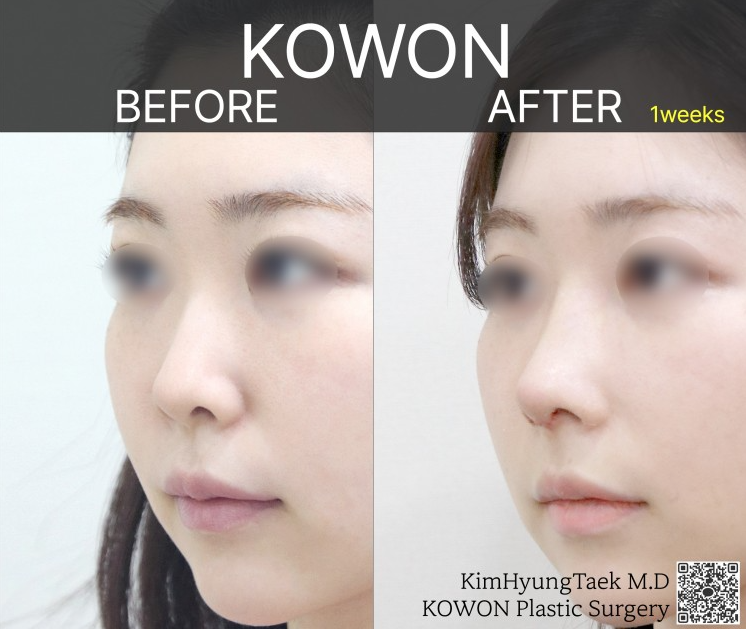
This was a case where a small nose made the face look flat and the mouth appeared protruded.
A nose surgery without implants was used to change the philtrum line and give the face more dimension, while also improving the appearance of the protruding mouth.
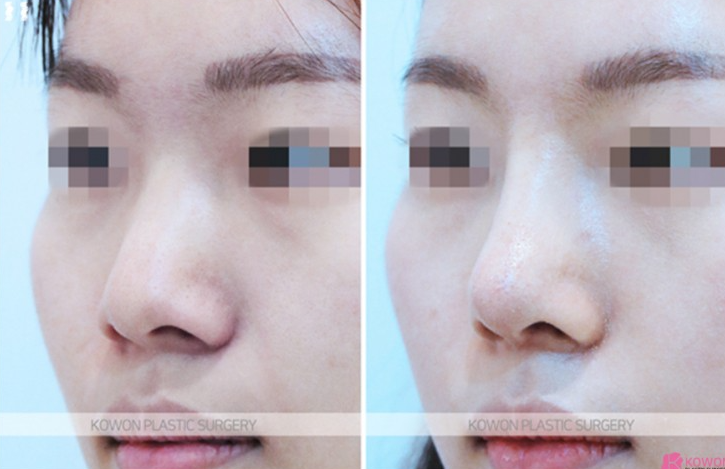
This is a case of correcting a wide nose using septal cartilage.
The bridge between the eyes was low, and the nose was bulbous; by using septal extension and implants such as silicone and septal cartilage, a natural nose shape was created.
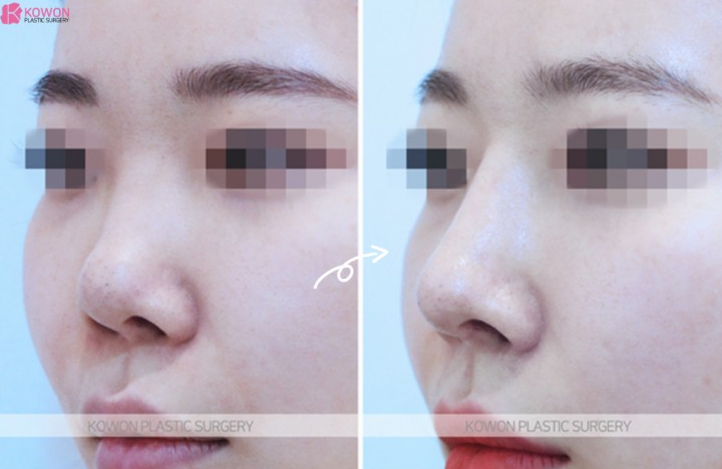
This woman had already undergone nose surgery using silicone and ear cartilage.
However, she requested revision surgery because she was not satisfied with the result.
Even though the hump was corrected, she was dissatisfied because the line was not smooth.
Unlike the first surgery, which used donated rib cartilage, the revision surgery was performed using autologous rib material.
Make a Kowon consultation reservation!
If you would like to see more stories,
please check the link below!