
Hello. I’m Kim Hyeong-taek, Director of Kowon Plastic Surgery.
In rhinoplasty, one of the changes that many people want most
is a harmonious line that creates a high nasal bridge and a slim nose tip at the same time.
However, many people express disappointment because simply raising the bridge or doing silicone rhinoplasty alone
does not produce the desired result.
In particular, when considering revision surgery,
it is common to see cases where the nose tip became blunt or nasal asymmetry became more noticeable after the first surgery.
Also, because there are many misunderstandings and concerns about Alloderm surgery,
an accurate diagnosis and approach suited to each person’s skin characteristics and structure are important.
Today, I will explain this in detail through one such case.

The nose I wanted was
a high bridge with a slim tip.
After the surgery, the bridge definitely seems higher,
but the problem is that the tip looks even more blunt and stuffy than before.
It’s really so different from the image I had expected that I’m very upset.
I had silicone rhinoplasty done at a place with a low price,
and I keep thinking that choosing based only on cost is what led to this result...
At the moment, everything has been removed.
My current nose has a wide, flat bridge, a blunt tip,
and, something I found out during the first surgery, even nasal asymmetry,
so the two sides are slightly different.
So this time I really want to look into it carefully
and get a high bridge rhinoplasty and slim tip surgery done perfectly.
Would I have needed surgeries like nostril reduction or tip fat removal as well?
People around me have been saying all sorts of things about Alloderm surgery,
and I even heard that it can actually make the nose look blunt,
but is that really true?
Would it have been different if the tip had been supported with cartilage from the beginning...
I have a lot to think about before revision surgery.
#높은콧대수술 #실리콘코수술 #알로덤수술 #코수술후기 #코재수술 #코원성형외과
Hello. This is Kim Hyeong-taek, a plastic surgery consultant on HiDoc-Naver Knowledge iN.
If you want to improve a wide, flat nasal bridge, want a slim nose tip, and also want to correct nasal asymmetry at the same time,
the first priority is to have a direct consultation while looking at the nose shape in person for an accurate diagnosis.
Putting together what you’ve described,
it seems that the first step in the surgery should be to correct the cause of the nose appearing crooked, in other words, the structure that looks asymmetrical.
If a deviated septum is the cause,
deviated septum correction should be performed first,
and the bridge can be raised using silicone rhinoplasty or Gore-Tex,
with high bridge rhinoplasty considered together.
In such cases, it may be better to use a material with some thickness.
Also, if you want the nose tip to look slim,
tip surgery needs to be performed as well, since simply adjusting the height will not be enough.
Alloderm surgery can also make the tip line look thinner and softer,
but depending on the thickness of the individual’s soft tissue or skin,
adding other cartilage at the same time may be more helpful.
I hope you get a good result.
I hope this consultation reply was helpful. Thank you.
Source
https://kin.naver.com/qna/detail.naver?d1id=7&dirId=70110&docId=182823921&page=1#answer1
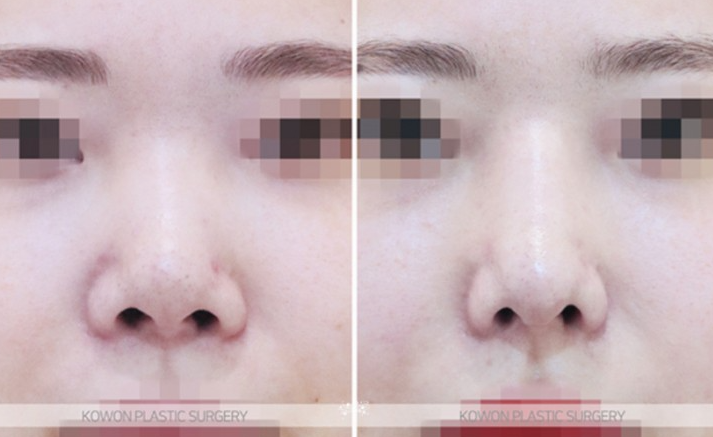
These are the results of revision rhinoplasty performed at Kowon Plastic Surgery, a specialized nose hospital.
From the front, it is clearly noticeable that the nasal bridge has become noticeably narrower than before,
and the collapsed line has also been neatly refined.
Most of all, the “effect of clearly lifting the nose tip” that the patient wanted
was achieved in a much slimmer and more sophisticated form in this surgery.
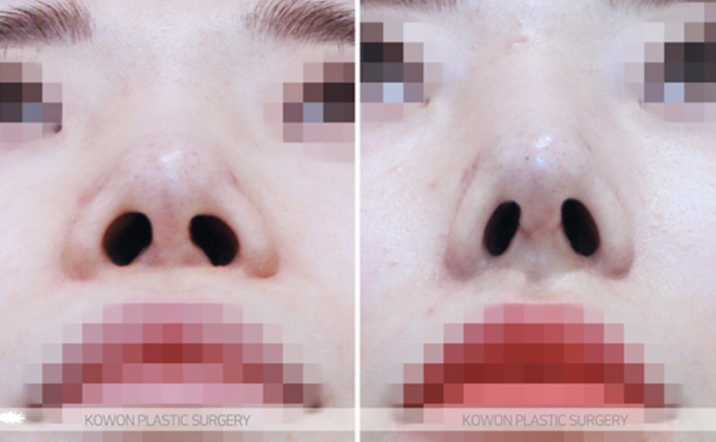
A high bridge rhinoplasty was applied starting from the area between the eyes, that is, the glabella,
and the bridge line extended straight, forming a much clearer straight line.
In particular, the sunken area in the middle of the bridge was also improved naturally,
and from the side, the nasolabial angle (the angle between the nose tip and the philtrum)
can be seen to have changed to a much more ideal shape than before.
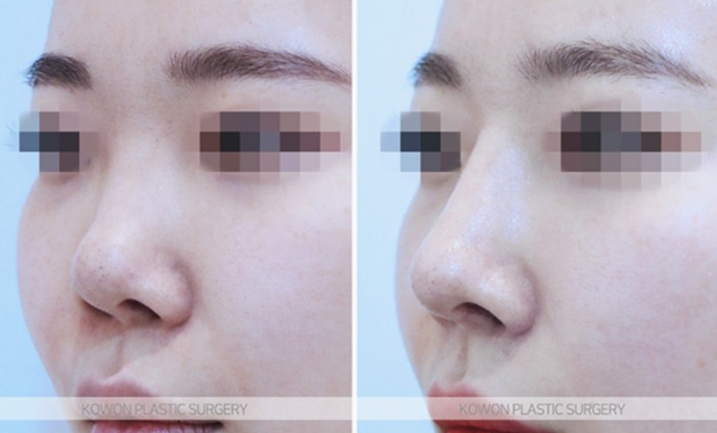
After seeing the results of revision rhinoplasty, some patients may initially feel that
the bridge is a little too high.
However, in this surgery, autologous costal cartilage was used,
and because it is autologous tissue, natural absorption of about 10–20% can occur.
Considering this absorption rate, unlike silicone rhinoplasty,
please note that the surgery was performed with a slightly higher design.
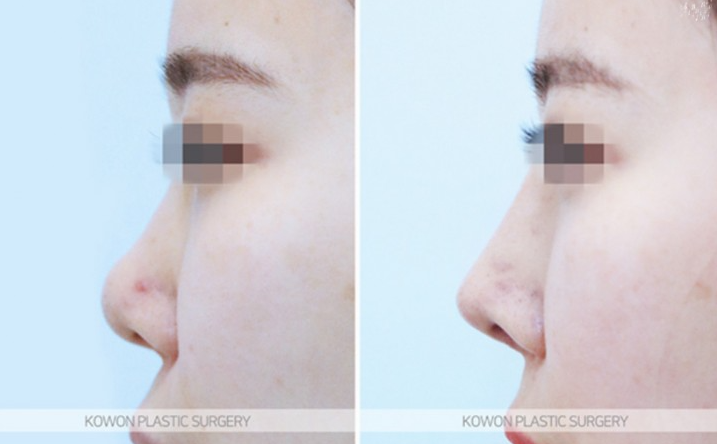
By comparing the before-surgery and one-month-after photos,
you can see the initial result.
After about six months, it will settle into a much softer
and more natural nose line than it is now.
In this case, along with autologous costal cartilage,
Alloderm surgery was also performed in the necessary areas,
so that the texture of the nose tip and the soft finishing touches were also addressed.
If you want a beautiful nose line or
were dissatisfied with the results of a previous surgery,
please feel free to receive a thorough consultation at Kowon Plastic Surgery.
Make a reservation for a consultation at Kowon!
If you want to see more diverse cases, click the link below!